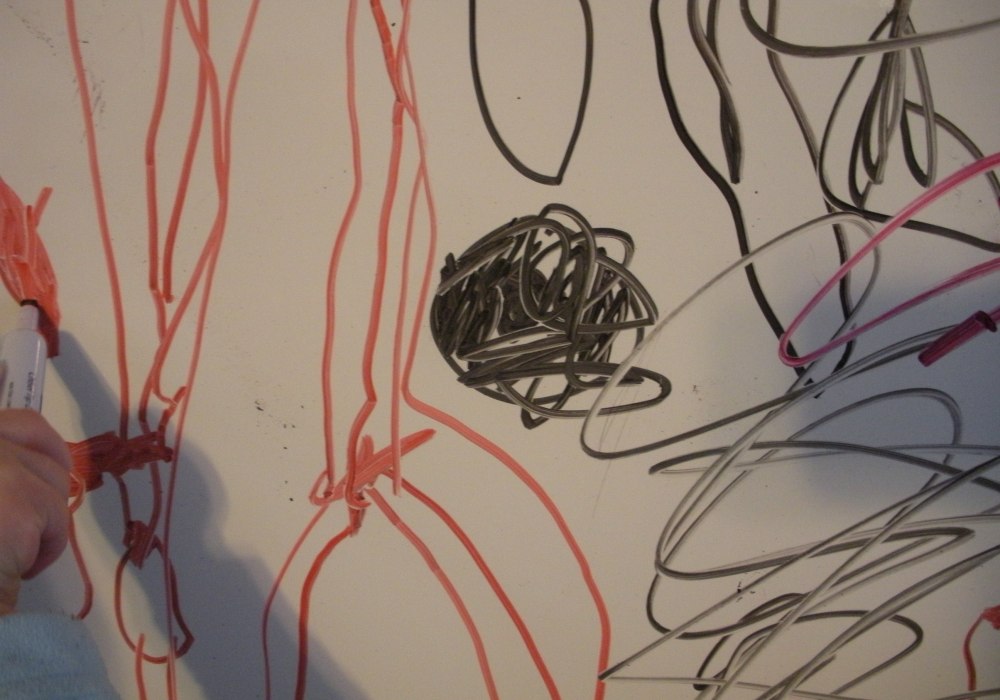
Portrait of the Toddler as a Young Artist

She’s not so much a “toddler” as a “careener,” but that’s a blog post for another day.
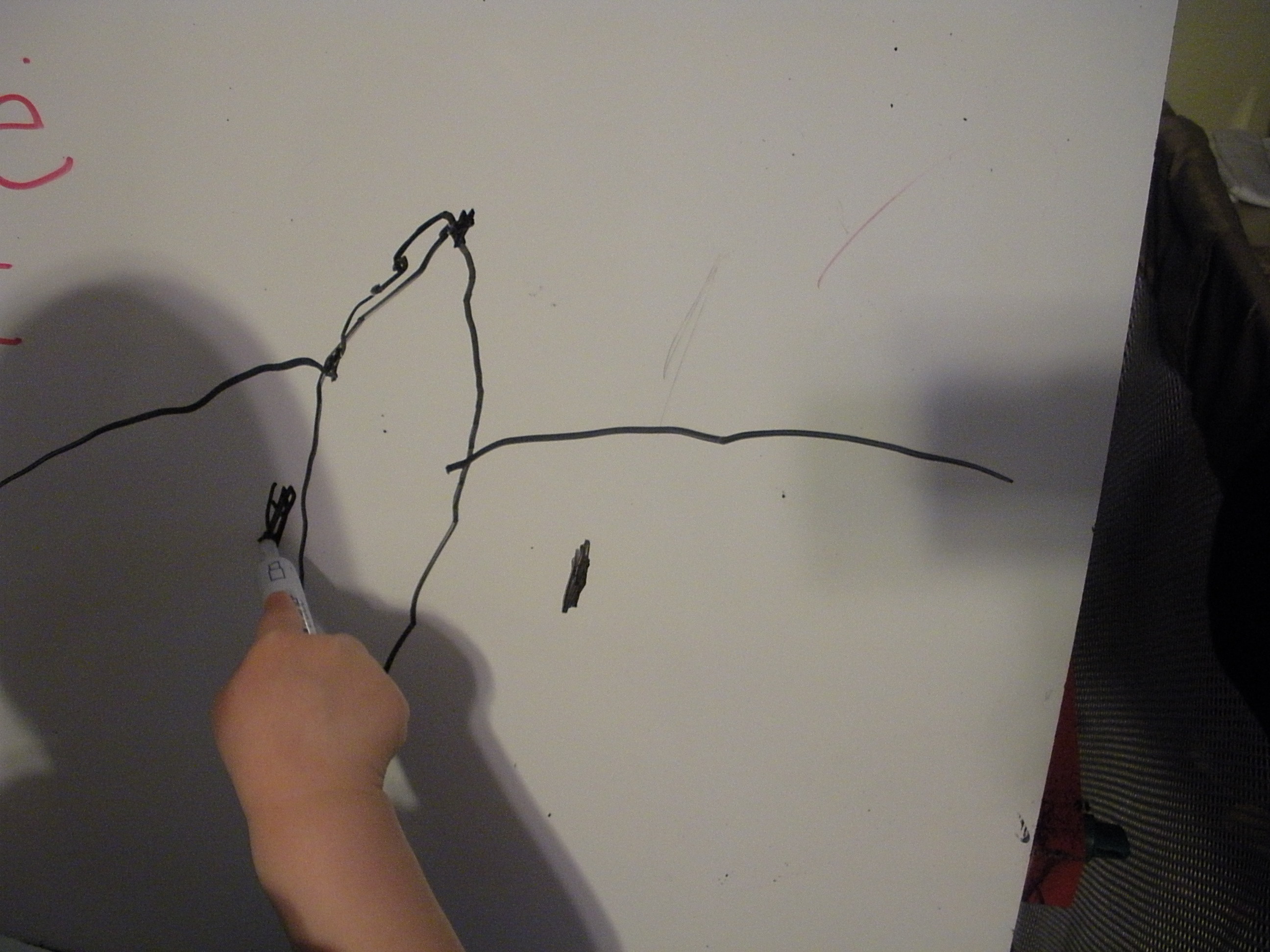
“One feather…two feathers…but he can’t fly,” she says as she deftly moves the dry erase marker across her white board. Our artist today is creating a penguin, which should be readily evident to all who view it.

Examine, if you will, the small aperture at the top of the head – the penguin’s beak. Also of note in this image is the artist’s careful handling of the marker. She clutches it in the form of such famous artists as Monsieur Pou Pou and Dame Underfungly.
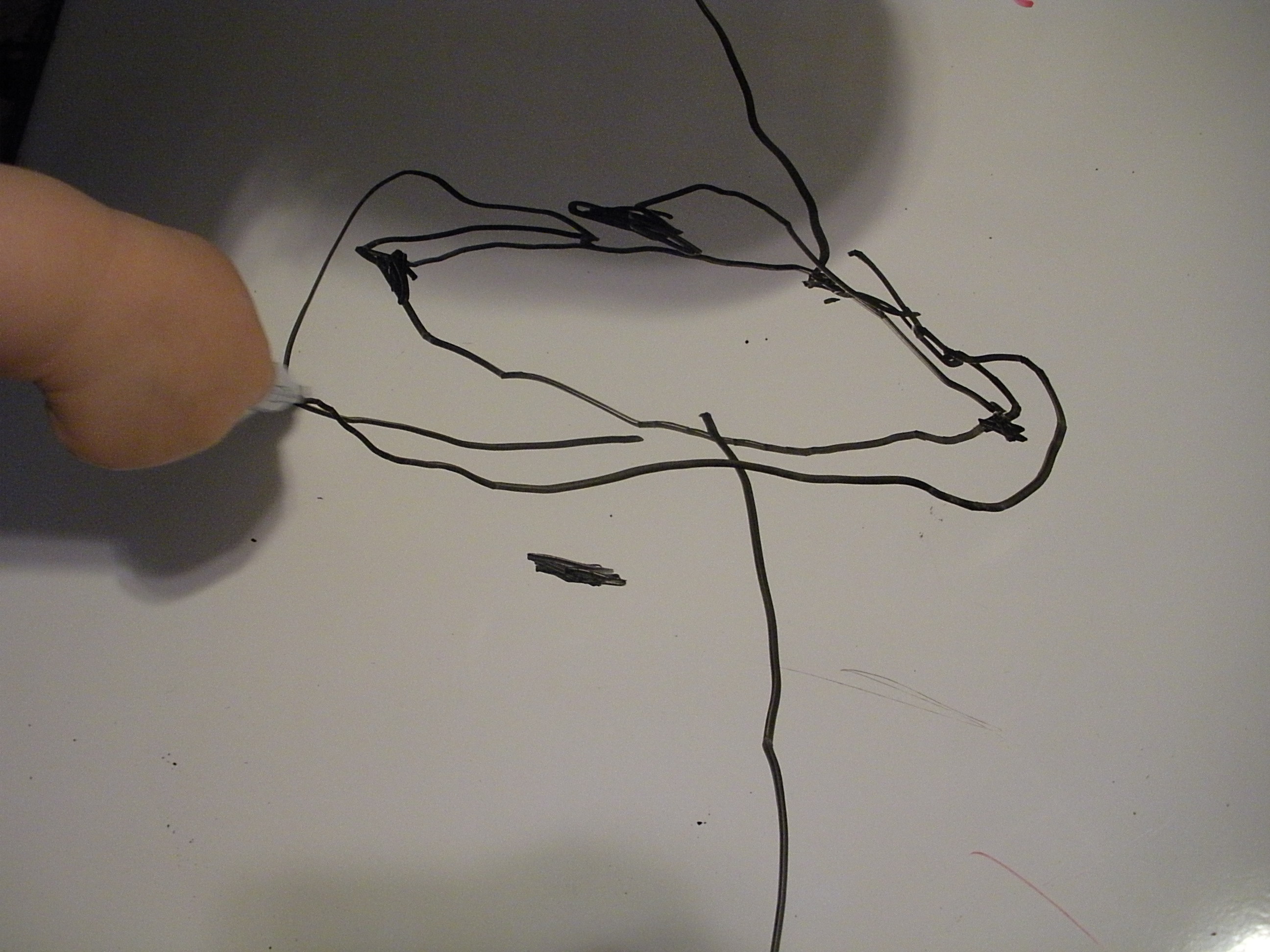
In the image on the right, the artist has given the penguin so much more: an aura to symbolize the life of the penguin. The penguin’s very being is celebrated in this caul-esque addition. View below, the bottom point of the penguin, and we see another dark feature, twin to the beak rendered above. This, the artist informs me, is the penguin’s “egg.” As if I needed telling. “But you can’t see it,” she says. “Why not?” I inquire. “He’s sitting on it.” The beak on top, the egg on the bottom – the artist has expertly captured the very symbolism inherent in parent-child relationships: I exist to feed you.
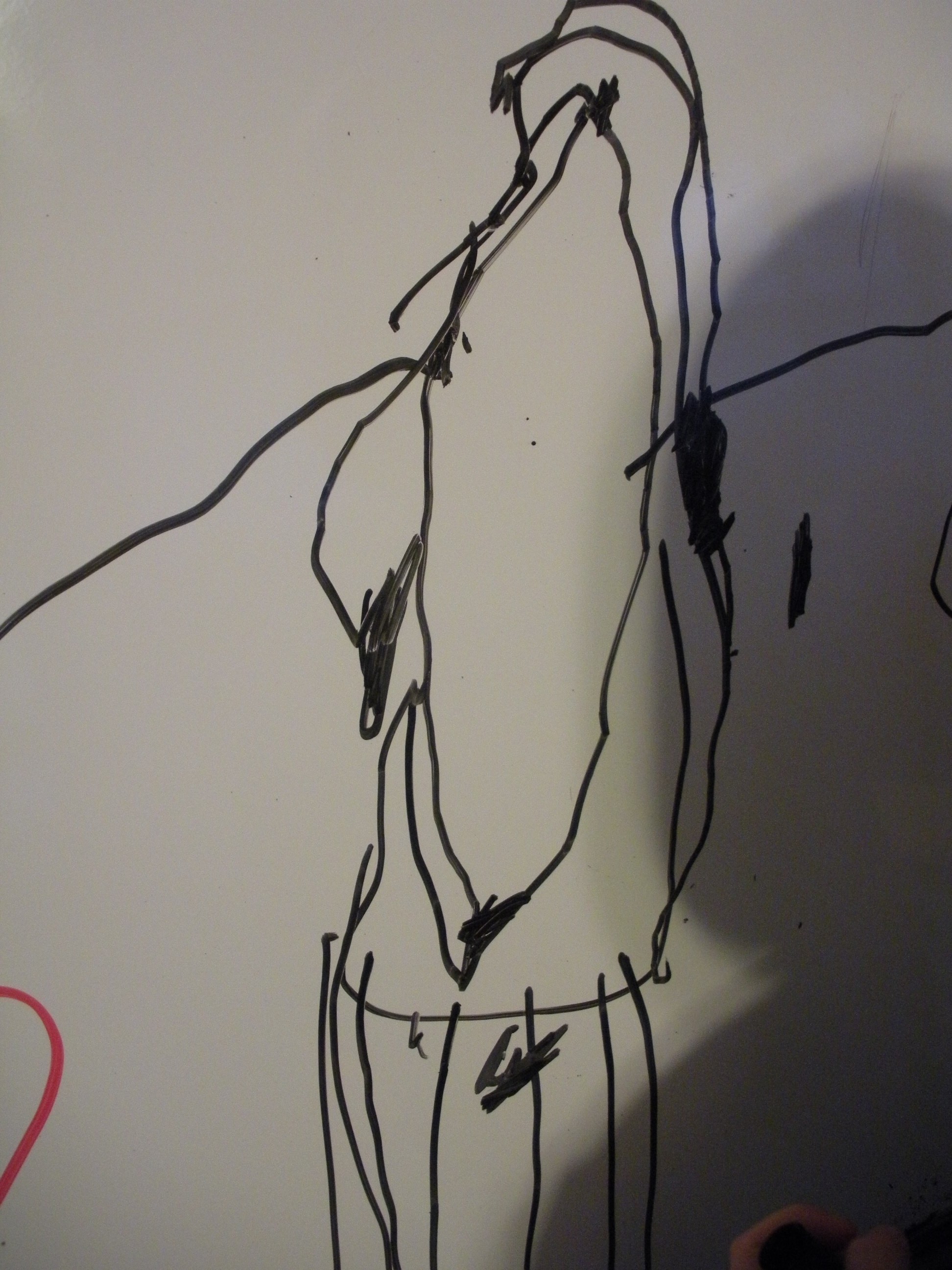
Penguin Parent

Finally, in the image at left, we have the final masterpiece. This penguin encapsulates the very concept of penguin. It now enjoys legs, and some additional eggs.

The artist, while often finding inspiration in nature, works primarily indoors on days when the weather is unpleasant. Perhaps she finds this creative outlet as an escape to cabin fever, desiring to infuse her immediate surroundings with natural phenomena that encapsulate freedom and fun.

Her primary joy is in creating one small image on a blank space, and then slowly elaborating upon the image throughout the course of a morning. She often enlists the help of friends and family for filling in the more mundane aspects of her masterpieces. In the dramatic rendering below, “Cabin Below Full Moon,” the artist has expertly incorporated the more rudimentary drawings of family members into her vibrant and large-scale depiction of the natural, amorphic symphony of the night sky.
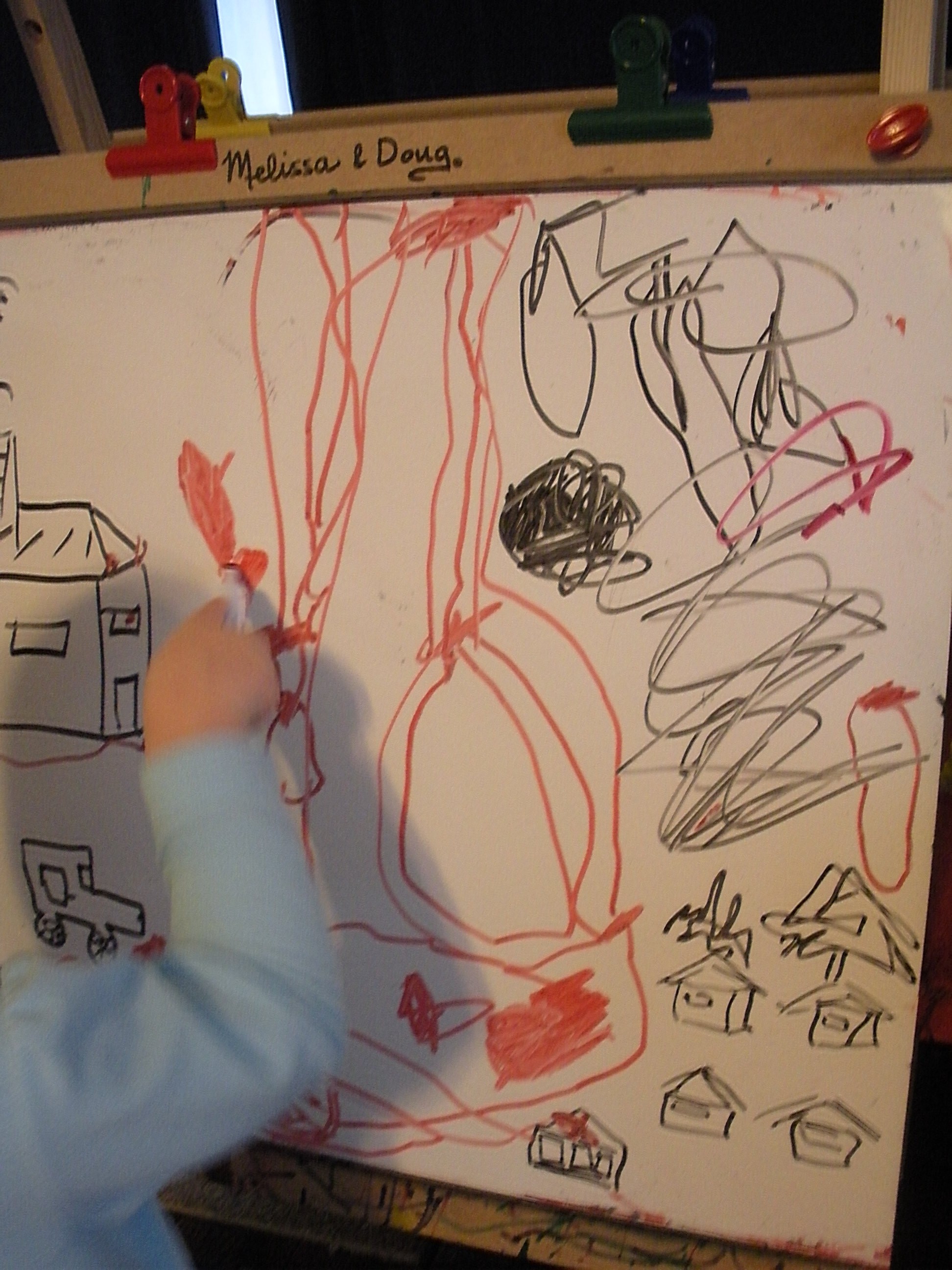
Cabins Below Full Moon

How fortunate we are to be privy to the magic of an artist’s work in progress! Now, I would like to open up my “museum,” if you will, to the Public. Do you have a favorite artist in your life? Is he or she creating awesome works of art that should be viewed by one and all? If you have my email address, go ahead and send me a jpeg file of your artist’s work. If you don’t have my email address, contact me through the tab at the top of my website. In two weeks, I will showcase the work of all our favorite artists. (No copyrighted images, please.)

Also, this Friday tune in to an interview with the talented Yvonne Prinz, author of The Vinyl Princess and All You Get is Me.
Post-poned.

Tragedy happens every day – both large and small tragedies (can tragedy ever be small?). Yet I’m a little distracted thinking about the people in Tokyo right now. Sad, worried.

So I’d just like to think about them for awhile, and save my blather for another time.

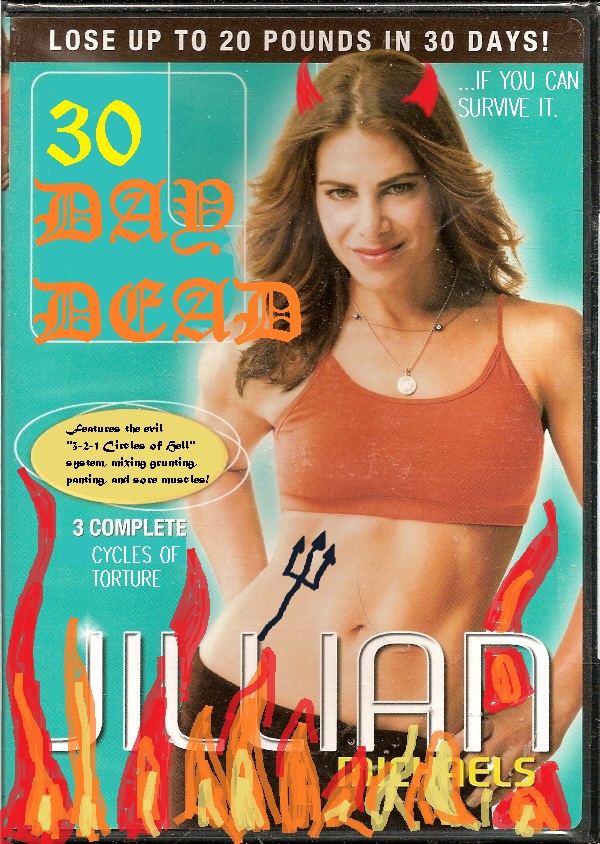
The 30 Day Shred’s Three Circles of Hell

As the mother of a two-and-a-half year old, I’ve got skills the So-Secret-Nobody’s-Heard-of-It Agency wishes they knew about. In fact, the So-Secret-Nobody’s-Heard-of-It Agency tried to recruit me. However, my skills are better put to use managing the small hostile force in my own home.

My skill set, however, does not include running faster than a toddler, or lifting more than 35 pounds over short distances when cajoling and bribes fail to get my daughter to move from Point A to Point B. My skill set is more along the lines of squatting down to play tea party, slowly jogging the two blocks to school (when Z feels like it), and half-heartedly chasing her around the playground a couple of times a week.

So I want to get buff. While there is no hope of fitting into my jeans from high school, I’d like to feel comfortable in my body.

And in Jillian Michaels’s 30-Day Shred, I am anything but comfortable in my body. My body, I discover, continues to jump even after my legs have stopped. “Yo, gut,” I say. “The jumping jacks are over.”

Despite this discomfort, every morning I join Jillian and her two minions (her “best girls,” she calls them. Like, are they really her best friends?). I watch Natalie doing the advanced version of the workout, smiling through her gritted teeth, and Anita on the beginner’s track, coolly appraising me with her don’t-you-wish-you-had-em abs. And then there’s Jillian. She acts all goofy in the beginning, like, “Hey, modest me, I’m just a dorky girl next door.” And then she starts bossing you around: “Don’t you dare turn off this DVD. If 400 pound people can do jumping jacks, then so can you!” and all sorts of verbal abuse she probably thinks is encouragement.

Amazingly, though, after a week I could get through Workout 1 without falling down on the floor. Thus encouraged, I decided to enter the second circle of hell, also known as Workout 2.

When I started workout 2, Z finally noticed what I was doing. “You’re doing the same things they’re doing,” she said. I don’t think she gets it, why I’m growling at the television while heaving my body around the living room and gasping like a scandalized southern belle. To her, this exercise thing is a strange phenomenon. She joins in occasionally, holding two stuffed animals for her “weights” and doing a few jumping jacks. Then she gets bored and sets up a tea party or picks up a book.

Natalie and Anita might be stuck in the second circle with me for awhile, repeating the same exercises over and over again, smiling their smiles, holding back their eye rolls every time Jillian says something about how she isn’t very flexible. 30 days? Yeah, right. 60 days probably won’t be enough for me to get past that cursed chair squat and V raise. I’m going to stick with it, though, for all those times my daughter does want to run to school, for the sheer joy of moving her body.

Really, though, plank pose is overrated.

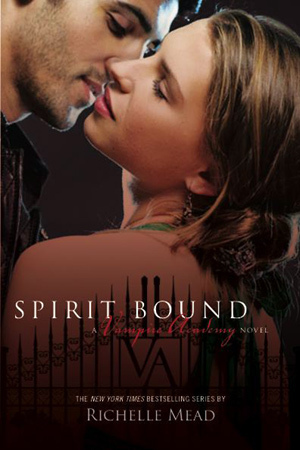
Spirit Bound by Richelle Mead

The set-up: After Rose failed to kill her ex-lover, Dimitri, who turned Strigoi (evil vampire) in a previous book, Dimitri sends her creepy-stalker death threat messages. Meanwhile, Rose graduates from the Vampire Academy and goes to the Moroi (nice friendly vampire) Court. From there, everything falls apart. Not the plot, really, although the thread of it winds around, but Rose’s life and handle on the world.


Main character’s goals: Rose wants to change Dimitri back from his evil vampire state (think Buffy wanting to save Angel), but failing that, she is determined to kill him (think Buffy wanting to stake Angel).

My reaction: BIG SPOILER HERE, BUT IT ISN’T REALLY A SPOILER BECAUSE THE BOOK DOESN’T EVEN HAVE AN ENDING….Please please please can we just have a beginning, middle, and end in a YA fantasy anymore? Please? I thought this was the last book. Imagine my surprise when instead of a happy ending we are left with Rose about to go to trial for murdering an important Moroi vampire. Imagine the swear words that poured from my mouth in a very un-mommy-like stream. Mmmkay, spoiler over.

Of interest to writers: You CAN write a sequel-begetting ending without cliffhangers. I have seen it done before and done well. Try Birthmarked by Caragh O’Brien, for one of my favorite examples, or The Forest of Hands and Teeth by Carrie Ryan, which I have reviewed here and here, respectively.

Bottom Line: I love Rose Hathaway. She’s tough and gutsy and not afraid to call the Moroi queen a “sanctimonious bitch.” Bella Swan would pee her pants even thinking about doing that.

Second Bottom Line: I have had it with YA fantasies not ending. I am now all about the contemporary fiction. Well, after I read the last in the Vampire Academy series.

NiFtY Author: Mike Orenduff

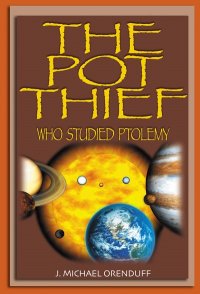
Joining us today is NiFtY (Not Famous…Yet) author Mike Orenduff, creator of the Pot Thief mystery series. His first book, The Pot Thief Who Studied Pythagoras, won the Epic eBook Award for 2010, and The Pot Thief Who Studied Ptolemy is up for the award this year…we’ll know soon if it wins!

BH: What’s your one-paragraph pitch for the latest novel in your Pot Thief mystery series, The Pot Thief Who Studied Escoffier?

MO:  Against his better judgment, Hubie agrees to design, throw, and fire chargers for a soon-to-open Austrian restaurant in Santa Fe. The $20,000 fee probably had something to do with his decision. But when one of the workers winds up dead in the back of Hubie’s old Bronco, he wants to take his edelweiss design home and not come back. His entry into the high stakes game of upscale dining turns even more dangerous when the coroner discovers that the poison that killed the cook was one of Hubie’s glazing compounds.

BH: When you wrote the first novel, The Pot Thief Who Studied Pythagoras, did you plan to create a series mystery?

MO: Yes. Mystery readers love series. I know because I’m a fan myself, and there is nothing worse than finding a mystery you love then discovering there are no more books from that author to read.

BH: I agree! Do you have a “series bible,” or some sort of record of facts so that you can keep details straight among (and within) the different novels?

MO: I do, and it comes in handy. I had Hubie twenty pounds heavier in Escoffier than he was in Pythagoras until I looked in the “bible” and saw my mistake. If I hadn’t caught it, maybe I could have just claimed he gained weight?

BH: Hubert Schuze is a thief, but he is also the protagonist, so you want the reader to like him and maybe even identify with him. How did you go about making him into a sympathetic character?

MO:  I try to make his rationalizations of what he does interesting and funny. And I show the good side of his character in other ways. Except for comic books, protagonists have flaws.

BH: Can you tell us about your path to your first publishing contract?

MO:  Long and winding, but then that is probably true of most writers. I tried querying those publishers who were accepting queries. I also queried agents, which are about as difficult to get as publishers. I finally found an agent who was excited about my work and signed on. Then she suggested I enter contests to get my name out there. I won the Dark Oak contest with The Pot Thief Who Studied Pythagoras. The prize was a publication contract. I hope the judges who selected my work are pleased that the book has since won the “Eppie” for the best eBook Mystery of the Year and the New Mexico Book of the Year.

BH: What does your workspace look like? Do you collect antique pots?

MO: If I posted a picture of my workspace, my wife might file for divorce. It is a mess on one wall of the kitchen, and I am under orders to relocate. Except for those on the New York Times Best Seller List, writers don’t make enough money to collect antique pots.

BH: What is your favorite book on the craft of writing?

MO: I have never read a book on writing. I have nothing against them, and I imagine there are some that people find helpful. I prefer to observe the craft rather than read about it.

BH: What is the best writing advice anyone has given you?

MO: My dissertation advisor, Dr. Harold Lee, told me not to fret about the opening of a book because you’ll never get started if you keep trying to make the start perfect. “Just start writing,” he said, “and keep writing until you finish the last chapter. Then go back to the first chapter and throw it out.” And that’s exactly what I do.

BH: Any words on advice to aspiring writers for keeping the hope alive?

MO: If you have a passion for writing, that should be enough to keep you going. And if you keep going, you keep alive the possibility of that break we all dream about.

BH: Thank you, Mike, for sharing your insights into your writing and your books with us today, and best of luck with the EPIC Award! For more about Mike Orenduff, you can visit his website by clicking here!