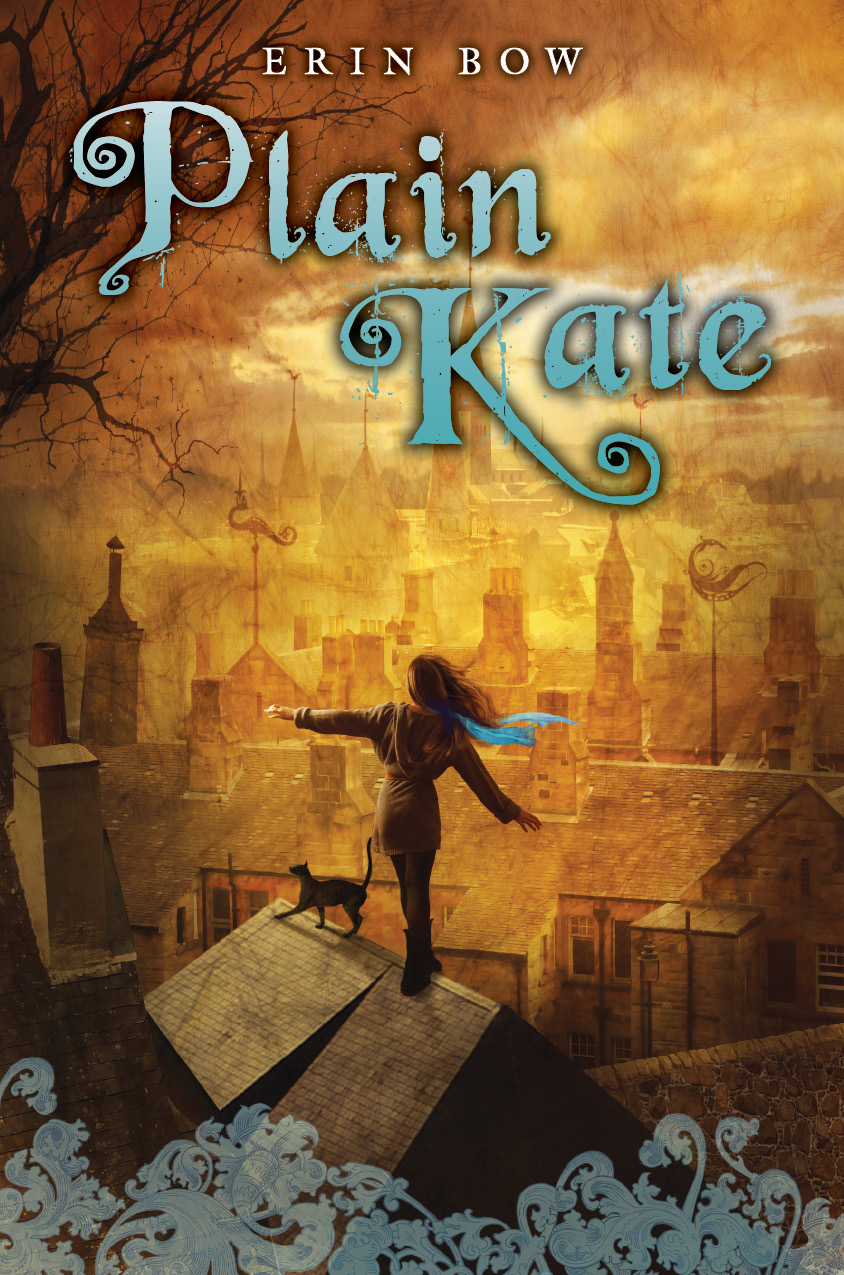
Plain Kate by Erin Bow
A copy of this book landed in my lap (thanks Mary!) and I devoured it.

Kate lives in (what sounds like) Russia in an era of magic and superstition. Her problem: her village has begun to think she is a witch. Yes, she is a carver (skill with a knife is a sign of a witch), she has different-colored eyes (ooh), and she has a cat friend who follows her everywhere (yup, definitely a witch). A mysterious man cruelly helps the witch rumors along, then convinces Kate to leave town, but not before trading her some survival necessities for…her shadow.

Beyond “did I like it?” (because I really, really did), do I think Plain Kate works? Overall, yes. Through the course of the novel I got to know Kate very well, from her love of wood-carving to her fears: of losing her shadow, of being kicked out of the Roamers’ caravan, of being alone. Knowing the character intimately is one of the best ways to get a reader to care.

As far as supporting cast – that is also very strong. My favorite supporting character was Kate’s sidekick, Taggle. A cat. I will say no more about him except you should read this book if for no other reason than to meet Taggle.

What worked best in the book, and what I will be re-reading this book to study, is how the setting and tone work together to create this beautiful, spooky mood. The lyrical prose (you know how I’m always raving about that) is also out of this world…unsurprising as Bow has also published a book of poems.

The beginning felt a little slow to me, but this could be because I was in such a rush to start reading that I didn’t give myself a good chunk of time to get immersed. Once I’d invested a half hour of reading time, I couldn’t put Plain Kate down.

To visit Erin Bow’s website, click here. If you visit, be prepared to forget whatever else you had planned. I found an absorbing essay on her “Odds and Ends” page and stayed up late to read the whole thing.
Ruined by Paula Morris (again)

This post is dedicated to the lazy students writing book reports.

ETA, PLEASE NOTE: I am not able to give any help on this book. I’m closing comments for that very reason.


Setting: New Orleans, Louisiana, shortly after Hurricane Katrina blasted through and ruined (ahem) many lives and livelihoods. It’s definitely gloomy and spooky in places. [You don’t know how tempting it is for me to tell you cheaters this book takes place in Iceland. So tempting. Actually, there might be a scene in Iceland, towards the end. If I remember correctly (and I might not), Rebecca takes her beloved library books and whaps Helena over the head with them.]

Characters:

Rebecca Brown, the main character. She likes libraries [and this is extremely important to the story].

Anton Grey, the hottie inexplicably drawn to Rebecca.

Helena Bowman, Rebecca’s snooty arch-nemesis.

Lisette, the ghost who helps Rebecca piece together the secrets of Rebecca’s life and the secrets of Lisette’s death.

Theme: I don’t know; months have passed since I read this book. If you’re writing a book report, you can always make something up. I frequently did (but before you think I’m getting all chummy or approving of you cheating by looking up these details on a website that maybe you can trust, maybe not, I will also say that I actually read the books I reported on. Except Moby Dick. But that is much longer than a 307-page contemporary fantasy and while some people actually enjoy reading Moby Dick (or say they do), that book was not for me). ETA Dec. 2015: I finally read Moby Dick! YAY!

As long as you can support whatever you say about the theme with evidence from the book, you should be golden. A good starting point for a theme is “friendship versus secrets.”

Symbols: Go for fire, gravestones, angels. Oh, and libraries. Again, what they symbolize is up to you, but you’ll impress your teacher if you cite evidence from the story or even – gasp! – supply quotations placed within quotation marks, followed by page numbers. If you are usually a slacker, and your teacher has a heart condition, please just skip this step. Pretend you don’t know what a symbol is. I don’t want to be responsible for any teacher deaths. Teachers work hard and deserve long happy lives.

That’s it. I didn’t rein in my tendency for parenthetical journeys into the Land of Totally Irrelevant. And it was oh, so fun.

12/6/2015. EDITED TO ADD: I am closing comments because I can’t offer help anymore. I read this book a loooong time ago and don’t remember enough to give specifics. I wish you students all the very best with your papers!

Picture the Dead by Adele Griffin and Lisa Brown

I know, I know I said I wasn’t going to read any more supernatural-type books for awhile. But this book landed in my lap, and it is so pretty, and autographed by the authors to boot, so fine.

Jennie Lovell believes in ghosts. Her twin brother died in the Civil War just before the story begins, and she feels his presence on a daily basis. Then, at the beginning of the story, Jennie receives news that her fiancé, who is also her cousin (by marriage, people, before you get the heebie jeebies. And even if they weren’t cousins by marriage, that’s how things were often done way back when, so go with it in historical fiction).

Jennie’s place in her uncle and aunt’s house becomes unstable (she’s an orphan), and she begins having ghostly experiences of her dead fiance. He’s angry about something, and she feels compelled to discover what. These searches lead her to befriend a spiritualist photographer (eh? eh? Picture in the title? No? Fine).

Most remarkable about the book are the illustrations. I’ll admit: I hated them at first. I thought they did not reflect the spirit (har har) of the times and instead gave a Civil War setting too much of a contemporary graphic novel vibe. But soon I got into the illustrations, which are set up to be Jennie’s scrap book, complete with her commentary and various items she pilfers from her adventures. Jennie’s notes, scribbled amongst the “photographs,” enrich the story and strengthen her voice. In the end, I decided I was sold on the illustrations.

The front and back covers of this book read like an invitation list for popular authors: Holly Black (twice), Brian Selznick, Michael Chabon, Kit Reed, and Judy Blundell. I was actually a little worried. Did the authors need this much endorsement to get readers to pick up the book? Maybe, maybe not. But the story and setting were engrossing, and that’s all I can ask for as a reader.

Flash Burnout by L. K. Madigan

Now, I’m not a teenaged boy, and I never will be. So my assessment of what a “valid” or “true-to-life” male teenager’s voice sounds like might not be one hundred percent accurate. But Blake’s voice in Flash Burnout is convincing enough for me.

The whole sarcastic/funny teenager can be overdone in YA literature. And writing from an adolescent male’s voice is undoubtedly tricky (click here to read the simultaneously scathing and encouraging gauntlet author Hannah Moskowitz throws down on writing books geared toward YA males). Blake’s voice is humorous and poignant, and not in the way that sounds like the author is breathing “look how funny I am” from the white space between the words.

I enjoyed this book. The humor worked, the male point-of-view worked, and without Blake appealing to me-as-a-woman because he was so unbelievably romantic and tragic and sparkly, but instead because he sounds like a real guy experiencing real problems. There wasn’t anything sparkly about the romance here…I don’t even think I want to call it romance, at least not in the traditional way everyone might think of it in literature.

Another interesting point in Flash Burnout: the parents are both present, and they are awesome. A few months ago Julie Just wrote an essay for the New York Times Sunday Book Review, discussing what’s going on with all the absentee/horrible parents in young adult literature. Madigan gives us something refreshing in Flash Burnout: I fell in love with both of Blake’s quirky, fun, and ultimately there and loving mom and dad. In fact, Blake’s family serves as a foil for the families of the two love interests, making the family excellence a double-whammy.

But really, the humor is what did it for me. I love funny books. This was effective, and still had a meaningful story. I’m very sorry to say it, but Louise Rennison’s Georgia Nicolson books are a bit lacking in the poignant, life-changing drama department (click here to read my review of those lovely tomes). Georgia is hilariously funny, but a well-curved character arc is not something she can boast about.

Blake, in Flash Burnout, isn’t a heart-throb. He’s a normal guy, and a funny one at that. His story is worth your time.

To read more about L. K. Madigan and her fiction, you can visit her website by clicking here.

Vintage Veronica by Erica Perl

I’ve been having a lot of luck with my pull-a-random-book-from-the-library-shelf method. It’s not that random, I suppose. I’m looking for new books (within the last year), and I’m looking for things without any supernatural elements. Pretty soon I’ll be able to return to the fantasy realm…but I’m really enjoying my time here on Mundane Lane. Besides, I get plenty of fantasy with my own work-in-progress.

Oh right! The book review!

Vintage Veronica takes place in one of the coolest settings imaginable: the Clothing Bonanza. It’s a humongous building full of vintage clothing, decorated with (cool) old crap (like an old motorcycle and a VW Bug). Veronica has the great fortune to get a job taking in and processing the consignments, and she often finds amazing articles of clothing. Unfortunately, she can’t wear most of these clothes, as she’s too big. Fat, in her words.

Veronica’s obesity has some impact on her characterization. She’s never been able to keep friends, she hates crowds, and she equates fat with ugly, leaving her with low self-esteem. However, what I really like about this book (beyond the fantastic clothes and the drama with the floor-sale bitches and the romance with Lenny the Lizard Boy) is that Veronica’s obesity is not the focus of anything. It’s a part of who she is, but it doesn’t define the entire plot.

I love an ugly duckling story as much as the next girl, but it doesn’t always have to be that way. What if we discovered we were beautiful without turning into swans? If we stayed socially awkward, or overweight, or attitudinal, or whatever, and could be happy that way? This is not a message the book tells us, because it doesn’t have to. Veronica does her thing, and we come to see past her appearance…just as she does.

Veronica’s voice comes across whether she’s being funny, bitchy, insecure, or smitten. A few times I wanted to put the book down because I could see where it was going as soon as she became “friends” with the two wild girls who rule the sales floor, but I had to keep reading.

*very mild spoilers here*

There was a great sense of fate in this book, like wisdom coming from the mouth of an oddball pothead (is anyone else thinking of The Big Lebowski when they read this book, I wonder?), or Veronica’s epiphany dawning with the falling of clothes from a giant chute. I came out of the book feeling pretty good about the world.

And that Clothing Bonanza? I want to go there.

To learn more about Erica Perl and her books, you can visit her website.