The Underneath by Kathi Appelt
Although I read this a couple of months ago, it has stayed with me. The Underneath is so beautifully written, how can it not stay with you? On the surface it is the story of a mother cat, her two kittens, and an old (abused) hound dog who is chained up to a porch in a Louisiana bayou. But it’s also about a mythical snake creature, a family of Native Americans living over a century ago, and the cruel man who is the undeserving owner of the hound.

The “underneath” is the space below the porch, the safe place the mother cat finds to raise her two kittens. Only one curious, adventurous kitten sets into a motion a heart-wrenching story of (a whole bunch of sad stuff) (but ultimately) (redeeming) love.

It’s another one of those books that makes me “feel.” And you know how I feel about those. Highest compliments and praise to the author, but then I need to read some blood-sucking vampire action (with a good dose of either humor or melodrama – both is best) to reaffirm my hope in the world. Sad, isn’t it?

Actually, no, that’s not really true, other than the highest compliments and praise to the author.

**very mild spoiler**

Because this story does reaffirm one’s hope in the world. Maybe not in the middle of the book. The middle has tears, and they are NOT tears of happiness. But hope and love come through in the end, which is more than I can say for Feed. Stupid [ed. Artistic, mind-blowing] book that it is.

But back to my book review. I highly recommend The Underneath. Beautiful, poetic prose and interwoven stories crossing time but all arriving at a single, redemptive space, make the story worth a few tears.

To learn more about Kathi Appelt, visit her website by clicking here.
Ida B by Katherine Hannigan

Ida B’s book comes with a subtitle, which you probably can’t read in that tiny little image, so here’s the whole thing: Ida B…and Her Plans to Maximize Fun, Avoid Disaster, and (Possibly) Save the World.

So I’m thinking, Cool. A funny book.

I started crying on page 41 and didn’t really stop until the end.

I don’t particularly enjoy crying. My eyes get all red and swollen, and I have to use a bunch of tissue to mop up snot and tears. It’s ugly.

But I couldn’t stop reading.

Ida B is ten years old. She lives with her parents on their farm, and spends almost all of her free time in the apple orchard, talking to the trees and the stream. She’s so hilarious, and endearing, and it just killed a little bit of my soul when she enters her Black Period and suffers through depression.

Even when she’s depressed, Ida B is amusing – even funny – and I found myself falling in love with her. She’s a cool little kid, so creative, and her strategies for coping with the difficult turns in her life reminded me of being ten. Caught between imagination and reality, the line still isn’t there completely, but you’re starting to realize there’s a difference between the two. I ache for that time. Going through boxes of my childhood things this weekend (post about that later) doesn’t ease the feeling of nostalgia.

It was a great book. I couldn’t put it down (probably because I knew I’d never smile again if I didn’t get to the redeeming end). If you’re one of those people who likes watching sad movies or reading sad books, this is definitely for you. And even if you don’t particularly enjoy, you know, weeping in your spare time, you might like the book anyway.

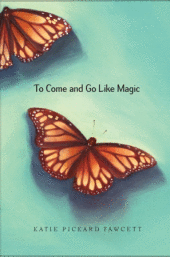
To Come and Go Like Magic by Katie Pickard Fawcett

So far so good on my contemporary-fantasy-fast. In the past two and a half weeks I’ve read To Come and Go Like Magic, Ida B, and I finally finished The Botany of Desire. [Like whoa on The Botany of Desire.]

Today I review, for your reading pleasure, To Come and Go Like Magic. If you’ve read The House on Mango Street by Sandra Cisneros, you’ll know what I mean when I say this: sparkling, poignant vignettes. [Um, I actually haven’t read Cisneros’s book in its entirety, just a couple of vignettes while doing classroom observations. But I plan to read it. Maybe soon.] To Come and Go Like Magic is an entire novel written in sweet, two-to-four page chapters. But they’re not really chapters because they do everything a novelist is not supposed to do when trying to create suspense and keep the reader turning the page. Each vignette has a beginning, middle, and (kiss of death for chapters) an end. There’s a sense of completion, which made each vignette feel like its own poem, its own work of art.

Beautiful writing and the main character’s voice add to the magic in this book. The setting is also unique: Chileda is twelve years old, growing up in the 1970s in a small town in the Appalachian mountains. Her thirst is to see the world, and this thirst conflicts with her micro-society’s expectation that you just don’t leave home.

A suspenseful novel this is not. Piercing, pretty, quiet – yes.

On a total sidenote, is there something about middle grade fiction that requires at least one scene of total and absolute unfair action towards the main character? I’m thinking of the scene here where Chili’s uncle does something so unfair I wanted to reach into the pages and strangle him. A similar thing happens in Ida B, and if you haven’t met the Dursleys in the Harry Potter books, you’re missing out on some prime injustice writing.

My guess is that one of the extremely irritating things about being a middle-grader (ages 9-12) is the discovery that the world isn’t fair, in so many startling ways. And perhaps these novels are working to address that universal, middle-grader issue.

But I need to conclude my actual book review, so: To Come and Go Like Magic is a quiet gem, and a huge turn from my vampire biting, werewolf howling, demon slaying contemporary fantasies. In one word: refreshing.

To read more about To Come and Go Like Magic, check out the Q & A session posted on Katie Pickard Fawcett’s blog.

The Forest of Hands and Teeth by Carrie Ryan

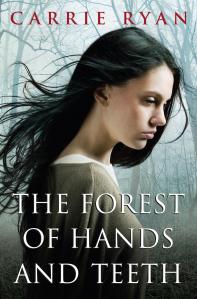
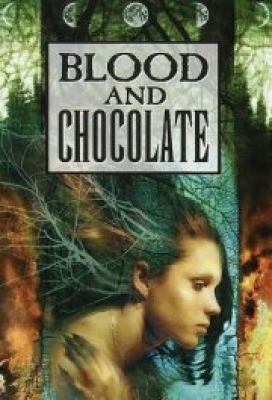
It sounded like a werewolf story to me. And something about the cover art reminded me of Annette Curtis Klause’s Blood and Chocolate:

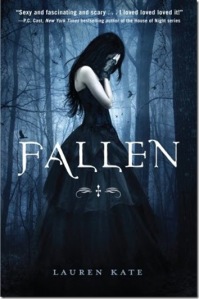
Hmm, now that I look at it, why don’t we throw Fallen (Lauren Kate) up here?

Lots of unhappy girls’ profiles.

A likeness of my main character will be grinning like a cheesy idiot from the cover of my book if/when it’s published. Because I hear authors totally get their say in cover art.

Yes, yes, this is actually a book review. You know I get side-tracked. By my own brain.

As I was saying, I thought this would be (another) werewolf novel, but no! It’s a post-apocalyptic zombie story! Way cool. A risk with zombies is they end up totally ridiculous (brain flashes to Shaun of the Dead). However, I was pleasantly surprised. Mary, the main character, begins her story with the statement, “My mother used to tell me about the ocean.” Mary has lived her entire life in a fenced village surrounded by wilderness inhabited by zombies, or, as the Sisters (the ruling religious sect of her village) call them, “the Unconsecrated.”

Right away I started making connections to M. Night Shyamalin’s film The Village. While there are a striking number of similarities, I was able to forget them as the novel progressed, because as Mary’s story developed it moved further and further away from The Village.

Besides, Mary’s character is so fascinating I sometimes paid more attention to her than to the plot. I mean, here is a character who has some pretty distinguishing personality flaws, yet I can’t help but love her anyway. She is selfish, obsessive, and utterly winning. The sequel to The Forest of Hands and Teeth doesn’t feature Mary as a protagonist, but I hope she plays a major role.

Not only was the heroine awesome, the writing was lovely! Who knew a zombie story could be so beautiful? The language in this book is so lyrical, the voice so dark, so perfect for the story. I am a sucker for lyrical prose (Roy’s The God of Small Things and Ondaatje’s The English Patient are forever-favorites of mine because of their language, even though the stories are dead depressing and rival Nicholas Sparks’s sob stories for potential in creating tear-filled oceans. But I digress). This novel was not a gory romance teeming with the walking dead. Okay, so it was. But it was so much more than that because of the poetic flow of the language.

Like Maggie Stiefvater’s Shiver, The Forest of Hands and Teeth proves that a romance-driven horror story can go beyond the romance and horror if it has memorable characters and simply beautiful prose.

That said, I’m taking a break from YA literature with fantastical elements. I am so saturated in this genre that I’ve started to get pruny, and it’s time for some fresh bathwater. I read a couple of middle-grade books last week, so maybe I’ll review one of those next.

Feed by M. T. Anderson

That’s the problem with literary fiction. It makes you feel.

And that’s what Feed did to me, and I actually sort of hate it for that. I don’t like sad stuff. I don’t like it when the dog dies, and I don’t like waves of hopelessness crashing into the beaches of my brain.

So, thanks a whole effing lot, M. T. Anderson. [Don’t worry, the dog doesn’t die. There is no dog, because Feed takes place on an earth where animals can’t even live anymore. All the dogs probably died way before the story begins.]

Okay, in all seriousness: Feed was amazingly written. I already heard literary agents praise its voice, so I was totally paying attention to that. I’m also really big on unique idioms and slang for unique worlds. Apparently Anderson is really big on this too, because in a couple of places the slang was nearly indecipherable. In fact, I’m still unsure of whether a “youch” girl is good-looking or just the opposite.

*vague spoiler alert*

But did it have to be so bleak? I mean, come on. There was like the barest note of positive at the end—the smallest straw of positive—so small I could barely grasp it—and the entire time I’m reading I’m quoting T. S. Eliot in my head (which you know is a bad sign):

“This is the way the world ends
This is the way the world ends
Not with a bang but a whimper.”

Let me emphasize that my discomfort with this book is more about me than the book itself. As I said, the writing’s great, as is the story. It’s just my own preference is for something a little lighter that doesn’t have me reaching for the Prozac after the story ends.

The whole thing with the lesions: disgusting.

Funniest part: the beef farm. But I had to stop eating my breakfast while I read it.

Saddest bit: disposable table. Okay, that’s not really the saddest bit, but it was pretty sad. Just, the state of the world, that people not only dine on disposable dishes, but they throw their table away at the end of the meal.

Am I glad I read it? Yes. Will I buy the book to enjoy again? Not a chance. I prefer my happy endings, thank you.