
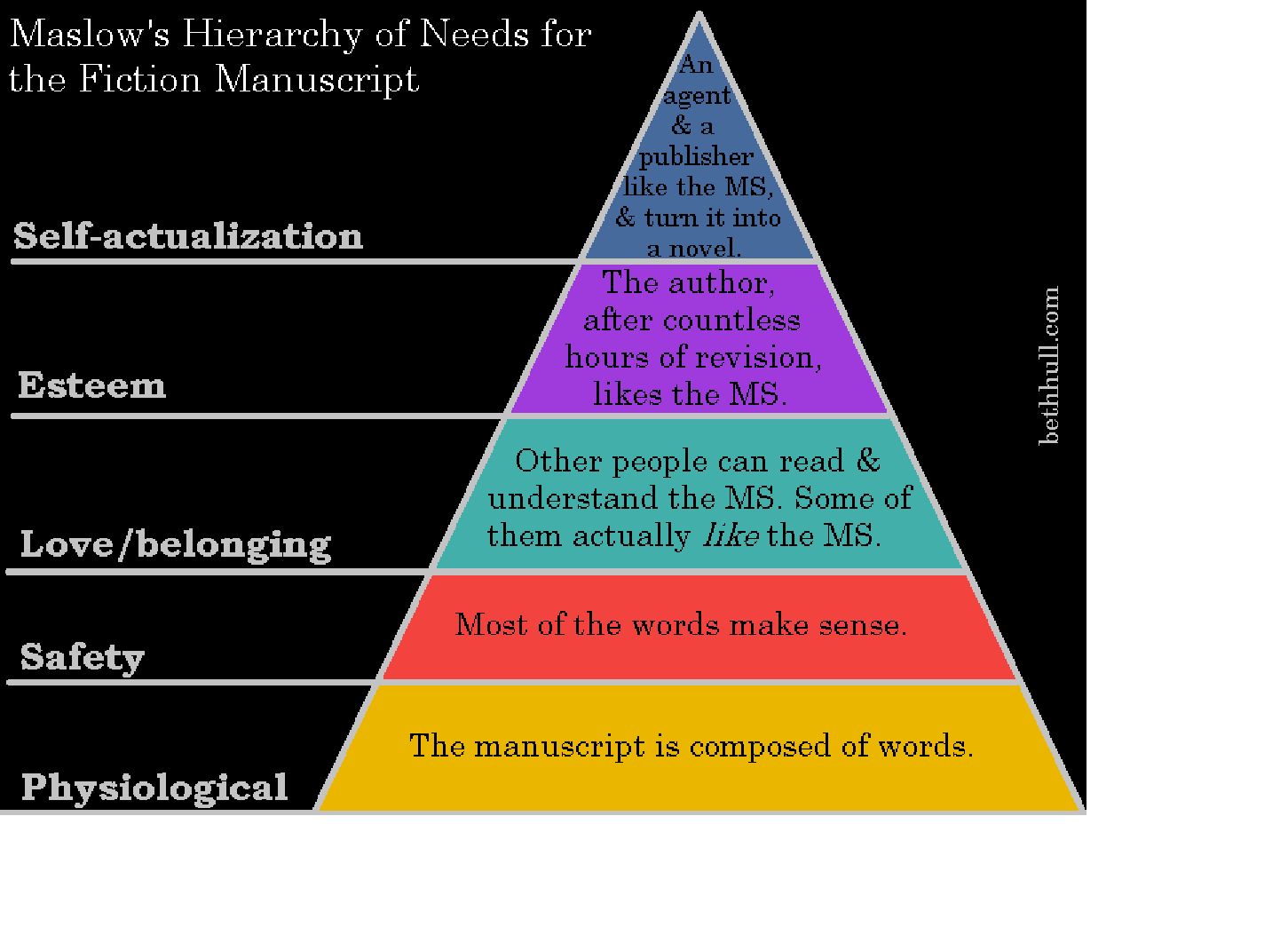
Maslow’s Hierarchy of Needs for the Fiction Manuscript
I wrote the first draft of my work-in-progress (nicknamed le manuscript) in a little over two months. I’m sure it’s not the fastest record on time, but it’s much better than my first manuscript (over a year to complete) and my second (clocking somewhere around eight or nine months). Experience has something to do with it, but for me, it helps to have some rules.
You can do something with assigning word counts to different stages of the plot, like Anne Greenwood Brown describes in her blog post that inspired this one, “Kicking Out a Fast First Draft.” What I did was a slightly-less-insane version of NaNoWriMo, a goal of 1200 words per day. My friend Seven organized it, and we and a few other writers encouraged each other to go, go go!
Not all of us finished our drafts. Part of what helped me was I was already somewhere around 15,000 words ahead, because I’d started drafting le manuscript in February, then gave it up in March when I realized Manuscript Numero Dos needed some serious help (it still does). But I got le manuscript done, and will now be revising it for the next 86.92 years.
Here are some rules that helped me reach my goal:
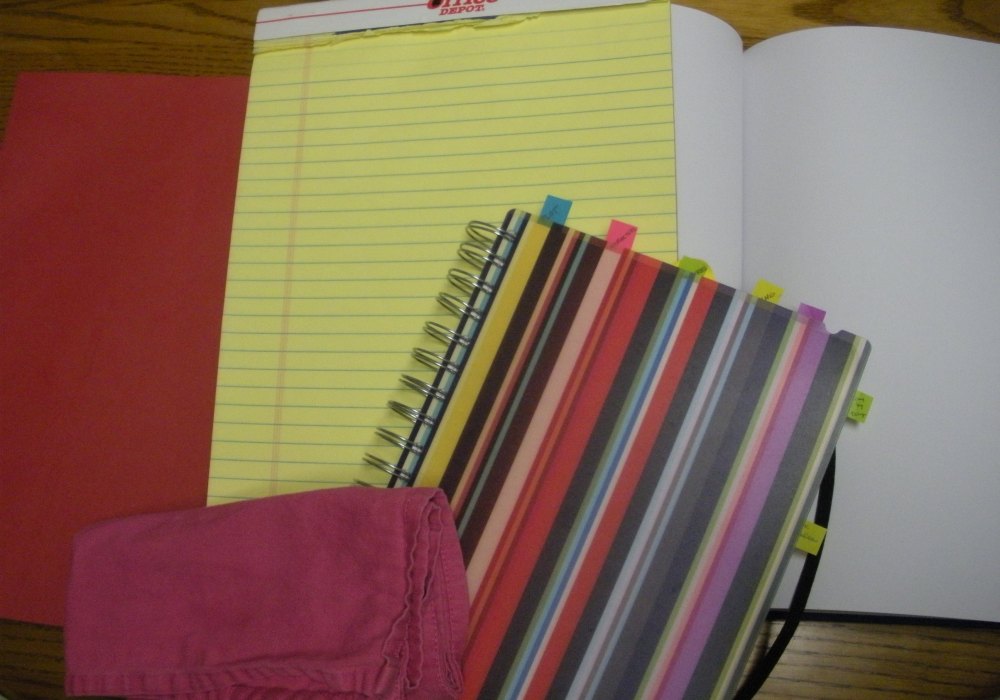
1. A Writing Schedule Is Your New Best Friend. This was easy at the time, because Z was still taking her naps (this is a blog post for a different day). The rule was: I pick up my blank book and work on that draft, as soon as she goes down for her nap.
2. A Back-Up Writing Schedule Is Your Second Best Friend. If, for some reason, I got distracted by the scrub jays in the back yard, or the way my pinky fingernail desperately needed filing, or how that spot on the wall kinda-sorta resembles an ex-boyfriend’s nose… If I didn’t make 1200 words during Z’s nap, I had to finish them up after she went to sleep that night.
3. Clean Houses Are For People Who Don’t Write. Or who write, and have maids. Or who write, and have older children they can make into their chore slaves. I did whatever household chores I could while Z was awake. She really loves to “help.” That’s right, Z, washing dishes is FUN. Never forget it, ’cause this is just the beginning, baby.
4. Do It On Paper. My Paperblanks journals are the bestest ever. You know why? No wireless internet. No Mahjong Titans or other tempting solitaire games. No wireless internet. No lights to irritate the eyes after prolonged exposure. No wireless internet. I recently read a blog post, How to Get More Done by Pretending You’re on an Airplane. It’s true. The most writing is done distraction -free. Twitter, lately, has been hearkening to me like a sadistic siren, and I don’t even like Twitter. I don’t. There. I said it. Now every time I try to log on they’ll tell me Oops! they’re over capacity.
5. Outline It. I’m way too much of a control freak to just start writing. I also adore lists and bullet points. So I come up with a rough idea of where I want the story to go and how I want it to get there. This doesn’t mean that I know all the major players right away. This doesn’t mean I ignore tempting paths – I take them. Having an outline keeps me going because I don’t have to chew thoughtfully on my pen while deciding what should happen next. One of my critique partners, Jo, has a good post on creating an outline (click here for that), although I get by with a bullet-point synopsis.
Like Anne Greenwood Brown says at the end of her post, there’s no way she’d share her first draft with anyone, not even her mother. I agree. The first one is total trash. If anyone has tips on how to revise a novel in two months, do share. As things are going, I only have about 86.33 years left of revising le manuscript.
There’s probably more, but I’m off to the woods for some mosquito-slapping, bear-dodging, holing-up-in-my-cabin-and-writing adventure. See you Wednesday.

*and to my students who graduated last year – I’m sorry I didn’t think to do this for you then, so now everybody’s included in this commencement address.
First: I am so proud of you.
Second: I don’t know where this blog post is going, so just hang out for a couple of minutes. It might meander like our discussions on Of Mice and Men or The Cask of Amontillado.
Whether you go to a four-year college, a junior college, a technical school, or no school at all, you will be making choices every single day. Sometimes these choices won’t be important, like, “Do I ask the dude making my sandwich to put mayo on both sides, or just one?” or “Do I straighten my hair today or let it go curly?” or “Do I call my girlfriend now or wait until after I finish this episode of [whatever show is popular at the moment]?”
Sometimes the choices will be very important, like, “Do I blow off writing this paper and just copy it from the internet?” [If you were truly a student of mine, this answer would be, “No, I will write this paper and learn while I’m doing it!”] Other important choices might be, “Do I get into the car with this dude I just met at the club?” or “Do I sample the mystery substance everyone seems to be having so much fun with at the party, or do I amuse myself taking photos of them to post on Facebook later, and make sure none of them die from whatever side effects the mystery substance has?”
The point is: the future is filled with choices, and you are responsible for making the choices. It might be overwhelming, as it often was to me in college. The sheer mountain of choices scared the crap out of me. And sometimes you’re going to shine, and other times you’re going to fail. You will fail. It will happen. (I think J. K. Rowling covered this point in her address to Harvard graduates in 2008. Click here to read that.)
Failing can bring you to surprising new places. It can be an opportunity. I’m not saying it doesn’t suck, because it does. But take some responsibility for it. You get to make the choices, from here until forever.
I hope you choose:
I love you all. If you think I’ve forgotten about you for one day since I quit teaching to raise Z, you’re wrong. I taught you English, but you taught me so much more. I delight in memories of being your teacher. I delight in the choices you make, especially when those choices are conscious, purposeful, and full of intent to make your lives, and the world, delightful, fanciful, creative, kind, gentle, and peaceful.
Thank you for being who you are. Never stop.
1. Shock & denial – Did they even read my brilliant manuscript? Or did they just vomit red ink all over it? I’m seriously doubting the collective mental capacity of my critique group.
2. Pain & guilt – How could I have given them this drivel? No wonder they didn’t get it. It isn’t that they don’t know how to read…I just don’t know how to write.
3. Anger & bargaining – You know what? FINE. If my critique group obviously has such a problem with this stupid story, maybe I should just shelve it. It can join the other stupid manuscripts in their dusty old binders. And if I do that, the next one will be better. It has to be. It’s like, the Law of Writing.
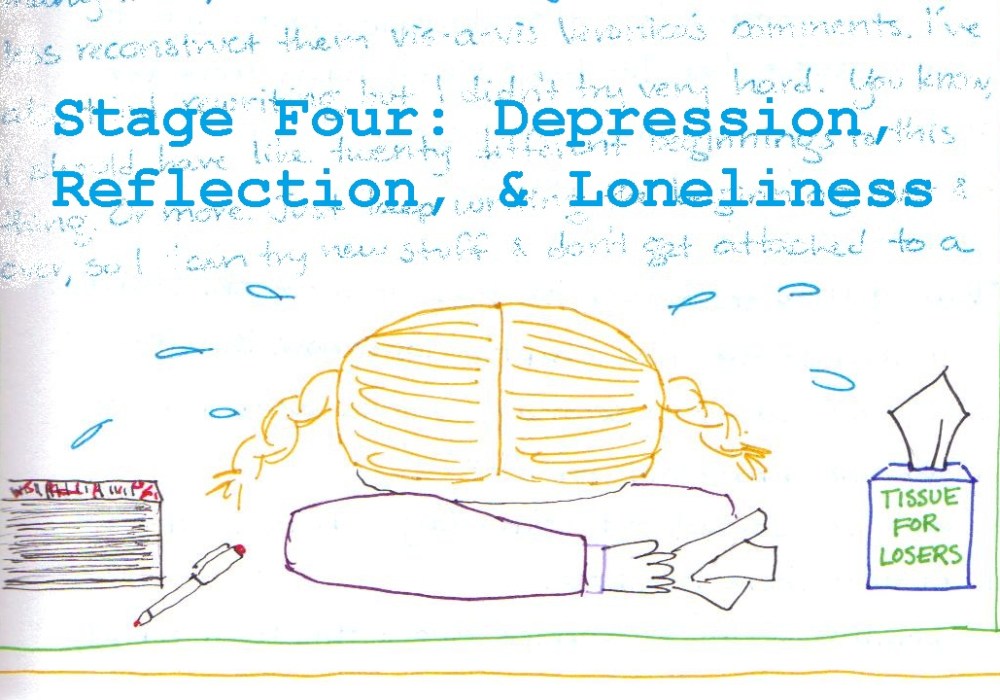
4. Depression, reflection, & loneliness – Whyyyyyy? Why do I even write? This is the stupidest “passion” a person could have. It only brings me pain. Nobody can understand what I’m going through. Nobody. Nobody. Nobody.
5. The upward turn – Even I’m getting tired of my whining. The only person who’s going to fix the (obvious, gaping) plot holes in this story is ME. So I better just cowgirl up and do it.
6. Reconstruction & working through – So if I can revisit these comments without slitting my throat, maybe I’ll find the very useful suggestions my esteemed critique group gave me.
7. Acceptance & hope – They’re right. My critique group is right. It doesn’t make sense for X, Y, and Z to happen in light of the fact that my main character is obviously B. Crap. But I can fix it. This happens with every manuscript – I think it’s unfixable, and then, I work through it. I can do this, and I will, and it’s going to be smashing, baby. Smashing.
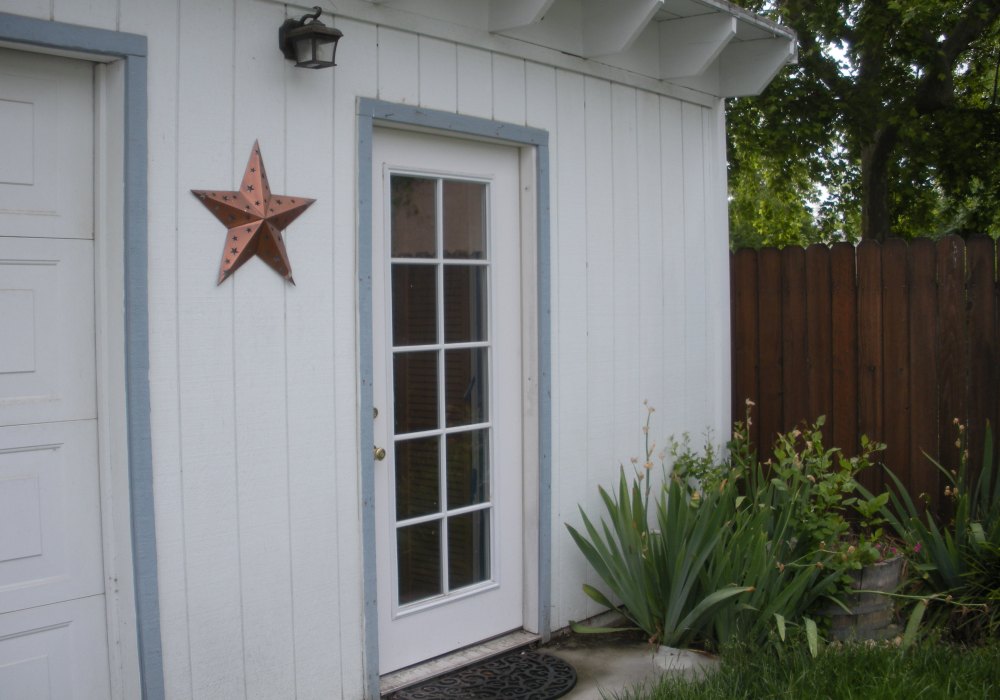
This post is long overdue. You see, friends, I have been working on a Secret Project of Joy (in addition to conspiring to send my daughter away to military camp, aka Preschool). My Secret Project of Joy is transforming our garage guest room, the “Love Shack” as we like to call it, into a place I can actually work.
The first step was covering up the orange paint.
I am anything but a designer. Like most people, I enjoy being surrounded by beauty. When I get tired of standing in front of the mirror, I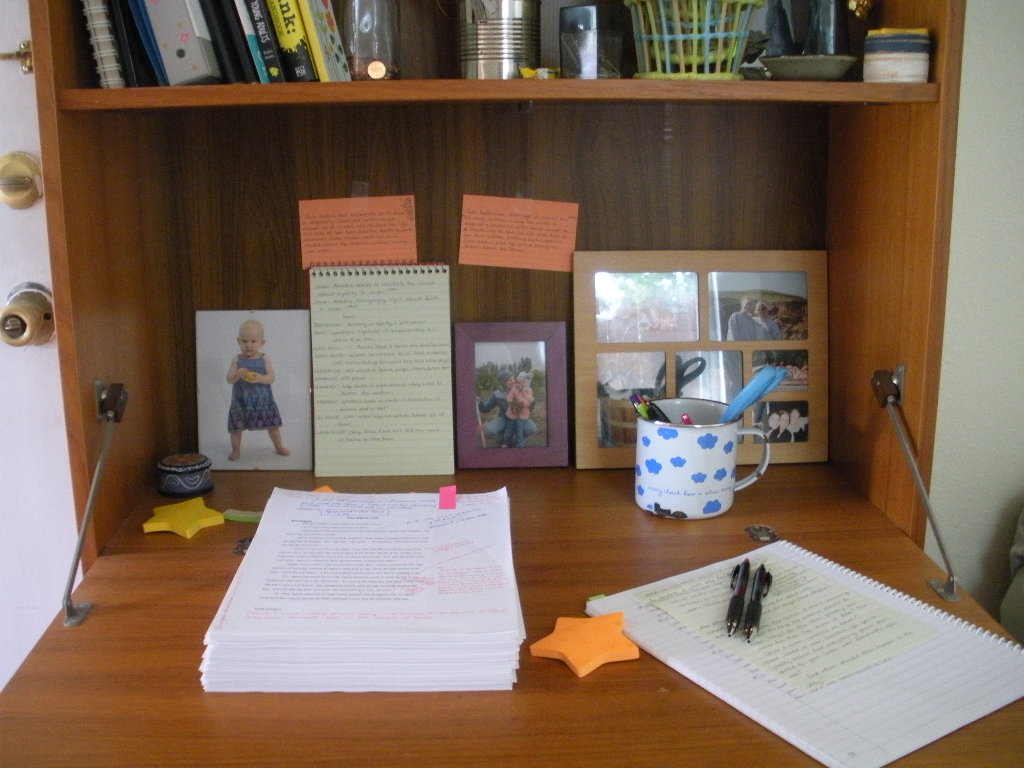 am left to find beauty in my environment. Husband and I picked out this great tile to go in the Love Shack, a terra cotta with blue designs on it (click here to see it up close). (By the way, I don’t recommend this tile unless you enjoy scraping bar codes off the floor. Some genius decided to put the bar codes on the TOP of each tile. As we are a lazy/busy family, there are still tiles with bar codes on them. In fact, the only ones without bar codes are a gift of my mother’s hard work. Thanks, Mom.)
As I was saying…I tried to match the terra cotta tile. And do an accent wall. Thankfully, I can’t find any photos of the old Love Shack, because although people were nice enough about it, it was Ugly. A few months ago I went out there to write, and as I sat on the bed, looking around (not writing), I couldn’t help but notice the pleasing sandy color I’d chosen was orange. Orange!
So on Mother’s Day, I painted the heck out of those walls, to a nice soft Informal Ivory. Now it’s Very Boring, which is better than orange, and I can always kick up the color a bit with the trim. And paint some poems on the walls, maybe some birds and stars. It’s MY ROOM. Yeah, guests sometimes sleep in it, so I don’t want to put anything disturbing on the walls, like these prints we got to enjoy when staying in a hotel room in Nasca, Peru:

Sweet dreams!
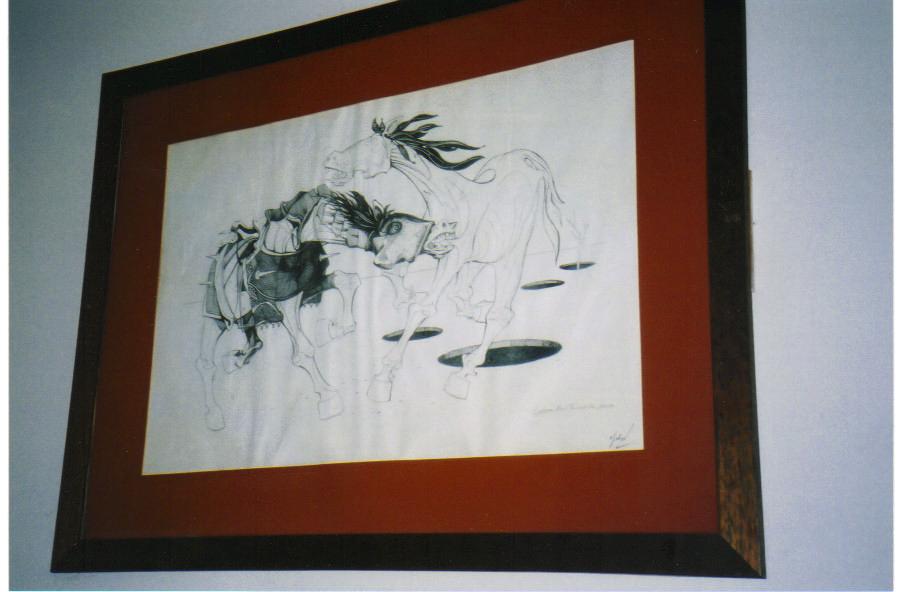
Don't let the bed bugs (er, horses) bite!
We weren’t sure which one we liked more, but we think the execution scene really sets the mood for peaceful slumber.
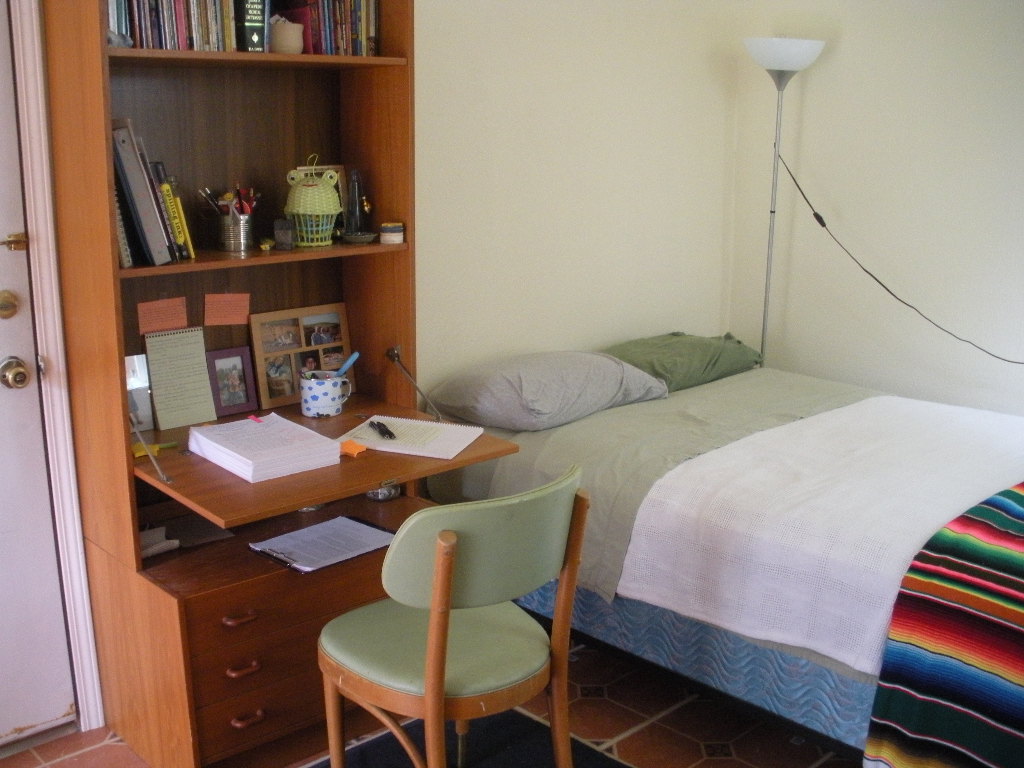
It’s clean and cozy, there’s a full bathroom, and even better: I can get work done in there. I’ve got lots of plans for the room, and the only challenge to my writing will be that I need to sit still and write, not putter about fixing up the place. In the meantime, it’s a workable writer’s studio. I like to call it my “sink paceuary” (taken from “peace sanctuary” when I was doing the Hypnobirthing CD – don’t laugh).
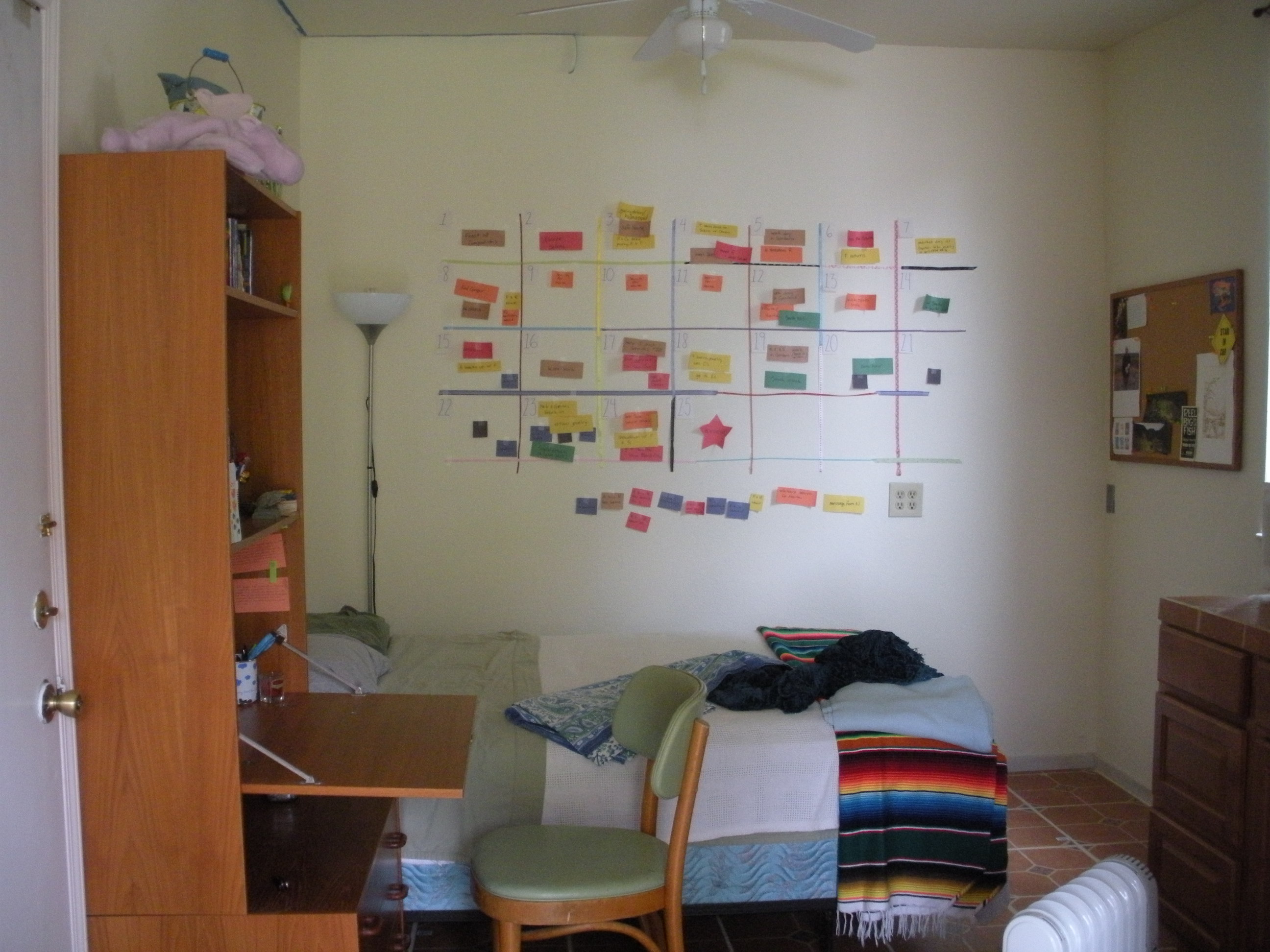
Finally moved my story board from the bedroom wall to the Love Shack.
“All I could do was to offer you an opinion upon one minor point — a woman must have money and a room of her own if she is to write fiction,” Virginia Woolf so famously said. Actually, I’d forgotten about the money part until I looked it up, and I now wish I had left the quote to memory. Anyway. I at least have the room of my own. It’s enough.
ETA: I was inspired to write about the Love Shack after doing Erin Bow’s interview. Her fantastic digs (located in a pole dancing studio!) make the Love Shack look tame by comparison.
 Beth Hull