NiFtY Author: Elaine Cantrell

Today’s NiFtY (Not Famous…Yet) Author is Elaine Cantrell, an award-winning romance novelist. Join us as we learn a little about her life and her writing.
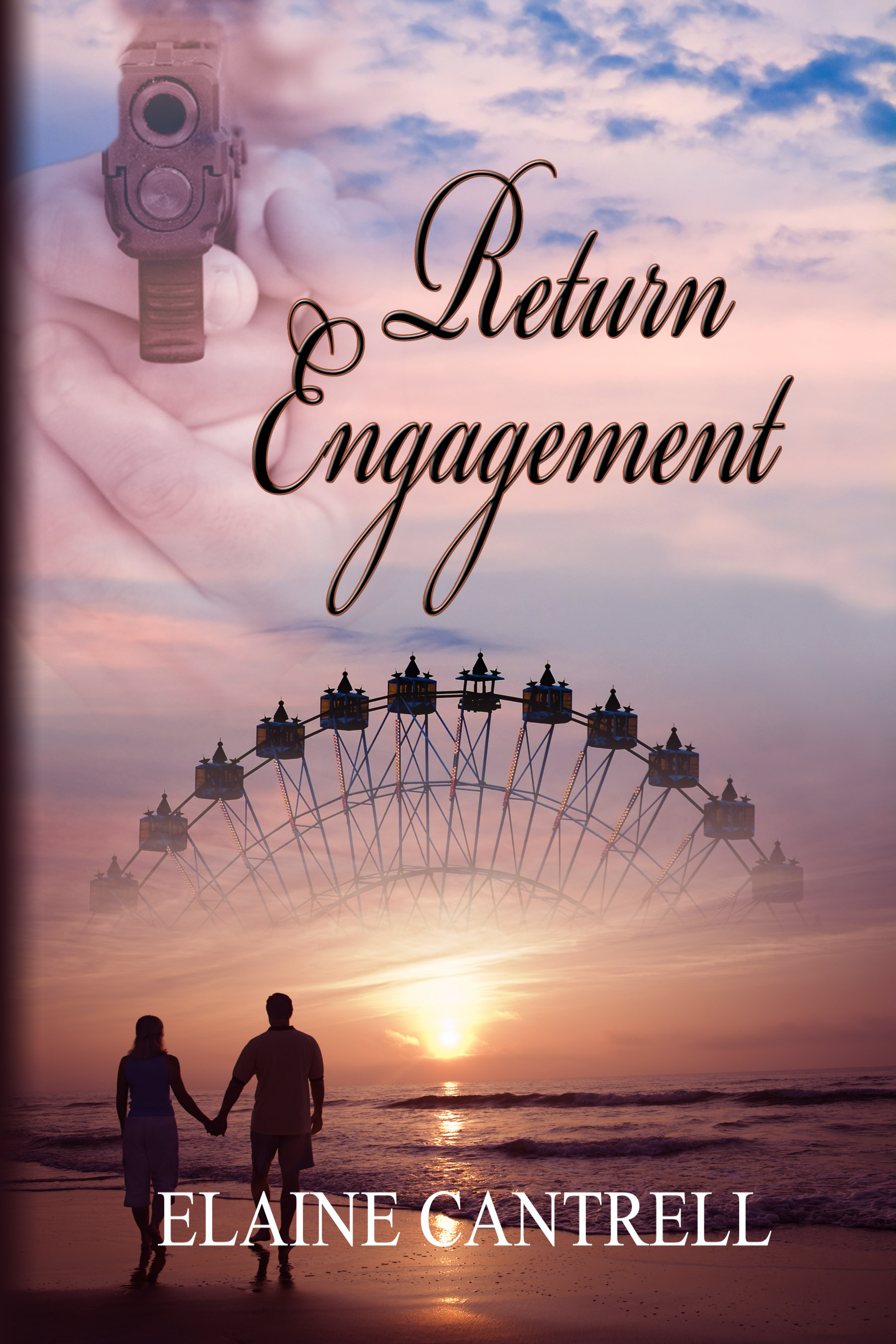
BH: Tell us a little about your latest book, Return Engagement.

EC: I’d love to!  Return Engagement is the book I wanted to write for a long time before I actually sat down at the computer to do it.  I thought about my characters so long and so hard that I once called my husband Richard (the hero in Return Engagement) which he didn’t like too much.

The book is centered around the idea ‘what might have been.”  I think most people have looked back in their lives and wondered how things would be different if they had made different choices; I know I have.  Richard and Elizabeth met when he was seventeen and she was twenty two.  They fell in love, but Richard’s father the powerful senator Henry Lovinggood broke them up.  He didn’t think Elizabeth was good enough for Richard whom the senator plans to make the president one day.

Ten years after their breakup Richard and Elizabeth meet by accident on a California beach and find that their feelings for each other haven’t changed.  When they decide to rekindle their relationship, they find that Senator Lovinggood isn’t their only problem.  There are others who wish them deadly harm.

BH:  Ooh. Sounds good! You’ve published six books, am I right? Are they all romances? Which one is your favorite?

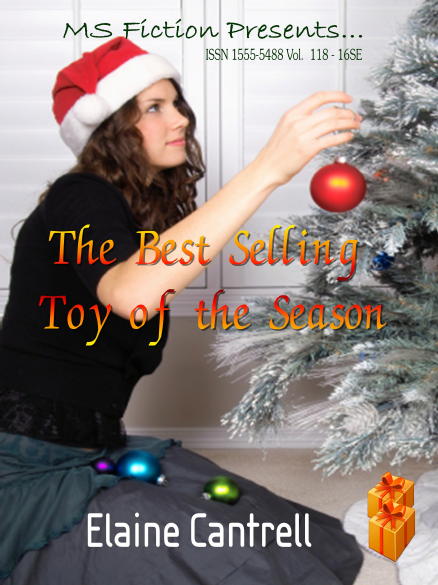
EC: Yes, they’re all romances, and my favorite one is always the one I’m working on at the moment.  If I had to pick just one I’d pick Return Engagement, mostly because I love that Richard so much.  I also like the book about Elizabeth Lane’s cousin Nikki.  That book The Best Selling Toy Of The Season is set at Christmas time and is available at http://www.midnightshowcase.com.
That’s an interesting thing too.  My husband couldn’t stand Richard, and I’ve gotten some reviews where the reviewer praised the book and called it a page turner, saying how filled with conflict and clever plot twists it was.  The reviewer then went on to say that she didn’t like the characters.  I guess I don’t understand that.  If she couldn’t put the book down because she had to know what happened next, why didn’t she like my characters?

Romantic Times Magazine liked the book just fine, though.  They gave the book a 4.5 which means it’s a keeper, and they said, “This touching story is beautifully written and explores the emotions involved when two people who love each other are influenced by outside forces and their own doubts.  Each character is fully developed, and the plot is filled with interesting twists.”

BH: You’re the first romance writer I’ve interviewed. What are some of the joys of writing romance? Are there any aspects of the genre that you don’t like?

EC: The joys are the same as for any other genre I think.  Authors get to create worlds of their own choosing, and things always turn out the way you think they should.  The negative part is that sometimes the characters are stereotypical and flat.  Hmm.  That’s probably why that reviewer didn’t like my characters.  I made them into real people who have warts and make mistakes.  They’re anything but stereotypical.

BH: Which of your characters would you say is the most like you?

EC: I give most of my characters the personality traits I’d like to have myself, so none of them are necessarily like me.  The one I’m most like is Betsy McLaughlin my heroine in A New Leaf.  A New Leaf was the winner of the 2003 Timeless Love contest which thrilled my heart more than you can imagine.  Betsy’s an ordinary girl who makes some life-changing mistakes, but instead of whining about things she does the best she can with the hand she’s been dealt.  I’d like to think that describes me too.

BH: What other literary projects do you have in the works? Can you tell us about a work-in-progress?

EC: My work-in-progress is a sci fi/ fantasy novel which is untitled at the moment.  I’ve had to lay it aside for the moment because I’d doing edits for a new book that’s coming out in June of 2011.  The book is tentatively titled Jilted!, and it’ll be published by Lachesis Publishing.

BH: Tell us a little about your path to publication.

EC:  It all started when my son wrote a book.  I was so overwhelmed with pride!  I’d always wanted to write a book, but I didn’t think I could.  I decided to give it a try when he told me that he had always made up stories in his head to amuse himself, and he thought he might as well write them down.  Glory be!  I had always done that too.  I wrote that book in record time, but nobody liked it.  My husband didn’t want the hero to be crippled, and my friend said that my heroine who was a good girl wasn’t as interesting as a bad girl would be.

So, I started another book, A New Leaf.  At the last minute I submitted the book to a small publisher who sponsored the Timeless Love contest.  The prize was publication of your book.  To my great and utter surprise, I won the contest, and A New Leaf was published the following year.

BH: Sounds like a dream come true! What does your workspace look like?

EC: Right now I’m sitting in my living room and writing on my laptop because the computer in my study crashed and died.  My husband bought me a new computer for Christmas so we’re going to redo the study and put in a glass table that stretches from one end of the room to the other.  Then my husband and I will both put our computers on the desk and sit side by side.  We’ll cover the wall behind us in bookshelves and leave space for a TV.

BH: What is your favorite book on the craft of writing?

EC: I’m ashamed to say that I don’t have one.  I could use the help as much as anyone, but there aren’t enough hours in the day as it is.  If I do read one, Stephen King has something out which my son says is very good.

BH: Any words on advice to aspiring writers for keeping the hope alive?

EC: Don’t give up.  I think the major difference between published and unpublished authors is that the published authors didn’t give up.

BH: Thank you, Elaine, for answering my questions and sharing your thoughts and your books with us!

Want more of Elaine Cantrell? Visit her website here, and her blog here. Also, here’s her Facebook page, and a link to buy Return Engagement.
NiFtY Author: Timothy Hallinan

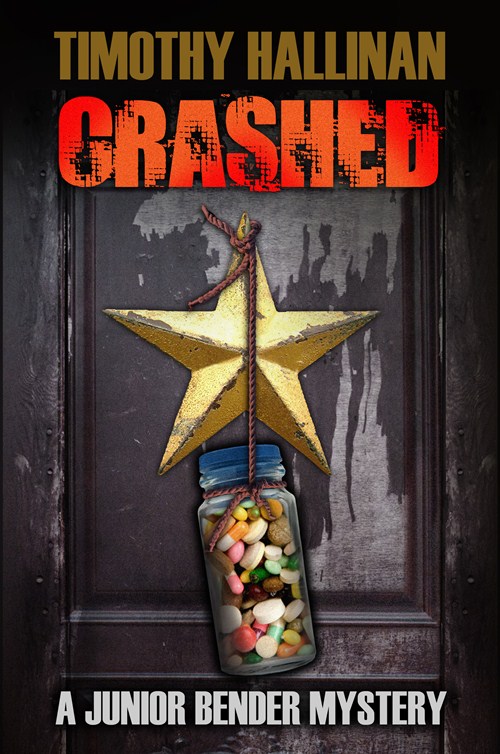
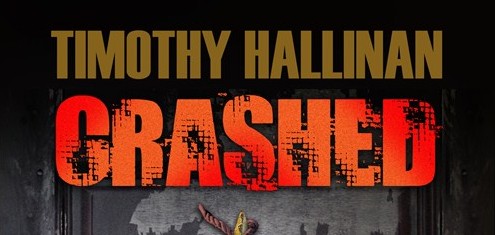
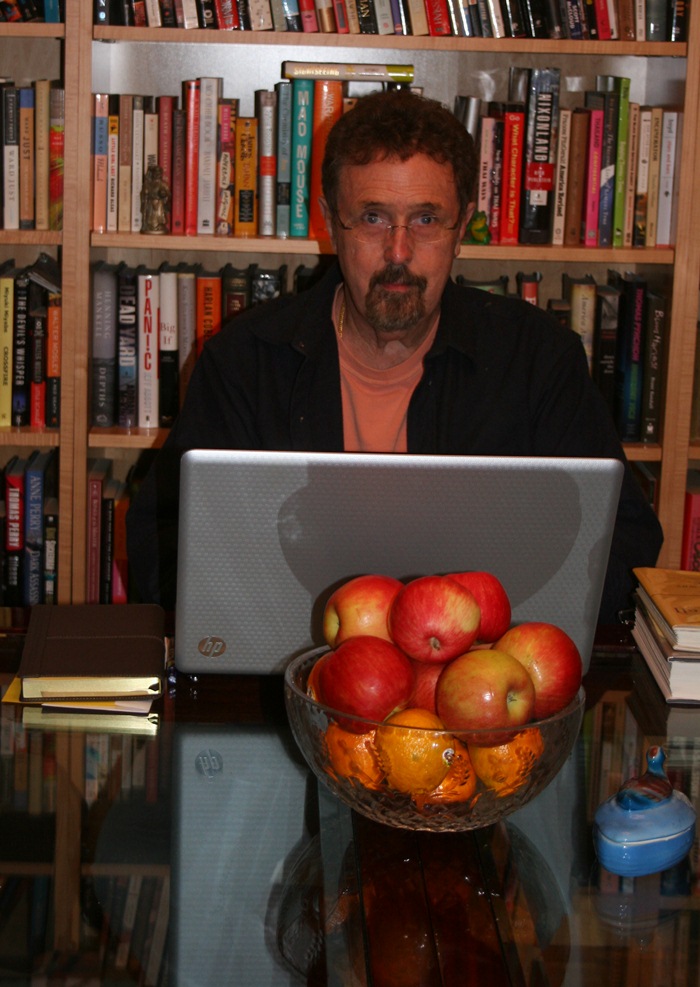
Timothy Hallinan is the other of sixteen published novels (eleven under his own name). His latest Poke Rafferty Bangkok thriller, The Queen of Patpong, was published in August, and his newest book, Crashed, is available for the Kindle (I’ve read the beginning, and didn’t want to put it down!). Timothy also maintains a website with an awesome “Finish Your Novel” page – several authors have published books after using the material. I really like the installment “What’s a Scene? (And What’s a Chapter?),” but there are other gems to be found there as well.

BH: What’s your one-paragraph pitch for Crashed?

TH: Junior Bender is a San Fernando burglar who moonlights as a private eye for crooks. In his first outing, CRASHED, Junior finds himself on the wrong side of his own already paper-thin moral code, being forced to prevent sabotage against a multi-million dollar porn film starring exactly the kind of person he’d normally want to protect. At the age of 23, Thistle Downing is broke and strung out – but between the ages of eight and fifteen, she was the biggest television star in the world. Now desperate, she’s facing the ultimate humiliation . . . and she’s so wasted she doesn’t even know that someone’s trying to kill her. And in between her and all that, there’s no one – except Junior.

BH:  Which book in the Poke Rafferty series would you encourage new fans to begin with? Should they start with the first book, or can they pick up somewhere in the middle?

TH: The first book, A NAIL THROUGH THE HEART, is the roughest in the series in terms of subject matter, but it’s probably the best place to start.  The thriller elements are self-contained from book to book, but the heart of the series is the ongoing story of the American travel writer Poke Rafferty and the little family he’s assembled in Bangkok with his wife, Rose, a farmer bar worker who now helps other women leave that life, and their adopted 9-year-old daughter, Miaow, who spend most of her childhood on the street. (She’s nine in NAIL and eleven in the fourth book, THE QUEEN OF PATPONG.)

BH: The Poke Rafferty series is your second series, is that right? How do you feel that your writing has changed throughout your career so far?

TH:  Well, I hope I’ve gotten better, but who knows?  One thing that strikes me is that back in the 1990s, when I was doing the Simeon Grist mysteries, I wrote a pretty male world.  I was not at all confident about writing women.  That changed in part because Miaow, Poke’s daughter in the Bangkok books, is for some reason the easiest character in the whole series – she comes to me as fast as I can write her.  After nine novels without a single scene between women when there wasn’t a man present, in THE QUEEN OF PATPONG, I wrote a 45,000-word section – practically a novella – about Rose’s road from being an unworldly village girl to the “queen” of the bars of Patpong.  It’s all women, and it’s the part of the book most reviewers (and all female reviewers) paid special attention to.  And women are vital characters in the new series, the Junior Bender books, too.

BH: Tell us a little about your path to publication.

TH: I wrote two really awful books that I showed to no one and then a third, SKIN DEEP, that introduced Simeon Grist.  I took it to a Hollywood agent and she sent it to a New York agent, and ten days later I had a three-book contract with William Morrow.  Not much drama there.  Then I wrote three more Simeons for a total of six, took about six years off to make money so I could write full-time, and then wrote the first of the four Pokes, which sold in an auction between two big houses.

What’s most interesting to me is the e-book revolution.  I’ve been very fortunate in my relationships with major publishers, but I’ve always had to write what they thought they could sell or what they thought readers wanted from me.  CRASHED is an edgy thriller with a laugh track, and two publishers said, in essence, “Nobody wants to read funny thrillers.”  But I wanted to WRITE funny thrillers, so I wrote two and a half Junior books and put CRASHED up for the Kindle, and it’s doing very well,  Seven reviews so far, and all five-stars, and they’re not people I know, AND there’s some serious TV interest.  The second Junior book, LITTLE ELVISES, will go online in about three months, and I’m writing the third.  I’m also writing the first Simeon Grist book in fifteen years – just because I want to.  This is a new world for writers.  (I’m also writing the fifth Poke.)

BH: The scope of the “Finish Your Novel” on your author site is simply amazing – it’s as if you made an entire book on the craft of writing available for free. What motivated you to create it?

TH: I needed a lot of help when I started trying to write, and I didn’t know where to go for it.  After the Simeon books came out, I decided to teach a college-level class on finishing.  Anybody can start a novel (or any other large-scale project) but most people don’t finish.  So I focused on what I knew about finishing, and along the way I had to talk about story and character and setting and writing habits and all of that.  A LOT of people who took the class over the years finished their books.  So when I did my site, I expanded the class notes into a series of relatively short interactive essays and put them up.  And I’m happy to say they’ve helped a lot of writers, including some who sell better than I do, to finish their first novel  Helen Simonson, who wrote MAJOR PETTIGREW’S LAST STAND is one of them.  I love that book, and it knocks me out that I was to some degree helpful to her in finishing it.

BH: You mentioned that you aim for 1500 words a day. I remember when I was drafting my latest work-in-progress, shooting for 1200. It was tough. Do you always get your 1500? What is your writing schedule like?

TH:  Seven days a week, as many hours as it takes.  I shoot for 1500 but will quit at 1000 if they’re a good 1000.  But then I try to make it up later in the week.  I start every writing session by editing the last 3-4 days’ worth, so about half of those words get cut or rewritten before I finally move on.

BH: What does your workspace look like?

TH: In Asia, where I write the Poke Rafferty books, I work in coffee shops, mostly in Bangkok and Phnom Penh, Cambodia.  I have apartments in both cities.  The Poke books are set in Bangkok, but Bangkok is very distracting, while Phnom Penh is much sleepier. So I tend to spend a couple of weeks in Bangkok, getting ideas and jotting down descriptions, and then I go to Phnom Penh for four or five months to draft the book.

In Los Angeles, I tend to work at home, on a big table because I’m disorganized.

BH: What is your favorite book on the craft of writing?

TH:  Anne Lamott’s Bird By Bird. I think it’s very important that it was written by someone who actually writes novels (and good ones), as opposed to someone who writes books about writing novels.  It’s an indispensable book, and Lamott is great company.

BH: What is the best writing advice anyone has given you?

TH: I’ve had several great pieces of advice, and I follow all of them.  First, write the book you would most like to read.  Second, create a shrine to your writing – not so much in space as in time; time that is set aside each day for writing and nothing else.  Third, write on tiptoe – the only way to get better is to try to do things you don’t know how to do. Fourth, remember that in the end, it’s only a book, not a bad chest x-ray or a truck barreling toward you on the wrong side of the street; in other words, the day’s failures are never fatal and might just lead you toward something more interesting.

Flaubert said, “Talent is a long patience.”  I love that line.

BH: Thank you, Tim, for sharing your books and your inspiration!

Link from Tim: www.timothyhallinan.com/blog I’m currently engaged in The Stupid 365 Project, which is a commitment to put up a blog of not less than 300 words every single day for a year.  It’s been very interesting so far – I’m just into the third month – and I have no idea whether I’ll be able to finish.

NiFtY Author: Geraldine Evans

Geraldine Evans is the author of seventeen books, thirteen of which belong to her popular Rafferty & Llewellyn mystery series. Below she shares her books and her thoughts on writing.

BH: Dead Before Morning is your first book in your Rafferty & Llewellyn series. Could you tell us a little about it?

GE: It was published in hb the US in 1994 by St Martin’s Press. It’s almost ready for publishing as an ebook on kindle, iPad, iPhone, nook, kibo, android, etc. It introduces DI Joseph Aloysius Rafferty, some of his rumbustious family and DS Dafyd Llewellyn, his straightlaced sidekick. In this book, a naked girl is found murdered in a private psychiatric hospital, her face horribly mutilated. Rafferty has to solve the crime as well as get one of his many cousins out of jail. And it is only when he does his good deed for the day with regard to the latter, that the fates help him solve the murder.

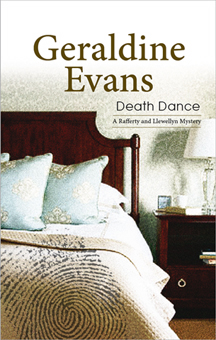
BH: How about your most recent installment in the series, Death Dance?

GE: Detective Inspector Joseph Rafferty is getting married; the last thing he needs is another murder that puts his plans in jeopardy. Adrienne Staveley was strangled, and is soon revealed as a woman with several lovers, a stepson who hated her and a husband who tramped the streets rather than spend time in her company. Altogether, there are a number of suspects who could have reason to kill her. Another possible disruption to Rafferty’s plans and his heart occur when some of the fingerprints in the Staveleys’ home are revealed to be those of his fiancee, Abra. She’d never mentioned knowing the dead woman, moreover, her prints had been found in John Staveley’s bedroom. Was Abra cheating on him even before they married? Or was she a possible murderer? His mind in turmoil, he wasn’t sure which option he preferred. But, somehow, he must put his problems aside and find the murderer.

BH: Which character do you feel is most like you? Did the similarities make it easier or more difficult to write the character?

GE: Definitely Joe Rafferty. He is me – the me I would be if I were a man and a cop. The similarities made it a lot easier to write about him. He’s a bit more of a rule-breaker than I am, but our sense of humour is the same. There’s something of my mother in Ma Rafferty, as well as a bit pinched from the various ladies I used to know when we went to Dublin for the summer holidays when I was a kid. But having said that, there’s a little of me in Llewellyn as well, as I’m quite a studious type.

BH: Which book in the series would you encourage new fans to begin with? Should they start with the first book, or can they pick up somewhere in the middle?

GE: It’s not necessary to start at book one as each book can be read as a standalone. But I suppose all authors prefer readers to start from the beginning and learn about the characters gradually. But if they would like to start with my favourite book, I still think I like Dying For You best as it’s the one where I get my poor old Rafferty deep inthe mire. It’s number six in the series and came out in, I think, 2005 in the US.

BH: Is it hard to write from a male perspective? Do you have any tips for authors who wish to write from the perspective of the opposite sex?

GE: I don’t find it hard, but then I’m not a very girly woman; I  was never very fond of pink, for instance, even when I was a little girl. Tips. Hmm. I would say try not to make them too tough. All men have their feminine side, even the most macho types. I’m not saying have them spend hours prinking and preening, but make them rounded, rather than a stereotype. Think about the men in your own life – they will all have their weaknesses and emotional times; maybe use them to help you build your characters.

BH: Tell us a little about your path to publication.

GE: It was a long one! I started writing in my early twenties, but I never finished anything. It was only when I hit the milestone age of thirty that I really got down to it. I wrote a novel a year for six years, only the last of which was published. That was Land of Dreams, a romance set in the Canadian Arctic (don’t ask!). When my next romance was also rejected, I turned to crime and – apart from one historical novel Reluctant Queen, about Henry VIII’s little sister, which was written under the name Geraldine Hartnett – I have written crime novels ever since. All during the years I was rejected, I had also written articles on subjects like historical biography, writing and New Age and these were published, not just in the UK, but in foreign magazines also.

BH: What is your writing schedule like?

GE:  I’m not an early riser. I generally start writing around 10.00 a m and carry on till around 6.30 or 7.00 p m. I’ll often continue to write later in the evening as well, though nowadays, I tend to give myself the weekends off (if I don’t, my husband moans! Quite rightly, really. He married me because he likes my company, after all).

Of course, as with other writers, I have other calls on my time. I’ve just finished proofreading my latest Rafferty novel, Deadly Reunion, which is out in the UK at the end of February 2011 (out in the US a few months later). Next, I have to do the final proofread of the ebook version of Dead Before Morning, after which I’ll have to get myself in gear to get the next out of print Rafferty novel, Death Line, ready for epubbing. I give talks and interviews. I do all my own marketing and produce flyers, bookmarks, news releases and postcards.. I also interview other writers for my blog, which I started recently. I use facebook, I tweet and belong to various Author websites, where I post and which I regularly update. So altogether, I keep quite busy.

BH: What does your workspace look like?

GE: I do most of my work downstairs in the living room by the fire (nearer the kettle for tea!). It’s quite a small room and is not very tidy (no Domestic Goddess, me!). I used to work all the time in my study upstairs, a small boxroom as we call them in the UK, but since Mark, my stepson, gave me one of his spare laptops, it’s been wonderful to have the freedom to work anywhere. I’ll get my husband to take a picture. The living room’s a bit of a shambles at the moment because I was busy yesterday evening wrapping Christmas presents for my family (nearly done. Only four more to get, though we also have four December birthdays and three in January L). Wish my lot went in for a bit of family planning!

BH: What is your favorite book on the craft of writing?

GE: I like the one by Lawrence Block. I can’t find it at the moment and I can’t quite remember the title (From Plot to Print?), but I’ve read that from cover to cover many times. I love his humour. Some writers who try to teach about writing get a bit too precious, but I’d definitely recommend his book.

BH: Any words on advice to aspiring writers for keeping the hope alive?

GE: I know it’s difficult. I’ve been rejected many times. Have a cry, then dry your eyes, grit your teeth and say: ‘I’ll show ‘em’! Try something different and shorter, like an article, something you don’t need to put your heart and soul into Anyone can research facts for a non-fiction piece and put them in order with a bit of flair. Don’t forget to do your research on your intended market, too, regarding what their requirements are (word length, subject matters covered, etc). As I mention on the Advice Page on my website (www.geraldineevans.com), this will, hopefully, give you something, maybe several somethings, to put on your writer’s CV, which should lead editors to at least consider you a professional. Getting non-fiction published is a lot easier than trying to place a novel. But with regard to your novel, please don’t follow the herd with the latest hot ticket. All would-be writers do that. Do your own thing and write what matters to you: that way, you’ll stand out from the crowd.

BH: Thank you, Geraldine, for the interview and for your thoughts on writing and publishing! For more of Geraldine, you can visit her in various places on the internet:

Website: http://www.geraldineevans.com Here you can visit Geraldine’s blog, find links to her books on Amazon, and read all sorts of writerly advice.

Blog: http://wwwgeraldineevanscom.blogspot.com (If this link doesn’t work, try going from Geraldine’s website.)

Twitter: Geraldine_Evans

Facebook Fan Page:
http://www.facebook.com/search.php?q=www.blogger.com&type=users#!/pages/Geraldine-Evans-Crime-Author/134541119922978

Crimespace: http://crimespace.ning.com/profile/GeraldineEvans

NiFtY Author: Erica Perl AND Contest!

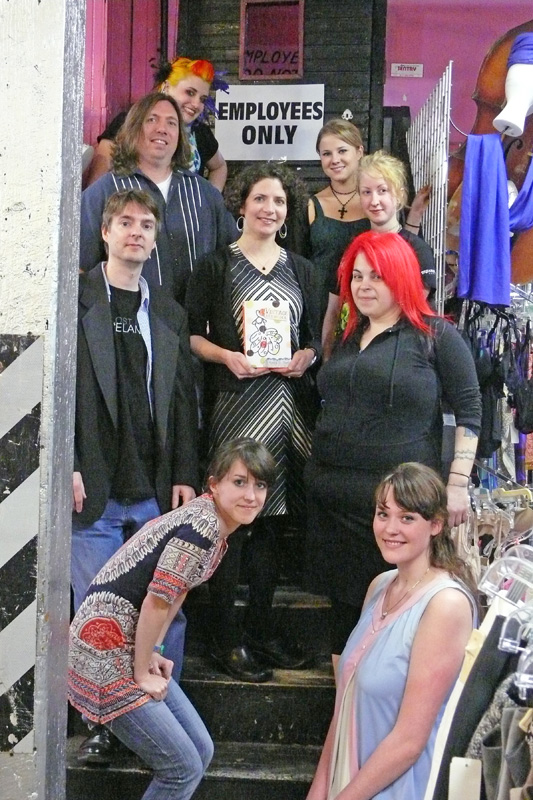
Erica Perl and employees of The Garment District, the store that inspired the Clothing Bonanza

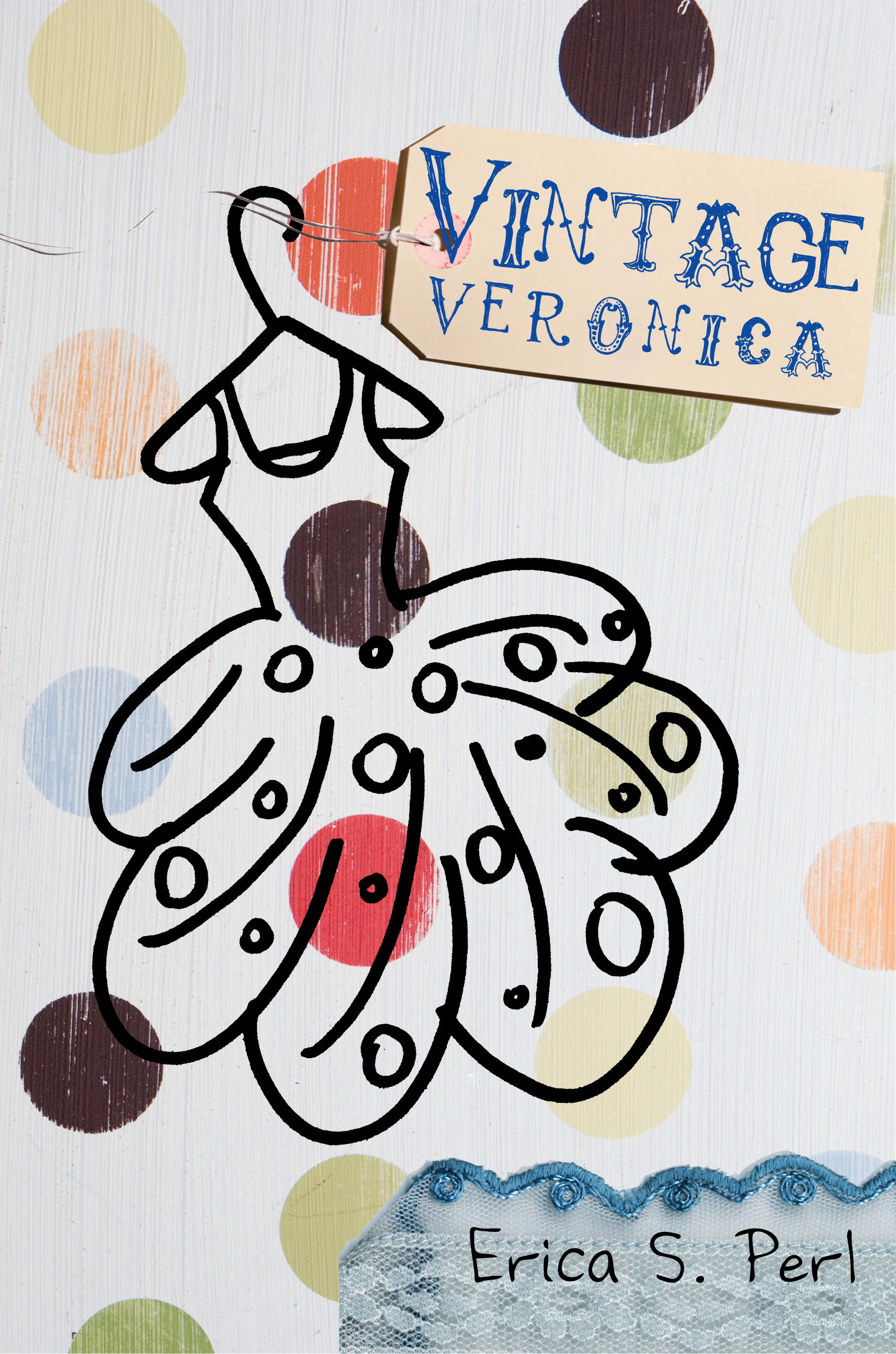
Exciting times, amigas, amigos, y rivales! This is the second week in a row I’ve had the privilege of interviewing an author whose book I randomly plucked from the shelf AND WAS SO GLAD I DID. Erica Perl wrote Vintage Veronica, (you can click here to read my review), and now she’s agreed to answer some questions about her book and her writing. She’s also agreed to give away a signed copy of her book!

BH: What’s your one-paragraph pitch for Vintage Veronica?

EP:  Veronica Walsh is 15, fashion-minded, fat, and friendless so her summer job at a vintage clothing mecca is a dream come true. There Veronica can spend her days separating the one-of-a-kind gem garments from the Dollar-a-Pound duds without having to deal with people. But when two outrageous yet charismatic salesgirls befriend her and urge her to spy on and follow a mysterious and awkward stock boy, Veronica’s summer takes a turn for the weird. Suddenly, what began as a prank turns into something else entirely. Which means Veronica may have to come out of hiding and follow something even riskier for the first time: her heart.

I also think you can get the flavor of the book via my book trailer.  Here’s the link:

http://www.ericaperl.com/vintage-veronica-video/

and here it is on youtube:

http://www.youtube.com/watch?v=udRBvaJvT_M

BH: Veronica has a wonderful voice. Can you share with us some of the joys (and challenges) of writing such an engaging character?

EP:  Thanks!  The joys were many, since Veronica has a lot of attitude, so I had fun letting her give voice to many things that I wouldn’t necessarily say.  For example, she’s snarky to Bill, her co-worker at The Clothing Bonanza, at a point where he’s pretty much her only friend.  I think the challenge was making it clear that she’s pushing people away because she’s scared of being rejected (again) herself.

BH: Where did you get the inspiration for the Clothing Bonanza? Have you been to a place like it? If so, where is this magical store?

EP:  The store that inspired the Clothing Bonanza is The Garment District, which is located just outside of Boston in Cambridge, Massachusetts.  I researched the book there and many aspects of the store and its long history made it into the book (the Yellow Brick road, at one time, existed as did the store cats, including Rags).  Here’s the store’s website, which also contains some fabulous archival photos as well as current store info.  It is very much worth a trip.  And the store was phenomenally supportive of the book, welcoming me while I researched and wrote it, and then hosting a launch party for it when it came out!

Erica Perl (on left) at The Garment District for the Vintage Veronica book launch

BH: So, Veronica does some things that a conservative readership might find offensive. (I’ve been thinking about this a lot since October’s Banned Book Week.) Have you had any negative experiences because of this?

EP:  So far so good.  I occasionally wonder if I should have toned down the language, since I feel like the younger segment of my readership (11-13 year olds) might not get their hands on the book in more conservative areas.  But I really wanted the dialog to feel real so I tried to reflect the way 15-19 year olds actually talk.

I also wanted to use Zoe and Ginger’s coarser commentary as a means of showing that they are older and more confident than Veronica.  She’s a little shocked by them, but also enthralled.  I feel like there’s room for good adult/teen conversations in this, since it is a common situation for younger girls to find themselves in.  So I’m glad to hear that many librarians have been championing Vintage Veronica as a book that battles bullying (and offers a positive depiction of a plus-size girl who doesn’t have to lose weight to find happiness) rather than getting stuck on the fact that the language is a little edgy.

BH: Tell us about your path to publication.

EP:  If it was an ice cream flavor, it would have been rocky road.  I actually sold the book twice – along with my second novel, WHEN LIFE GIVES YOU O.J., which is a middle grade novel that will come out in June, 2011 – because of publishing industry ups and downs.  However, after a long and bumpy journey, the happy ending was landing at Knopf with my wonderful editor, Erin Clarke.

BH: What does your workspace look like?

EP:  Well, it is clean and well-lit and there’s great – if somewhat expensive – coffee.  In addition to Starbucks, I write in a room the size of a postage stamp that has not one but three desks in it.  Yes, I share my office with my two daughters.  We call it The Drawing Room, which sounds very sophisticated but really it’s just because we all like to draw.  And write.

BH: What is your favorite book on the craft of writing?

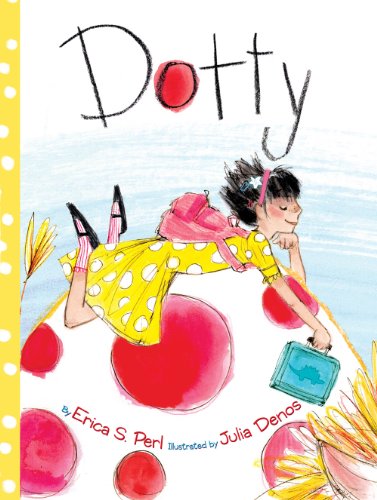
EP:  I love Leonard Marcus’ Ways of Telling, which I think is out of print.  It is interviews with picture book creators about craft (I write picture books in addition to novels.  My most recent is DOTTY, illustrated by Julia Denos.  I am also the author of CHICKEN BUTT!, illustrated by Henry Cole.  There’s now a CHICKEN BUTT! doll and the sequel, CHICKEN BUTT’S BACK!, comes out in April, 2011).  I also like Bird by Bird by Anne Lamott, even though the birds in question are not chickens.

BH: There is a lot to like about putting the word “butt” into the title of a story. What is the best writing advice anyone has given you?

EP:  I think the best writing advice is that of Jane Yolen:  it all boils down to BIC (butt in chair).  In other words, put in the time writing and then figure out later whether you have anything to work with.

BH: Any words on advice to aspiring writers for keeping the hope alive?

EP:  It’s a corollary to write what you know: write what you love.  In other words, don’t write a book because you think it is the kind of book you “should” write.  Write about what you are passionate about, and work on it until it is as good as it can possibly be.  Vintage Veronica took eight years start to finish.  I hope that is inspirational and not discouraging!

BH: Erica, thank you for taking the time to visit and answer some questions for us. It was delightful!

You can visit Erica’s website by clicking here, or click here to buy her book on Amazon.

And didn’t I say something about a contest? It’s my first ever, and a big thank you to Erica for making it possible. So, the rules are simple. The giveaway is limited to the continental United States (sorry, overseas people…unless you have an address here you’d like the book shipped to!). To enter, leave a comment and do two things:

1) respond to something Erica says/writes in the interview, and

2) share who your favorite strong heroine is in YA literature (if you pick Bella Swan you better be prepared to explain your reasoning).

If you tweet about the contest & share this link, you can get an extra entry (limit one extra). Just comment with the link to your tweet so I can verify that everything’s on the up & up.

The winner will be picked out of a hat at random. Well, his or her name will be picked out of a hat…not the winner in person, which would be too strange.

Deadline: Sunday night, 11/14/2010, 11:59 p.m. PST. Winner announced sometime on Monday.

NiFtY Author: Katie Pickard Fawcett

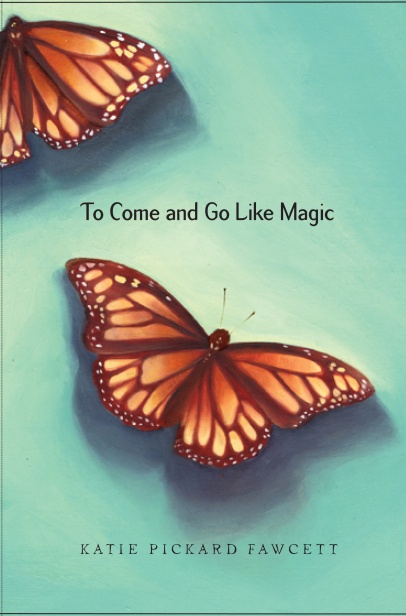
A few months ago I reviewed Katie Pickard Fawcett’s book To Come and Go Like Magic (click here for the review), and I was delighted when she agreed to an interview on my blog. So without further blather on my part…here’s a truly inspiring interview!

BH: I could be wrong, but To Come and Go Like Magic seems like one of those books that the author just had to write…like you couldn’t not write it. What inspired the story?

KF: My own childhood growing up in Appalachia was the inspiration for the setting, characters, and experiences.  Some years back I read The House on Mango Street by Sandra Cisneros and loved the way she told the story in vignettes.  I was excited to write a book about Appalachia in this style with glimpses into the lives of many different characters.

BH: Chili, the main character, longs to see the world. Then she befriends her teacher Miss Matlock, who has traveled extensively. Did you ever have a Miss Matlock in your life?

KF: No.  I didn’t have a teacher who had traveled the world and came back with stories to tell.  I did, however, have several wonderful teachers who read great books to us, encouraged me to write stories, and offered interesting classroom activities.  The trip to Mexico chapter in To Come and Go Like Magic was very similar to a geography activity we did in fifth grade.  Miss Matlock’s travels, her interest in the Monarch butterflies, in hiking in the Andes, and in the rainforests of Central America come from my own experiences.

BH: Another fantastic element of To Come and Go Like Magic is the setting. How much of the story’s setting is based on your imagination, and how much is based on your actual experiences in Appalachia?

KF:  I grew up in Eastern Kentucky so the setting is based entirely on the actual area and the environment, activities, problems, and concerns of the 1970s.  The characters, story, and most of the place names are fictitious.  I kept the name (Cumberland) of the real river.

BH: Your book is told in vignettes, and in some places these vignettes have such flowing language I think of them as prose poems. Was this your intent from the beginning, or did the format emerge as you told the story?

KF:  I love poetry and I enjoy writing “snapshot” pieces, so my writing tends toward the poetic.

BH: Can you tell us about your experience publishing To Come and Go Like Magic?

KF: I sent To Come and Go Like Magic to Random House and got a call and a contract within the month.  Sound too good to be true?  The complete story is a bit longer.  I worked for ten years in the publishing department of an international organization writing pieces for the house journal, summaries of development projects, and publicity pieces, and didn’t have much time to write fiction.  I was also a social worker in Kentucky, worked for a consulting firm in Washington, DC, and spent three years at various jobs at a university.  I majored in psychology, sociology, and education in college.  I also tutor and teach writing workshops and SAT prep on occasion.  I wrote a young adult book several years ago and sent it to Dutton.  They had me do two rewrites and then rejected it.  Ditto for Scholastic.  Then off to Random House.  After the second rewrite, my editor said she was willing to read it one more time.  I figured it wouldn’t fly.  So I asked if I could send her another manuscript I had lying around and she agreed.  That was To Come and Go Like Magic.  I spent about 6 years researching, writing, and revising the first book that got rejected by three big publishers over a period of 3 or 4 years.  I spent about 6 weeks writing To Come and Go. Just goes to show that “write what you know” makes sense.  Research was limited primarily to fact checking the dates for songs and foods and movies mentioned in the book.

BH: That is amazing, and heartening at the same time. I’m not surprised, though – I really get that “inspired” feeling from To Come and Go.

What does your workspace look like?

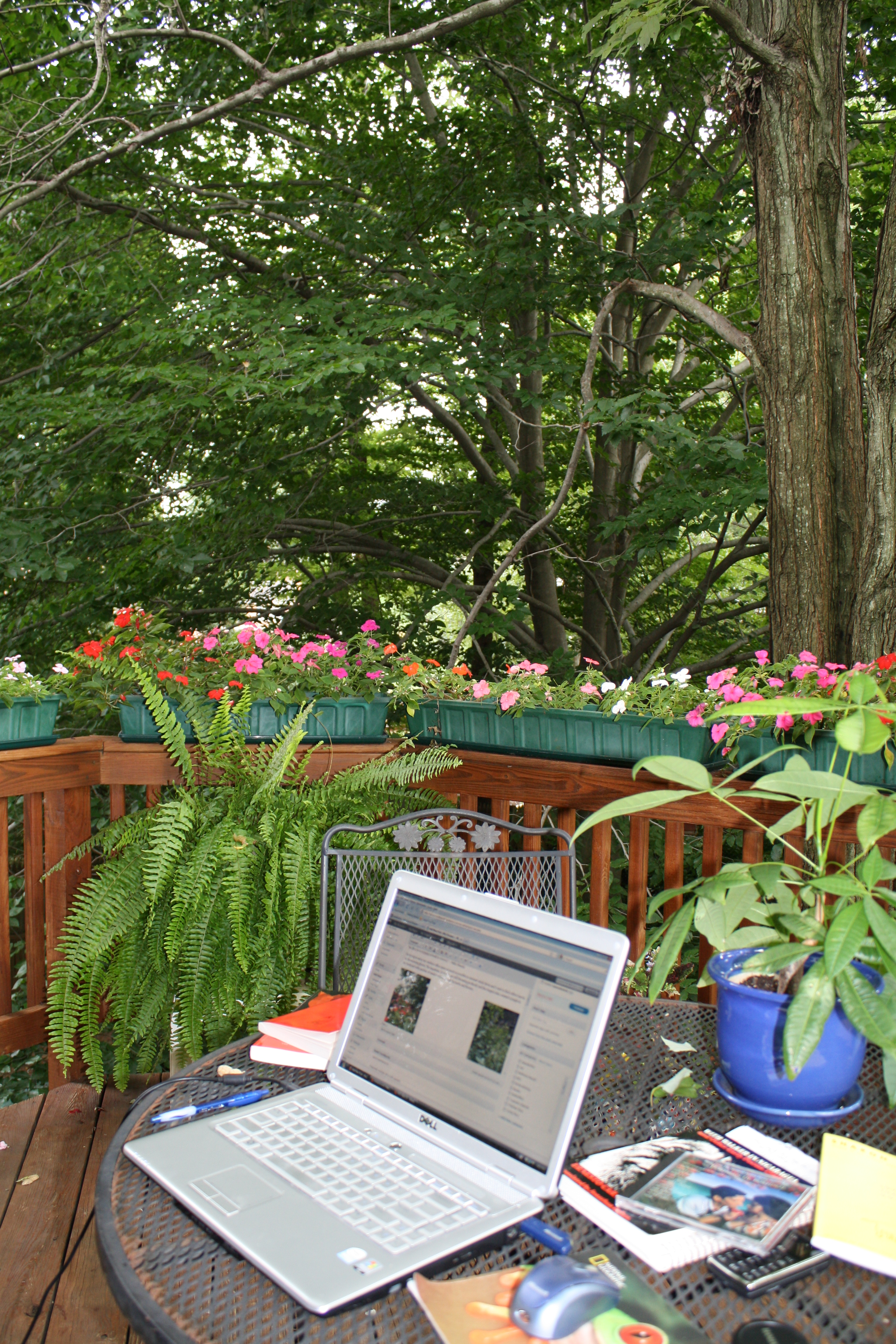
KF: My preference by far is to work outside and I love my laptop.  I enjoy the flowers and birds and furry critters that visit.  When it’s raining or too cold to be outside I work in my study.  I have a window that looks down to the front garden and three bird feeders – two for the squirrels and one that’s squirrel-proof.  A family of blue jays comes by almost every morning for peanuts.  They often respond to my whistle if they’re in the vicinity.  My study is filled with books and doo dads.  I have a hummingbird mobile above my desk, starfish on the window sill, green plants, and a CD player because I like music in the background while I’m working.

BH: What is your favorite book on the craft of writing?

KF: I have three books that I enjoy opening and reading a chapter or two when the mood strikes.  Reading Like a Writer: A Guide for People Who Love Books and for Those Who Want to Write Them by Francine Prose is entertaining and filled with great humor and wisdom and excerpts from some of the best writers past and present.  On Writing Well: The Classic Guide to Writing Nonfiction by William Zinsser has been around since the late 1970s and is still an excellent guide.  Many of these fundamental principles can be applied to fiction as well as nonfiction.   If I had to choose a favorite, however, it would be a little book published in 1996 titled Poemcrazy: Freeing Your Life With Words by Susan Goldsmith Wooldridge.  This is a marvelous little book filled with many inspiring exercises for getting the creative juices stirring.

BH: Any words on advice to aspiring writers for keeping the hope alive?

KF: I have been writing stories for almost as long as I can remember.  I passed stories around in elementary school and in high school study hall.  It seems that I have always needed to write and, although it can be physically tiring and mentally exhausting at times and rejection is always disappointing, it has never truly felt like work.  Publication is a big plus, but has never been a necessity for me.  The old saying that “it’s only work if you’d rather be doing something else” applies.  I love to write and it’s the passion, I believe, that keeps the hope alive.

BH: Thank you, Katie, for the great interview. I learned from this, and I appreciate your responses, insights, and inspiration.

Studio Audience! For more of Katie Fawcett, and where to order her book, check out the links below.

Links:

http://katiepickardfawcett.wordpress.com/ (On my blog I write about Kentucky, DC, Mexico, Costa Rica, Ecuador, the Caribbean, books, food, flowers, squirrels, and anything else that strikes me.)

Order from Amazon –

http://www.amazon.com/Come-Go-Like-Magic/dp/0375858466/ref=sr_1_1?ie=UTF8&s=books&qid=1287454169&sr=1-1

Order from Random House — http://www.randomhouse.com/kids/catalog/results.pperl?keyword=to+come+and+go+like+magic&submit.x=17&submit.y=10&submit=submit

To Come and Go Like Magic was a Parents’ Choice Award Winner in the fiction category for Spring 2010   http://www.parents-choice.org/award.cfm?thePage=books&p_code=p_boo&c_code=c_fic&orderby=award

Also nominated on October 9 for the Amelia Bloomer Project Award – an annual booklist of the best feminist books for young readers chosen by the Social Responsibilities Roundtable of the American Library Association  http://ameliabloomer.wordpress.com/