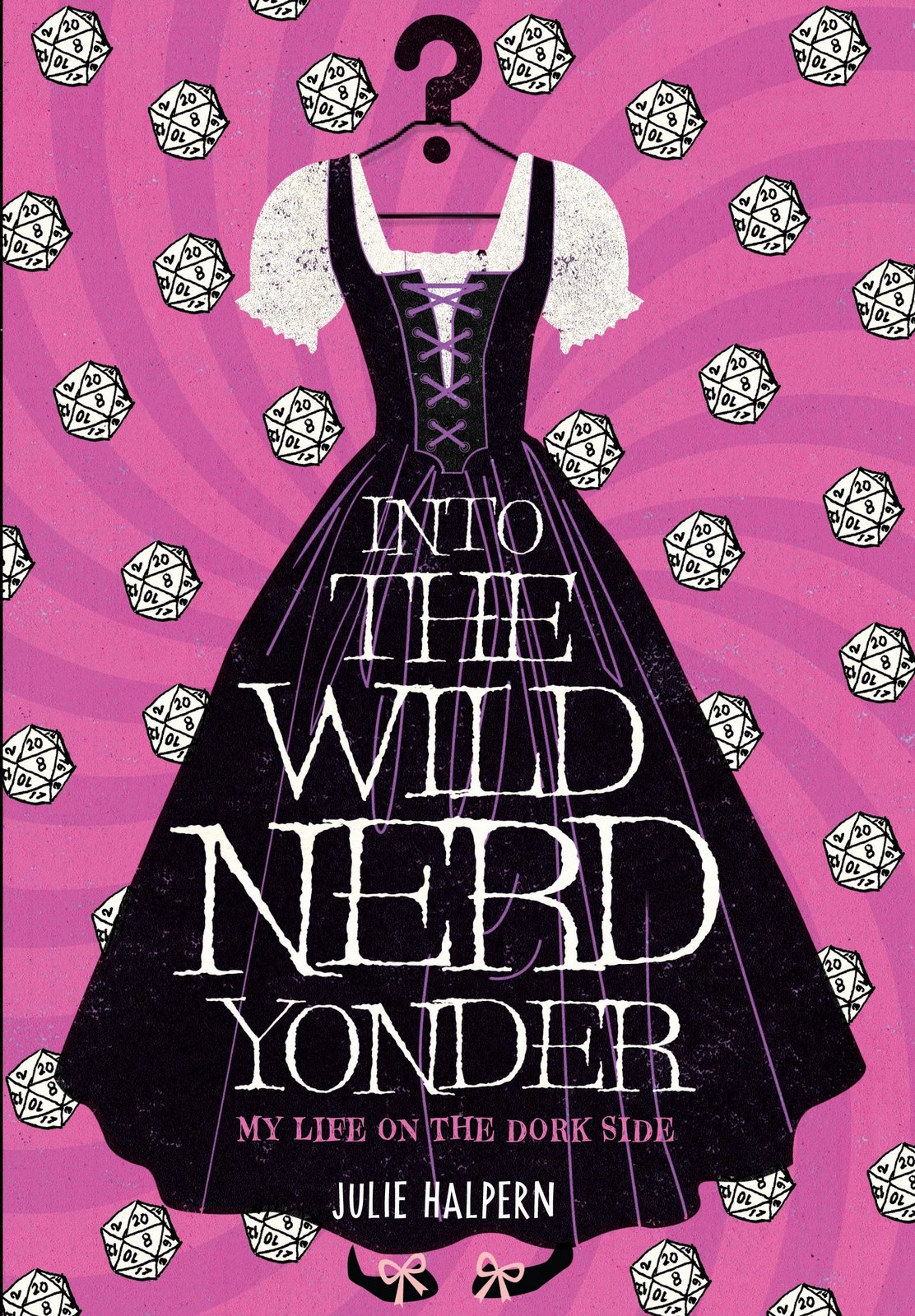
Into the Wild Nerd Yonder by Julie Halpern

You gotta love the title of this book. I did, and that’s why I picked it up. Those little flowery-looking things in the background? Those are 20-sided dice.

Yes, my nerdy friends, this is the book for YOU. (And you know who you are, although I shan’t name names.) (Yes I just wrote “shan’t.”)

Oh yes, the book review!

Set-Up: Contemporary middle-America (not Middle Earth, although Lord of the Rings references abound). Jessie’s so-called friends are using her, and it isn’t long into the story before they commit the cardinal sin: thou shalt not steal the crush of your BFF (or support said crush-thief). The so-called friends are also turning into punk poseurs, and they’re obnoxious.

Main character’s goals: Find new friends. Keep on making skirts. Stay away from the nerds, and stop crushing on hunky nerd boy.

My reaction: With her strange skirts, her math flashcards, and her love of audio books, I thought Jessie was already kind of a nerd (and she also admits this from the beginning), so why is she so worried about joining the uber-nerds?  But soon I recognized the subtle differences of her habits and the habits of the species Totallus Ren-fair-ius World-of-Warcraftiae. Oops, that’s not WoW, it’s Dungeons and Dragons. I guess they’re different somehow.

Anyway, I still loved Jessie, and she’s funny, which makes the book funny, which makes me like it even if there are subtle shades of dork explored here.

Of interest to writers: The family is lovable, both parents are present, and Jessie gets unending support from these folks. I wonder if this book (along with Flash Burnout by L. K Madigan) is some sort of response to recent talk about parents always being absent or losers in young adult literature.

I think a couple of things were too easy for Jessie, like the ending with her old crush. That’s all I’m going to say, because I don’t want to give anything away.

Oh, and she does some wonderful “larger-than-life” things, like how she resolves things with Bizza, and with the old crush.

Bottom Line: Totally worth a read, even if you aren’t a Renaissance Fair-attending, 20-sided dice-rolling, skirt-making nerd. Even a cool person would want to be this cool nerd’s friend.

To learn more about Julie Halpern and her books, you can visit her website  by clicking here.

And! Winner of a signed copy of Vintage Veronica….

is…

wait for it…

Megan!

I’ll be in touch to talk about the details of getting you your very own, autographed copy of Vintage Veronica by Erica Perl!

(It’s a contest. An overabundance of exclamation points is totally warranted.) !!!!!!

NiFtY Author: Katie Pickard Fawcett

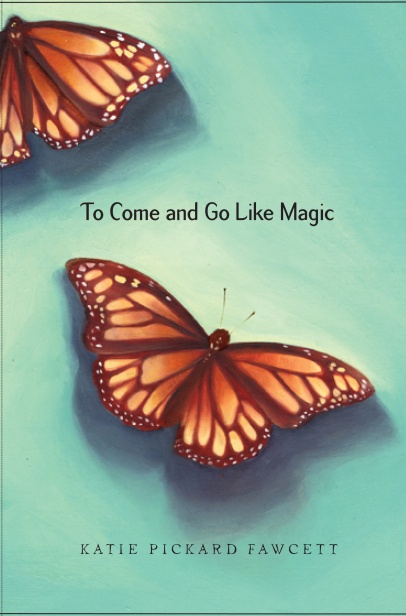
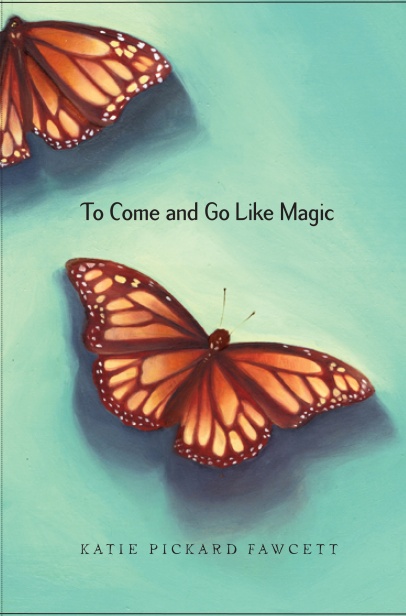
A few months ago I reviewed Katie Pickard Fawcett’s book To Come and Go Like Magic (click here for the review), and I was delighted when she agreed to an interview on my blog. So without further blather on my part…here’s a truly inspiring interview!

BH: I could be wrong, but To Come and Go Like Magic seems like one of those books that the author just had to write…like you couldn’t not write it. What inspired the story?

KF: My own childhood growing up in Appalachia was the inspiration for the setting, characters, and experiences.  Some years back I read The House on Mango Street by Sandra Cisneros and loved the way she told the story in vignettes.  I was excited to write a book about Appalachia in this style with glimpses into the lives of many different characters.

BH: Chili, the main character, longs to see the world. Then she befriends her teacher Miss Matlock, who has traveled extensively. Did you ever have a Miss Matlock in your life?

KF: No.  I didn’t have a teacher who had traveled the world and came back with stories to tell.  I did, however, have several wonderful teachers who read great books to us, encouraged me to write stories, and offered interesting classroom activities.  The trip to Mexico chapter in To Come and Go Like Magic was very similar to a geography activity we did in fifth grade.  Miss Matlock’s travels, her interest in the Monarch butterflies, in hiking in the Andes, and in the rainforests of Central America come from my own experiences.

BH: Another fantastic element of To Come and Go Like Magic is the setting. How much of the story’s setting is based on your imagination, and how much is based on your actual experiences in Appalachia?

KF:  I grew up in Eastern Kentucky so the setting is based entirely on the actual area and the environment, activities, problems, and concerns of the 1970s.  The characters, story, and most of the place names are fictitious.  I kept the name (Cumberland) of the real river.

BH: Your book is told in vignettes, and in some places these vignettes have such flowing language I think of them as prose poems. Was this your intent from the beginning, or did the format emerge as you told the story?

KF:  I love poetry and I enjoy writing “snapshot” pieces, so my writing tends toward the poetic.

BH: Can you tell us about your experience publishing To Come and Go Like Magic?
KF: I sent To Come and Go Like Magic to Random House and got a call and a contract within the month.  Sound too good to be true?  The complete story is a bit longer.  I worked for ten years in the publishing department of an international organization writing pieces for the house journal, summaries of development projects, and publicity pieces, and didn’t have much time to write fiction.  I was also a social worker in Kentucky, worked for a consulting firm in Washington, DC, and spent three years at various jobs at a university.  I majored in psychology, sociology, and education in college.  I also tutor and teach writing workshops and SAT prep on occasion.  I wrote a young adult book several years ago and sent it to Dutton.  They had me do two rewrites and then rejected it.  Ditto for Scholastic.  Then off to Random House.  After the second rewrite, my editor said she was willing to read it one more time.  I figured it wouldn’t fly.  So I asked if I could send her another manuscript I had lying around and she agreed.  That was To Come and Go Like Magic.  I spent about 6 years researching, writing, and revising the first book that got rejected by three big publishers over a period of 3 or 4 years.  I spent about 6 weeks writing To Come and Go. Just goes to show that “write what you know” makes sense.  Research was limited primarily to fact checking the dates for songs and foods and movies mentioned in the book.

BH: That is amazing, and heartening at the same time. I’m not surprised, though – I really get that “inspired” feeling from To Come and Go.

What does your workspace look like?

KF: My preference by far is to work outside and I love my laptop.  I enjoy the flowers and birds and furry critters that visit.  When it’s raining or too cold to be outside I work in my study.  I have a window that looks down to the front garden and three bird feeders – two for the squirrels and one that’s squirrel-proof.  A family of blue jays comes by almost every morning for peanuts.  They often respond to my whistle if they’re in the vicinity.  My study is filled with books and doo dads.  I have a hummingbird mobile above my desk, starfish on the window sill, green plants, and a CD player because I like music in the background while I’m working.

BH: What is your favorite book on the craft of writing?

KF: I have three books that I enjoy opening and reading a chapter or two when the mood strikes.  Reading Like a Writer: A Guide for People Who Love Books and for Those Who Want to Write Them by Francine Prose is entertaining and filled with great humor and wisdom and excerpts from some of the best writers past and present.  On Writing Well: The Classic Guide to Writing Nonfiction by William Zinsser has been around since the late 1970s and is still an excellent guide.  Many of these fundamental principles can be applied to fiction as well as nonfiction.   If I had to choose a favorite, however, it would be a little book published in 1996 titled Poemcrazy: Freeing Your Life With Words by Susan Goldsmith Wooldridge.  This is a marvelous little book filled with many inspiring exercises for getting the creative juices stirring.

BH: Any words on advice to aspiring writers for keeping the hope alive?

KF: I have been writing stories for almost as long as I can remember.  I passed stories around in elementary school and in high school study hall.  It seems that I have always needed to write and, although it can be physically tiring and mentally exhausting at times and rejection is always disappointing, it has never truly felt like work.  Publication is a big plus, but has never been a necessity for me.  The old saying that “it’s only work if you’d rather be doing something else” applies.  I love to write and it’s the passion, I believe, that keeps the hope alive.

BH: Thank you, Katie, for the great interview. I learned from this, and I appreciate your responses, insights, and inspiration.

Studio Audience! For more of Katie Fawcett, and where to order her book, check out the links below.

Links:

http://katiepickardfawcett.wordpress.com/ (On my blog I write about Kentucky, DC, Mexico, Costa Rica, Ecuador, the Caribbean, books, food, flowers, squirrels, and anything else that strikes me.)

Order from Amazon –

http://www.amazon.com/Come-Go-Like-Magic/dp/0375858466/ref=sr_1_1?ie=UTF8&s=books&qid=1287454169&sr=1-1

Order from Random House — http://www.randomhouse.com/kids/catalog/results.pperl?keyword=to+come+and+go+like+magic&submit.x=17&submit.y=10&submit=submit

To Come and Go Like Magic was a Parents’ Choice Award Winner in the fiction category for Spring 2010   http://www.parents-choice.org/award.cfm?thePage=books&p_code=p_boo&c_code=c_fic&orderby=award

Also nominated on October 9 for the Amelia Bloomer Project Award – an annual booklist of the best feminist books for young readers chosen by the Social Responsibilities Roundtable of the American Library Association  http://ameliabloomer.wordpress.com/
Ninja Slacker Mom

Confession scene from a serialized magazine ve...

"All right, I confess. I am a slacker mom." Image via Wikipedia

I have a confession which really isn’t much of a confession as I’ve never made a secret of its validity: I am a slacker mom.

When pregnant with Z, I taught high school. School ended in early June and Z wasn’t due until mid-August, so I figured the summer would be an excellent time to start my “Beth would make an excellent stay-at-home-mother” campaign. I thought I would cook the occasional meal, keep the house tidy, and generally show what a responsible adult I could be. What I ended up doing was writing tons in my diary, nearly-finishing my first novel, and taking nap upon nap upon nap. I would finish one nap only to start another one, and the only acceptable interruption to a nap was food. Habit Burger, usually. Excellent fuel for a growing fetus.

Naturally, I justified this behavior as my last-huzzah before becoming a responsible parent. Once I had a kid, I’d have plenty of time to do all the housewife things I’d always dreamed of.

Fantasy. Fantasy. Fantasy.

My stay-at-home-mommy-ness is defined by sneaking every spare minute I can possibly find for myself. And stealing other minutes that I can’t find. Time has become my eureka, my force, my raison d’etre.

I do laundry when I feel like it, or as is often the case, when it’s absolutely necessary. The same thing goes for washing the dishes and cleaning the bathrooms. Sure, I go through bouts where I vow to wash the dishes every evening while Husband gives Z her bath, but it soon turns into “wash the dishes every other morning” and eventually the vow devolves into something like “wash the dishes when company is coming over.”

Other stay-at-homers might complain about all the time they spend cleaning. Why bother? I wonder. They spend time with their kids, and they clean, and then there isn’t much time left for themselves. I spend time with my kid, I don’t clean, and I steal as much writing time as I can. It’s so much more fulfilling.

It can backfire, though. Sometimes I’m so intent on my ninja-stealth-time-thievery that I forget important things, like Husband. Or Z. And all I want to do is read-this-book-right-now-disturb-me-and-suffer-my-wrath. That’s when it’s time for a reality check, usually provided free-of-charge in the form of an incredulous look on Husband’s face. Then after Z’s tucked in bed, we curl up together and watch Castle on hulu. With take-out. Because after all that work, do you really expect me to cook a meal?

This post by Hyperbole and a Half says it (and draws it) a hundred times better than I ever could.

NiFtY Author: Elizabeth Kolodziej

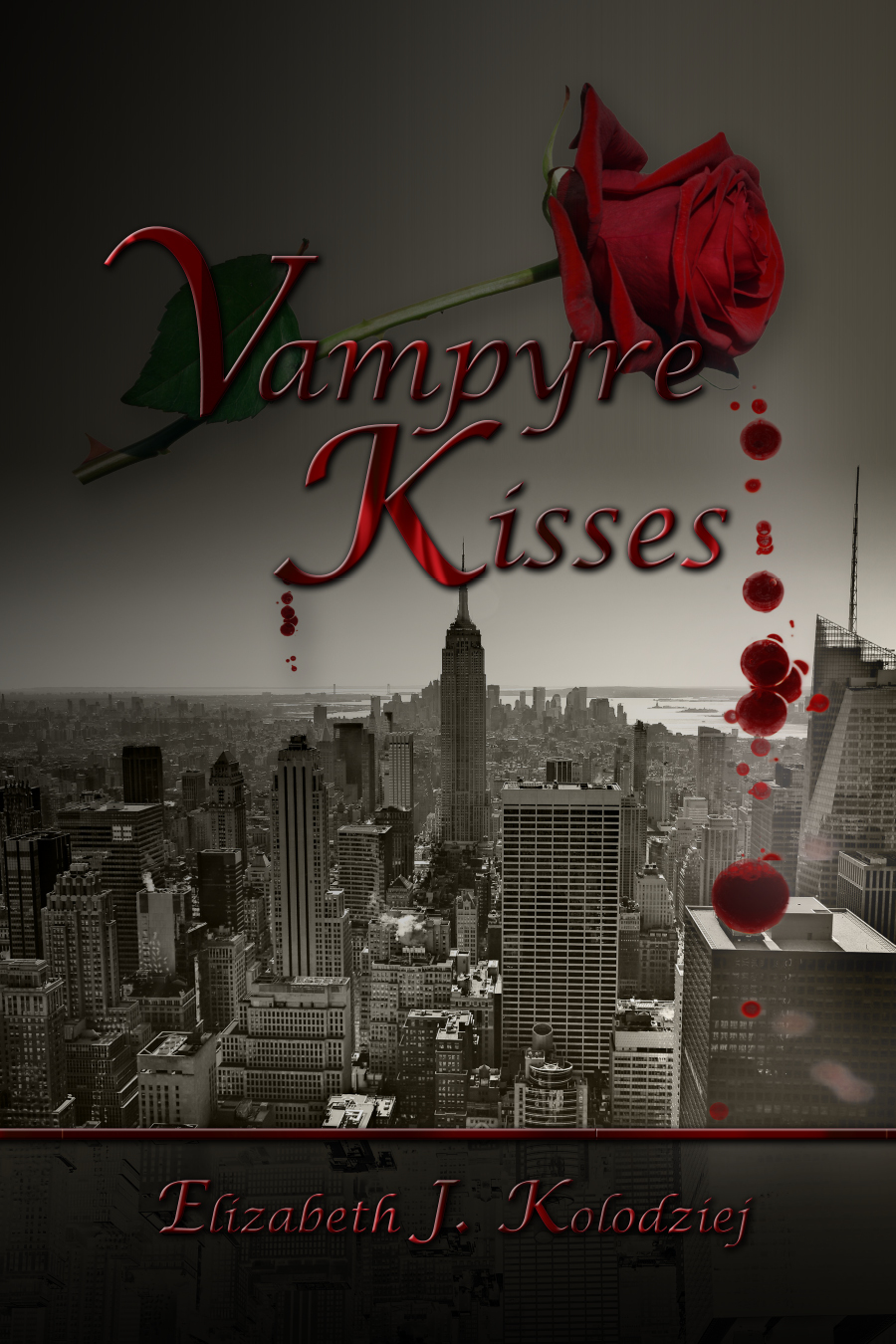
Gods, witches, werewolves, and…vampires! Timed just right for Halloween weekend, I give you a NiFtY Interview with Elizabeth Kolodziej, author of Vampyre Kisses.

BH: What’s your one-paragraph pitch for your novel, Vampyre Kisses?

EK: Vampyre Kisses is an enthralling story about a young woman, Faith, who meets a 400-year-old vampire named Trent. It isn’t long before Faith learns that she herself is a witch with a long family history. After finding out that Trent is a vampire along with being a terrific kisser he helps her find a way to take control of her powers. Soon powerful gems are stolen from the werewolf royalty and vampire master and they must be found. The reader will take a journey through a new kind of universe that is full of gods, vampires, witches and werewolves.

BH: Tell us a little about your path to publication.

EK: Well, I did try to go the traditional route, but I didn’t have any agents that wanted to take my story on. After awhile I decided to self publish my book. I truly believe that the book is great and with good marketing on my part I can get a wide range of people interested in it. I have readers all over the USA along with readers in the UK, Spain, and India. But I would warn anyone thinking of self-publishing that it is not easy. It takes you putting in your own money, lots of time, and being very open minded to do well.

BH: Okay, your bio saying that you’re a “young fiction writer” begs the rather rude question: how old are you? “Young” could be twelve or eighty-five, depending on perspective.

EK: hehe. I haven’t gotten this question yet! To be honest, I am a little over 90. Haha. J/K. Actually I am 25, which is young. I don’t care what anyone says!

BH: How long have you been writing fiction?

EK: I don’t remember the exact age I began, but I have been writing since I was around 8. I would read books on whales and then write research papers on them. I did this for fun; yes I was a nerd and still am. I wrote a few short stories when I was around 10 that were fiction. When I was 13 I began my first book but I never completed it though I was pretty much at the end of it.

I have always been the imaginative type though. I like to make up fantasies in my head. It actually really helps my writing because I can see the character in my head and the gestures that they make.

BH: I read on your website that Vampyre Kisses is the first in a planned series. How many books do you have planned? Have you outlined them all, or do you have a more general vision of the series?

EK: Right now I am almost half way through the second book. It is going to be called something like Lupine Secrets or Lupine Seductions. I haven’t decided yet. This book is outlines. For the third book I have an idea of what I want to do but nothing on paper yet. I think I could get a good five books or more out of this series. I have many ideas going on in my head when it comes to these characters.

BH: Faith is described as a girl who is mostly content but craves excitement. What sets her apart from the average young woman?

EK: Faith is a young adult in her early twenties and truthfully, I wanted Faith to be not average but just a regular person with a working job and dreams. When she finds out that she is a witch is when she starts having to learn and grow up quickly. What may make her unique is how she easily embraces the supernatural world she is thrust into. I find that it is easy for her because a part of her as been searching for where she belongs, for her witch side to be let out. I really hope that is apparent to readers in the book.

BH: The model wearing the Vampyre Kisses T-Shirt on your website is obviously not you. Any clues to the mystery man’s identity?

EK: I guess I can let that cat out of the bag. The mystery man is my muse. He is the one who would comfort me during my most depressing writers block and help me by letting me bounce ideas off of him. My number one cheerleader and someone who without, this book might not be written the way that is.

BH: What is your favorite book on the craft of writing?

EK: I would say one of my favs is the book, Book in a Month by Victoria Lynn Schmidt. I am very big on organization and this book offered me this. That book or The Art of War for Writers by James Scott Bell. I think that book is just fantastic in what it can teach you with such few words.

BH: What is the best writing advice anyone has given you?

EK: The best advice I ever got was from my professors at George Mason University who told me that to write a good book one must read many books, even the ones you don’t think you’ll like. This proved to be very correct. Even reading Milton’s Paradise Lost, which was the most difficult thing ever, really showed me other ways to make descriptions and connect with my own characters.

BH: Thank you, Elizabeth, for answering my questions and sharing your book, as well as your thoughts on the writing life!

Want more? You can visit Elizabeth on her website, as well as Facebook and Twitter (see below)…and if you’d like some vampire along with your Halloween, websites where you can purchase Vampyre Kisses are listed below as well.

Publisher’s Website: http://bit.ly/9aYtXo

Barnes and Noble: http://bit.ly/dpJsLC

Amazon: http://amzn.to/byci6O

Kindle: http://amzn.to/bMzSKN

Facebook.com/kweenkitten

Twitter.com/ejkolodziej

NiFtY Author: John Lindermuth

Today’s NiFtY Author features writer John Lindermuth, author of the Sticks Hetrick mystery series. In addition to the Sticks Hetrick series, he’s written four other novels, three of those historical fiction.

BH: What’s your one-paragraph pitch for the latest novel in your Sticks Hetrick series, Being Someone Else?

JL: When an out-of-state reporter is found murdered at a disreputable bar the tendency to violence spirals and the investigative trail keeps bringing Hetrick and his team back to the family of a wealthy doctor who has retired in his hometown.

BH: Dan “Sticks” Hetrick is a retired police chief who acts as a consultant to his successor. What are some of the challenges he faces due to his less-than-official standing?

JL: He has no ‘official’ status and constantly clashes with a town official who is an old enemy. In this novel there’s also Police Chief Aaron Brubaker’s fear Hetrick wants his job back.

BH: The setting of your series is a fictionalized town in rural Pennsylvania. How big of a role does the setting play in your mysteries? Would you describe it as a character in itself, or is it more of a backdrop highlighting the actions and personalities of your characters?

JL: I do see the town as a character. Its rural nature and attitude of the inhabitants is often juxtaposed to that of the ‘big city’ of Harrisburg. The nature of the small community is also constantly exposed to change which impacts on the residents.

BH: I am thinking of turning my work-in-progress into a series. What recommendations do you have for developing a far-reaching character arc? The idea is we want our heroes to grow…but not too much in one book, right? Do you have any advice or tips on how to accomplish this?

JL: It’s a gradual process. Hetrick was a widower and retired in the first novel. His offer to assist Brubaker wasn’t altogether altruistic. He was bored and irked over having been forced into retirement. In subsequent novels, he and Brubaker have become closer. Hetrick’s protégés Harry Minnich and Flora Vastine also became more important members of the cast. In the latest novel I’ve introduced Brubaker’s suspicion and a new love interest for Hetrick.

BH: Tell us about your path to publication.

JL: It has been a long road. Throughout my career as a newspaper reporter and editor I wrote and submitted and garnered enough rejections to paper a room. My first novel, Schlussel’s Woman, was accepted after my retirement in 2000 by a publisher who shortly  went bust. Frustrated, I published it through iUniverse. After more submissions and rejections, Whiskey Creek Press (www.whiskeycreekpress.com) offered me a contract for Something In Common, first of the Hetrick novels, in 2005. I now have five novels with WCP. I published another historical novel, The Accidental Spy, with Lachesis Publishing (www.lachesispublishing.com) in 2007 and just signed a contract with Oak Tree Press (www.oaktreebooks.com) for Fallen From Grace in their new Western line.

BH: What does your workspace look like?

JL: Usually a mess—sticky notes, stacks of paper, reference volumes, etc., crowding the space. As the mood takes me, I move between my desktop and the laptop (which may be in use anywhere in the house).

BH: What is your favorite book on the craft of writing?

JL: I actually have two: Stephen King’s On Writing and Elizabeth George’s Write Away.

BH: What is the best writing advice anyone has given you?

JL: The best advice I ever had actually came from a painter. When I was in high school I had hopes of becoming a painter. I wrote Thomas Hart Benton, one of my idols, for advice of succeeding. His reply was one word: paint.

I think the suggestion is equally applicable to writing. If you want to succeed, write. We learn best by experience. Write, read and persevere.

BH: Thank you, John, for joining us today and sharing your insights into your books and writing!

For more information on John and his writing, you can visit these sites:

Website: http://jrlindermuth.com

Blog: http://jrlindermuth.blogspot.com

Books link: http://whiskeycreekpress.com/authors/JRLindermuth.shtml