Pitch Tips

After judging entries in the fabulous Deana Barnhart‘s Gearing Up to Get an Agent Contest, I came away with some strong ideas on what I think makes a successful pitch. This is not a comprehensive list, just a few things I thought about as I was reading/judging.

Voice: While writing the pitch from your character’s point of view is considered a no-no, I enjoyed the pitches that gave me a sense of the character’s voice. Think word choice and careful descriptive details. Too much voice in the pitch can sound gimmicky and annoying, so write with care.

Stakes: I loved the pitches that included not only the character’s goal, but what might happen if he failed. It didn’t have to be specific, but if it was, all the better. Here’s an example from my own pitch: “…Amalia has one month to restore the powerful twin magic fueled only by their connection. If she fails they will not only lose their powers, but their freedom, and ultimately, their lives.”

Character: The pitches that really stood out gave a strong sense of the character. What is the character like, and how might she change, given the high stakes she faces?

Length: Remember it’s a pitch, not a synopsis. I heard people bandying about the “rule” that a pitch should only cover the first fifty pages. It might be a good guideline, to cover the set up through that first doorway. It often seemed like pitches that tried to cover too much more of the story grew cumbersome and confusing because subplots started getting in the way.

Some things that concerned me: Typos, grammar/spelling errors, and sentence fragments. A pitch, whether it’s going straight to an agent or making stops on blog contests, should be proofread multiple times, preferably by more than one person. While we all fall victim to typos, and I doubt one in a query would kill chances with an agent, I don’t know…I think we should try really really hard to get our pitches as perfect as possible.

Or: You could, you know, skip the querying altogether and enter Miss Snark’s First Victim’s 2012 Baker’s Dozen Agent Auction. Authoress just listed the agent line up here! I participated last year. It was a blast, although, yes, there was all kinds of anxiety and nervousness. But I met some great writer friends and got excellent feedback on my log line and first 250 words.
Adventures in Outlining!

I’m a total plotter. In the end, I might stray from my bulleted plot outline. New characters pop up like gophers from their little hidey holes in the ground. But I like knowing where I’m going. And what I’ve been using most lately is Blake Snyder’s Beat Sheet. It’s a ton of fun, and great practice for plotting story. I like to fill one out for Shiny New Ideas that may or may not go anywhere, because, like writing the pitch ahead of time, it’s great practice.

For some writers, this Beat Sheet thing is old news – but a few months ago I’d never heard of it, so I’ll share it here in case there’s someone else who hasn’t heard of it. Basically, screenwriter Blake Snyder evaluated gazillions of films and came up with a “formula” or road map, or, uh, beat sheet that outlines the common scenes, or beats, of a screenplay. Movies and books both are fundamentally stories, so these beats can be adapted very easily to novels. And it is A BLAST not only applying these beats to my own brainstorming, but evaluating some of the crappy movies we find on Netflix streaming (we’ve watched all the good ones that appeal to us). I’m starting to (starting to?) annoy Homes with comments like, “It’s been fifteen minutes and we haven’t even left the Ordinary World!” or “Ah, yes, the false high midpoint. I know these.”

The beauty of the whole beat sheet is I can overlay it with Christopher Vogler’s The Hero’s Journey (an abbreviated, simpified Wikipedia version can be reached here), and it still works. Because story is, for the most part, universal.

You can download Blake Snyder’s Beat Sheet for free, here. Really, though, a look at the book is recommended. He shares many great ideas about story and market and even genre.

There’s your unsolicited advice for the day! It’s good for you. Like vitamins.

Baby Songs

We’re beyond “routine” with the bedtime routine in this house. It’s become a superstition. So much so that when Z was a toddler, I had to read the same book, sing the same three songs (“O Holy Night,” “Scarborough Fair,” and “All the Pretty Little Horses”) in the same order, and give her the same stuffed friend for every single nap and bedtime. Followed by the ever popular, ever annoying Drink Of Water.

Whatever works, right?

While I usually end Maverick’s routine with the time-honored classic “All the Pretty Little Horses,” I’m trying to mix it up a little more. Mostly because he’s still taking two or three naps a day, plus bedtime, and I can only handle so much of the same three songs.

So here’s what I’ve got in my bedtime arsenal:

  • All the Pretty Little Horses
  • Loch Lomond
  • O Holy Night (a little too long for Maverick, & I gotta sing it loud when I sing it otherwise I can’t pretend I’m auditioning for church choir solos. I’ll save this one for later)
  • In Ancient Egypt (a made-up song – here’s the “sheet” music & lyrics)
  • Sleep, Baby, Sleep (I made up my own melody for this, but I think there are others)
  • Peace Like a River (don’t I wish)
  • Ring Around the Moon
  • Scarborough Fair
  • a mutant version of I Love the Mountains (either I wasn’t taught the right way, or I heard it incorrectly – I’m guessing the latter because that happens all the time)
  • You Are My Sunshine (Z doesn’t like this one, thinks it’s too sad because of the part where “I held my head and cried”)
  • Three Little Birds

Any suggestions? What did your parents sing to you? What do you sing to your kids or nieces or nephews or the little boogers in your life?

Too Many Notebooks

You might as well face it, you’re addicted to notebooks.

I remember being nine and putting “notebooks” and “diaries” on my birthday and Christmas wish lists. We’d go to the drugstore and I’d salivate over a pink, three-subject, college-ruled, spiral-bound notebook (still have that, although the cover came off). And I’ve rhapsodized about old diaries here.

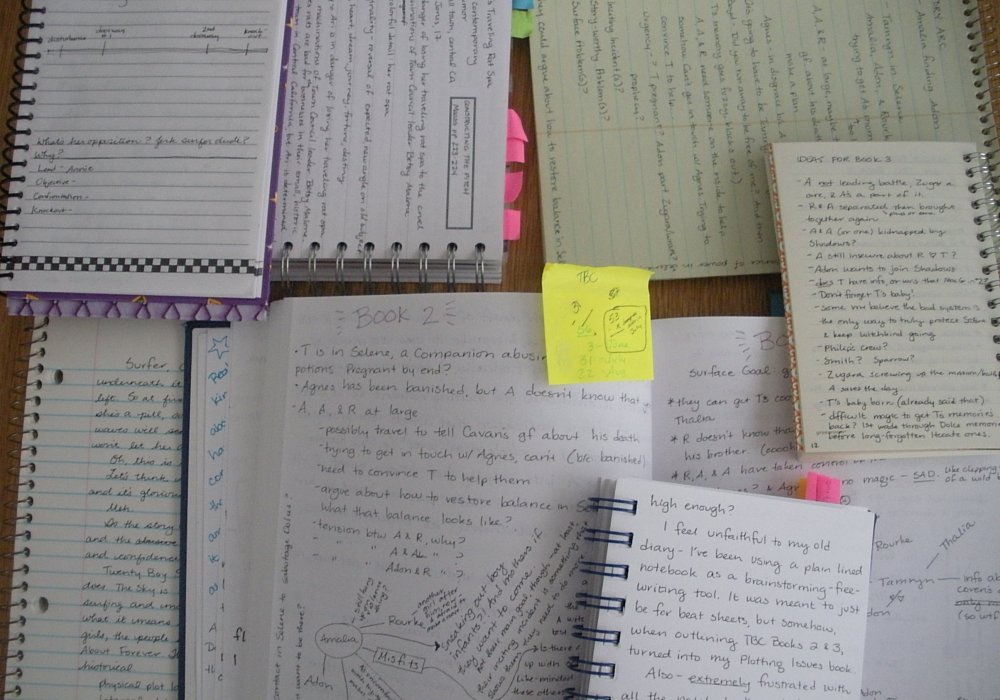
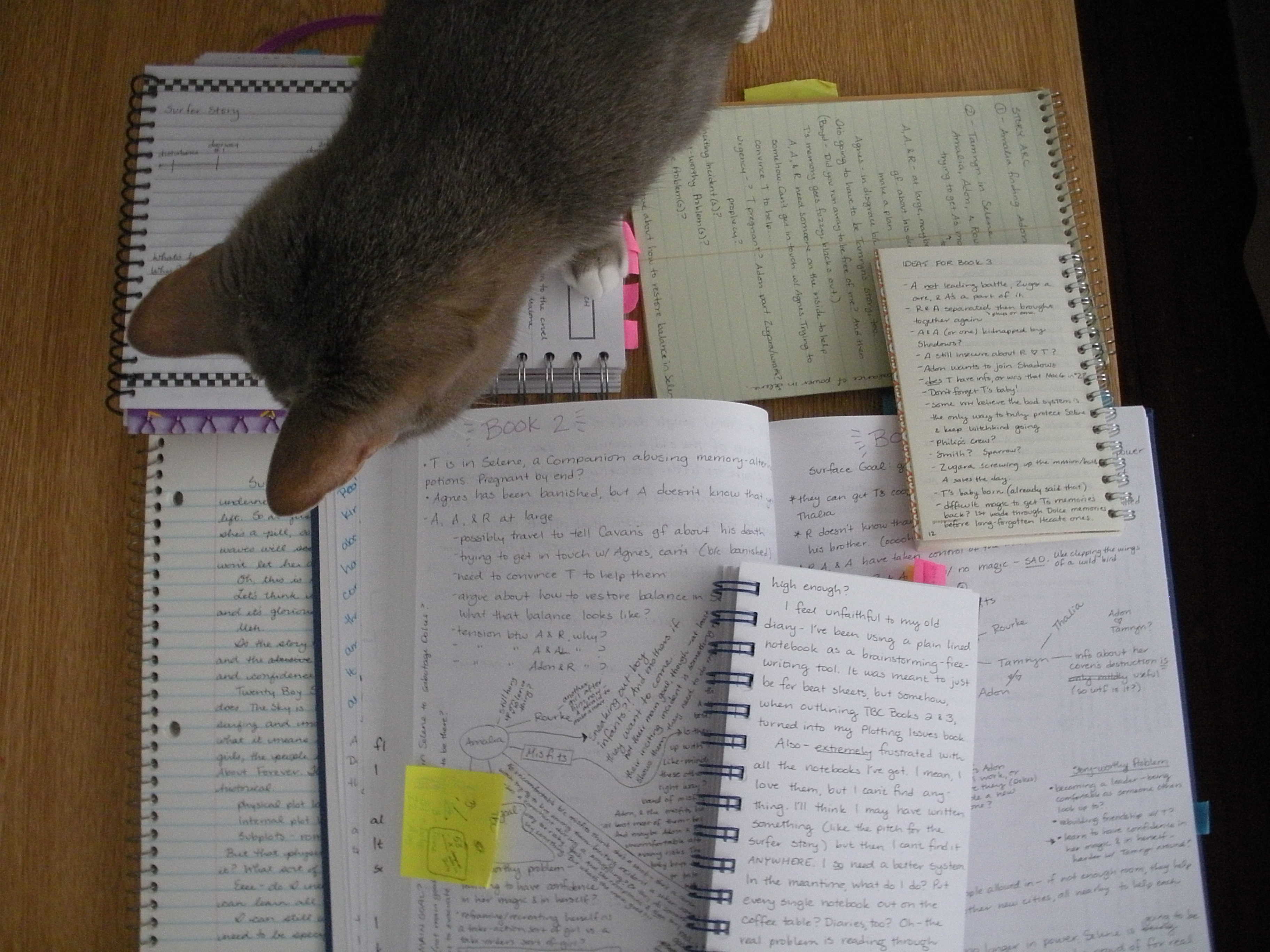
But now, as I outline Books 2 and 3, as well as craft pitches for various ideas I’ve had over the last year, I’m finding old ideas everywhere!

The problem with this, is that the reverse is also true: I can’t find anything! A few days ago (and I posted this on Twitter), I said to Homes, “Where is that prophecy I wrote?” His response: “In a big vault, with rows and rows of other prophecies, trapped in spheres.”

I never should have made him read Harry Potter.

There’s a line in Zero Effect that goes: “Now, a few words on looking for things. When you go looking for something specific, your chances of finding it are very bad. Because of all the things in the world, you’re only looking for one of them. When you go looking for anything at all, your chances of finding it are very good. Because of all the things in the world, you’re sure to find some of them.”

So true.

Clark thinks it’s too many notebooks, too. She bats at them in disapproval.

So what do I do? Something must change because I’m going bonkers trying to find pitches I may or may not have written months ago, and prophecies I apparently didn’t write months ago (because I read through six months’ worth of diary angst, obsession, and drivel, and never found the stinkin’ prophecy), and random scraps of ideas and half-formed Blake Snyder beat sheets. Maddening, I tell you.

And I LOVE Scrivener and always will, but there’s something grand about opening a notebook and jotting down ideas. There’s no screen involved, and my eyes thank me for that. And I can curl up on the couch more easily. It’s peaceful.

So…maybe limiting myself to a set number of notebooks? Say, seventeen?

PS: In the middle of writing this post I went to Target and bought two more notebooks. It’s a disease. I rationalize the purchase by exclaiming, “Back to school clearance!” but in truth, disease.

As My Houseplants Lay Dying

You know you’re getting old when you say things like, “Back when I was in college…” Usually with a nostalgic tone of voice, like when my friend KJoy was visiting and we reminisced about the amazing cream of cajun carrot soup we used to eat at this restaurant where we worked, Mulberry Street Pizzeria (in San Rafael. Smith Ranch Road. Go ye forth and try the soup).

KJoy: We used to eat so much of that soup!

Me: And the french bread! We’d have at least five pieces of it, which is like half a loaf, and just dip it in the soup…it’s amazing we didn’t gain fifty pounds.

KJoy: That’s because we were nineteen.

(To my nineteen-year-old self: ENJOY THAT METABOLISM WHILE IT LASTS, SISTA.)

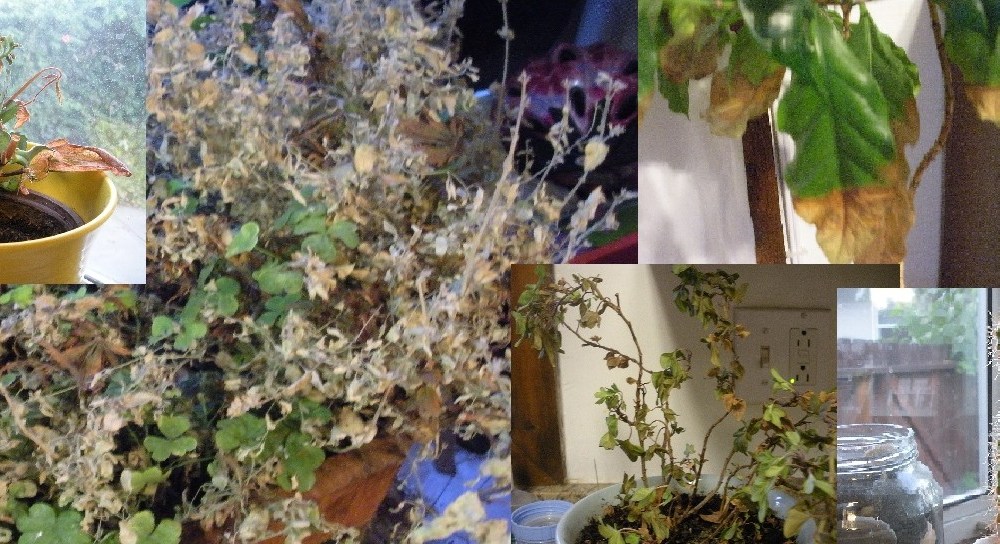
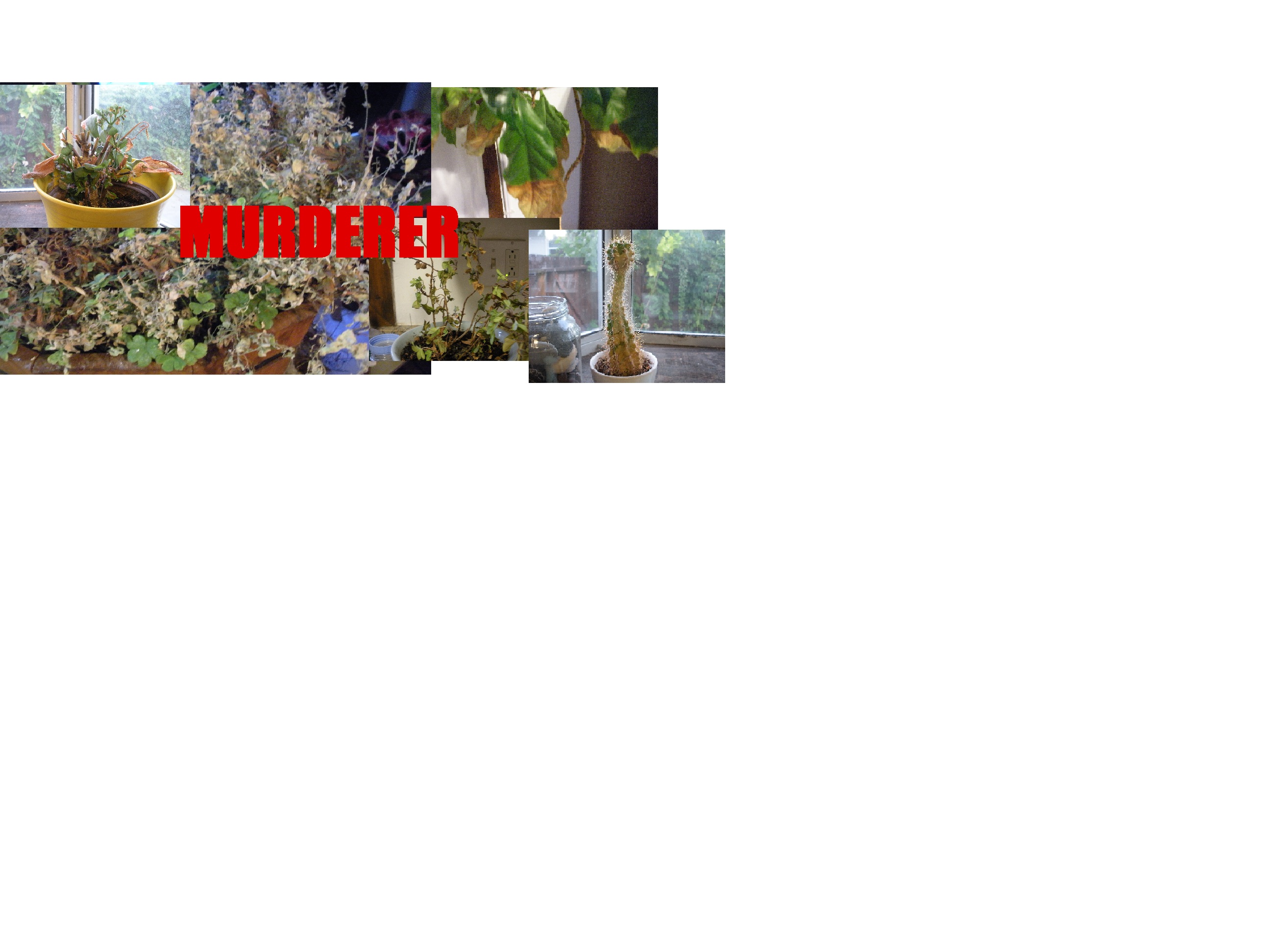
But this post isn’t about metabolism. It’s about houseplants. And how, back when I was in college, I loved them and I could grow them and keep them and they were just lovely little points of green in my life. I even talked to them because I read somewhere that it helped them thrive. Of course, back when I was in college, I was in the Bay Area, and not in the Central Valley, which is basically a hair dryer and not conducive to growing much except cacti and tomatoes. When I moved back to the Hair Dryer, all my favorite plants died. I’ve replaced them with a few others, but now they’ve gotta compete with kids.

Apparently in my house it’s survival of the whiners, and guess what: houseplants don’t whine.

I no longer talk to my houseplants, but I think they are talking to me. Their message is loud and clear.