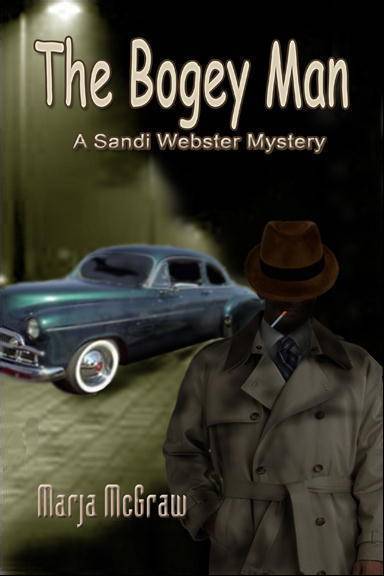
 This week’s NiFtY Author is none other than Marja McGraw, author of the Sandi Webster mystery series. Now she’s branching out into a new series, The Bogey Mysteries, which also promises to delight readers. Details on Marja’s books, as well as her thoughts on research, writing, and how pets enrich a story, can all be found below!
BH: What’s your one-paragraph pitch for the latest novel in your Sandi Webster series?
MM: Imagine you’re a young, female P.I., it’s late at night and you’re watching the motel room of an errant husband. Surveillance can be so boring, you think to yourself, until the angry wife shows up and blows your cover, and the husband comes after you. Now imagine that Humphrey Bogart, who’s been gone for many years, comes to your rescue. Huh?
BH: How many books have you published, and which is your favorite?
MM: I’ve published four books in the Sandi Webster series, one stand alone book, and the first book in a new series (The Bogey Mysteries) is due out before long.
 Hmm. My favorite would probably be The Bogey Man, because not only was it fun to write, but I was able to research and use a lot of 1940’s slang. Chris Cross, whom Sandi refers to as the Bogey Man, really wants to emulate Bogart as he was in his private investigator roles in the movies. Also, the new series is a spinoff from this book, which is opening new doors for me.
BH: Tell us a little bit about Sandi. What makes her unique and engaging as a series character?
MM: Sandi is relatively young and a little naïve for a private investigator. She tends to romanticize her job, which isn’t very realistic. She grew up watching the old P.I. movies, and she’s tried to model herself after the vintage gumshoes. Her partner, Pete, balances her attitude with his own ex-cop demeanor. She has an overbearing, menopausal mother who inadvertently teaches her about being tough. She’s constantly growing and changing as a character. She often feels she has to prove herself to people because of her naiveté, and she comes up with some fairly unique ideas in times of stress and danger.
BH: In a conversation with a friend recently, we discussed how some famous authors (unnamed for purposes of not slinging mud) have trouble keeping their series going for too long because eventually the hero’s development stalls. Do you have any tricks to share on avoiding that trap?
MM: What can I say? I’m mumble mumble years old, and I’ve never stopped changing and growing. Consequently, I try to fashion my characters to follow real life development. Circumstances change us on a constant basis. So I guess my trick would be to take a good look at real life and create circumstances in the stories in order that the characters may grow.
BH: Your novel A Well-Kept Family Secret departs from your other Sandi Webster books in that it involves a hundred-year-old case. While doing the research, did you come up with any new details that changed the shape of the novel?
MM: Nothing that actually changed the story, although the history for that era was quite interesting. I was able to include some of it in the story (in small doses), and I think that enhanced it. The people and their lifestyles were interesting around the turn of the century. This story involved the old Red Light District in Los Angeles, and I found some interesting papers and maps. For instance, there’s a tax map that shows Ladies’ Boarding Houses in Chinatown, and those were actually the brothels – so even maps helped.
In 1994 I read an article in the newspaper about the water district doing work on the parking lot at Union Station in downtown L.A. In the process they uncovered portions of the old Red Light District, including outhouses, which is where a lot of items were disposed of. I contacted the archaeologist who handled the project, and he supplied me with invaluable information.
Why was I so interested in this period? Because my great-great-grandfather was one of two men who ran the real red light district. I grew up hearing stories about him, what he did, and about a buried treasure attributed to him and his brother.
BH: Do you have any other projects planned?
 MM: As I mentioned, the first book in a new series will be out before long from Oak Tree Press. I’m pretty excited about it. Bogey Nights was a lot of fun to write. It’s probably a little more mature than the Sandi Webster series, because the characters are married and have a son, and I found a whole new type of humor in their lives. I’m working on the second book now, and the working title is Bogey’s Nightmare.
BH: I read one of your blog posts on how having pets in a story “enhances the storyline.” Could you elaborate on that?
MM: Absolutely. I’ve included canines in both of my series, so I’ll stick to dogs in my answer. A dog can play almost as big of a role as a human character if you’ll let it. They’re smart, funny and terribly loyal and protective. They’ll do anything in their power to keep their human happy, although they can be the cause of some angst, too. A dog can even be a possible victim or a hero, and they can provide comic relief. They can demonstrate hurt feelings, joy, sadness and grab your heart in the process. They can enhance the story without simply being filler.
I recall one of the lowest times in my life when I was sprawled out on the bed, crying my eyes out. My dog jumped up with her (gutted) teddy bear and laid it on my arm, and then snuggled up next to me until I’d cried it all out. Take note: the dog comforted me, while people kept their distance. I also recall another dog who became very frustrated with me because he thought someone was knocking at the door every time there was thunder during a storm. He couldn’t seem to figure out why I wouldn’t see who was there.
BH: What is your writing schedule like?
MM: I generally work for four to six hours in the morning, when I’m the freshest. I’ll work anywhere from five to seven days a week. Most of my stories take six to nine months to write. I write, let it sit and then go back and read it again, making changes where necessary. I have critique partners who read the stories two chapters at a time, and when they return the chapters, I rewrite again. When the story is done, I go back to the beginning and read it straight through, making more changes and edits.
In the meantime, I update my website every few months, and I try to keep my blog (located on my website) updated weekly, with a new one appearing on Sunday or Monday.
I critique for the same people who look at my work, review a book every once in a great while, and try to put together a marketing plan as best I can. Promote, promote, promote.
My writing schedule includes a lot more than just writing.
BH: What does your workspace look like?
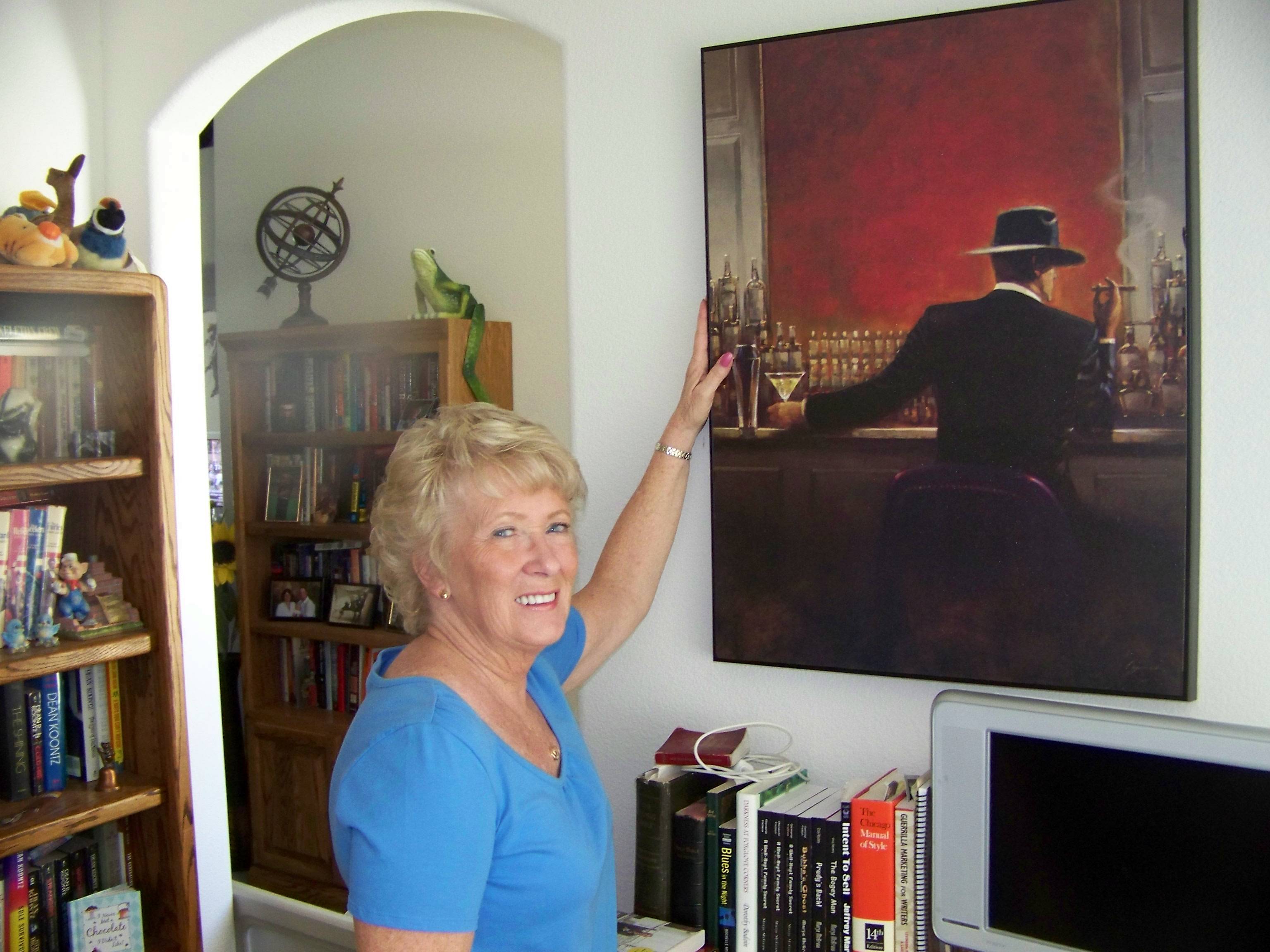
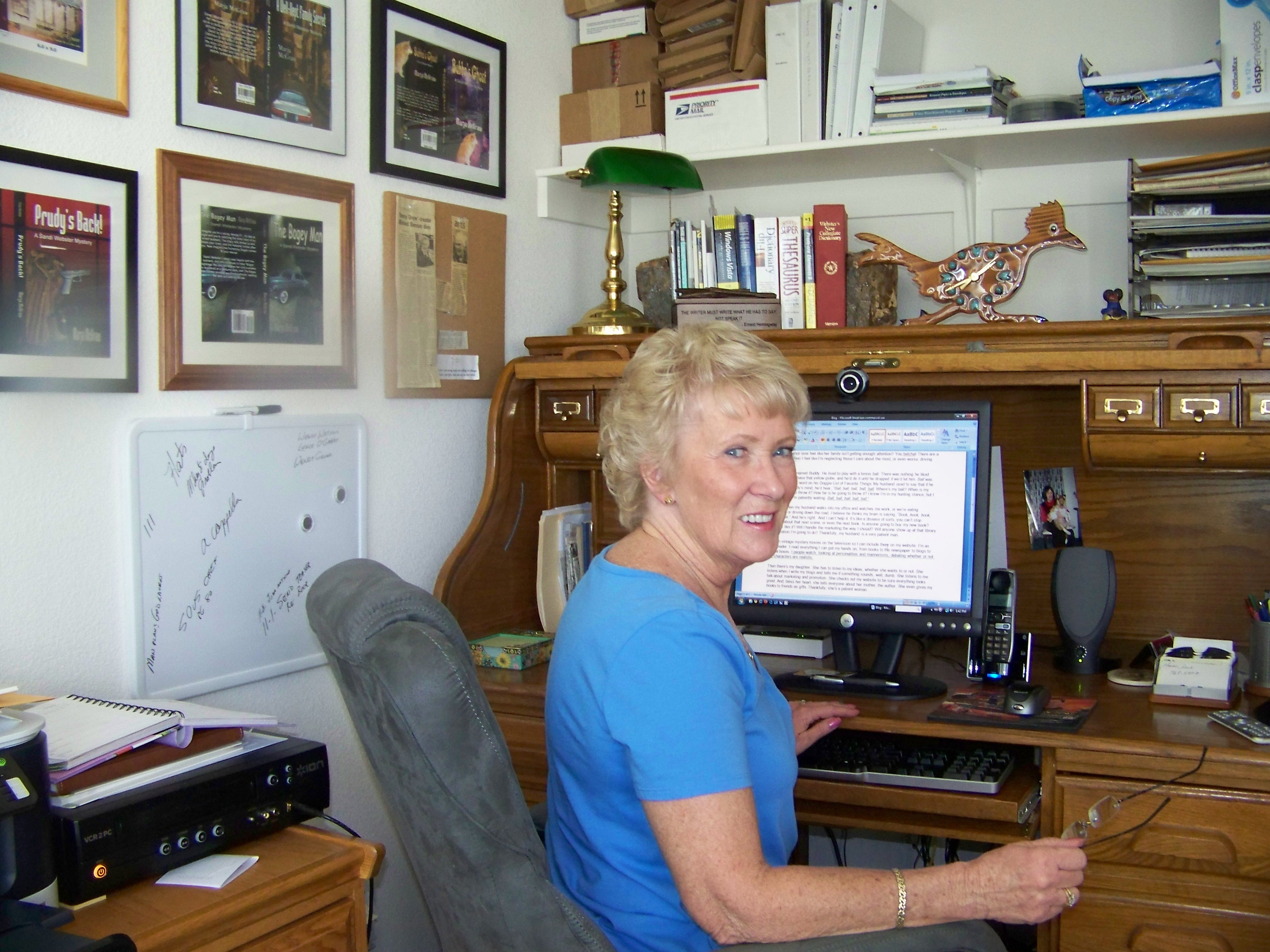
 MM: When we had our house built, I had them turn the third bedroom into an office. I have an oak roll top desk that fits nicely into what would have been the opening for a closet, and the closet shelf holds my paper and other supplies. Copies of the book covers adorn the wall by my desk along with a photo of Humphrey Bogart, and I have bulletin boards that I can jot quick notes on, so I won’t forget ideas as they come to me. For my birthday, my husband bought me a painting of a man wearing a suit and fedora, sitting at the bar in a lounge. The view is from the rear and you can just barely see the man’s jaw line. He has a martini in one hand and a cigar in the other, and it could most definitely be a picture of the Bogey Man sitting at the bar in the lounge part of the restaurant he and his wife own.
Other than that, my workspace is pretty much a mess.
BH: Sounds like my workspace. Oh, I’ll admit it. It sounds like my whole house. What is your favorite book on the craft of writing?
MM: I can’t honestly say I have a favorite. I’ve read several, and I pick and choose what I need from each of them.
BH: What is the best writing advice you’ve received?
MM: Never give up and keep striving to make your writing cleaner with each read through. And grow a thick skin, because not everyone will like what you write. (Nah, really?) Always, always, remember your manners and treat people the same way you’d like to be treated. Lastly, and most importantly, don’t let family and friends fall by the wayside because you think you’re too busy for them.
BH: Any words on advice to aspiring writers for keeping the hope alive?
MM: If you honestly believe you’ve written a good book that people will enjoy reading, never give up. Read some of the stories behind successful authors, and you’ll see that some of them went through a lot of hoops to get where they are now.
The Sandi Webster series is published through Wings ePress, and I’ll always be thankful to them for giving me a chance.
Now let me tell you my success story. I’d submitted Bogey Nights to Oak Tree Press, and they liked it, but they wanted to meet me. They were attending a conference in Las Vegas and asked if I could be there. Ha! Like I would have missed that opportunity. They offered me a contract right there, on the spot, something they’d never done before. Sometimes good things happen when you least expect it.
BH: That’s the kind of story that keeps us unpublished authors type-type-typing away. Thank you, Marja, for stopping by and answering some questions for us!
I don’t know about all of my writer and reader friends, but for me, it’s inspiring and informative to hear responses like this from other authors. The success stories are great because they get me movin’ and hopin’, and the advice is always sound, coming from other professionals in the trenches…er, I mean field.
To learn more about Marja and her books, you can visit her website by clicking here.
 Vintage Veronica takes place in one of the coolest settings imaginable: the Clothing Bonanza. It’s a humongous building full of vintage clothing, decorated with (cool) old crap (like an old motorcycle and a VW Bug). Veronica has the great fortune to get a job taking in and processing the consignments, and she often finds amazing articles of clothing. Unfortunately, she can’t wear most of these clothes, as she’s too big. Fat, in her words.


 Beth Hull