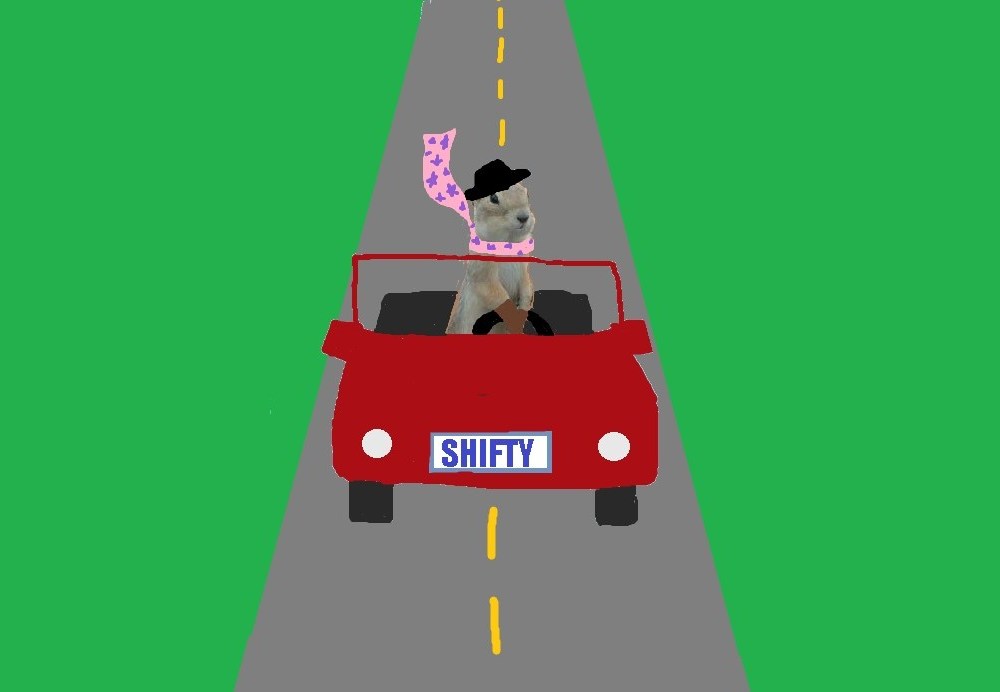
5 Reasons Why Writers Shouldn’t Drive
Woo! Back from my Social Media Blackout. It was very refreshing. While I’m happy to be back and check in with people, I’m coming away from this with a definite desire to set more limits on my social media use.
A comment a writer friend made got me thinking of…this. Blech. Let’s just jump in, shall we?
1. Fictional Worlds I.
You may think the writer present, noting details about her surroundings. This happens on occasion. But writers are often off in alternate realities. Another time, another place. With other people. Figuring out a plot issue, or having imaginary conversations with talkative characters (SHUT UP!). Suddenly the writer has missed several turns. She finds herself somewhere in Canada when she was trying to get to the corner store (in California) for chocolate.
2. Fictional Worlds II.
There is another, more secret kind of fictional world experienced by that of the writer (indeed, of any daydreamer). That of the fame and fortune that will, of course, inevitably be given the writer upon completion of her book. Imagining various scenarios in which she will be interviewed, how she will spend her humongous paychecks, where in Italy she plans to buy the villa – these thoughts are known to especially distract the writer whilst she drives to whatever mundane location happens to be on the day’s itinerary.
3. The Big Idea.
Ever have a sudden bolt of inspiration that just MUST NOT BE FORGOTTEN? I have. Usually when I’m drifting off to sleep, taking a shower, or driving down the highway. It’s pretty easy to deal with. You stop what you’re doing, grab a pen and paper, and jot down the big idea (or super important rhyming couplet, as was a recent case for me). When driving, this is very important: PULL OVER FIRST. Sometimes pulling over isn’t possible. In which case you’re stuck either a) trying to fumble for a pen and paper and write something legible while driving 70 miles per hour (NOT RECOMMENDED), or b) repeating the bit of dialogue (or rhyming couplet) to yourself over and over until a proper pull-over place is found (NOT FUN BUT BETTER THAN DYING).
4. Words.
Words can be a problem. Specifically, for me, certain traffic directives can either totally get on my nerves, and/or provide more than a years’ worth of imagined debates. Take, for instance, SPEED LIMIT 25 WHEN CHILDREN ARE PRESENT. It’s so ambiguous! Where do the children have to be, to be considered “present”? On the street? Behind the fences at the school? In their houses? In my car? Also, if you see a child, you slow to 25, I was told. What if the 25 mph zone continues for quite some time but there are NO other children? Can you speed up again? People frequently do. My latest beef with that particular directive is I’m trying to grammatically figure out if I have to slow down when there is only one kid. Child. Singular. Or if I have to see two kids (children, plural, as the sign says) before I must slow to 25. Either I’m distracted by the words themselves, or trying to convince an imaginary traffic cop, judge, or my sheriff brother of why I did the right thing. (Lest anyone think I’m an irresponsible driver, let me assure you: if I see a kid, I slow to 25 until I’m all the way through the school zone, end of story. I just like to argue with myself…and the people in my head.)
5. The Thoreauian Desire.
Sometimes I’ll be in the middle of a project, or trying to work out a plot problem, and I just know that if I could get away for a couple days and have total solitude, I could get the thing figured out. It’s sometimes a real danger that on a solo trip to Target, I might take the freeway by mistake and wind up in a nice hotel two towns over with my cell phone turned off. This hasn’t happened…yet. Cancun is also a real possibility. I bet there are margaritas there.
(Total sidenote: Does anyone else ever feel like a total cheater when referencing classic novels they have not, and never intend to, read?)

 Beth Hull