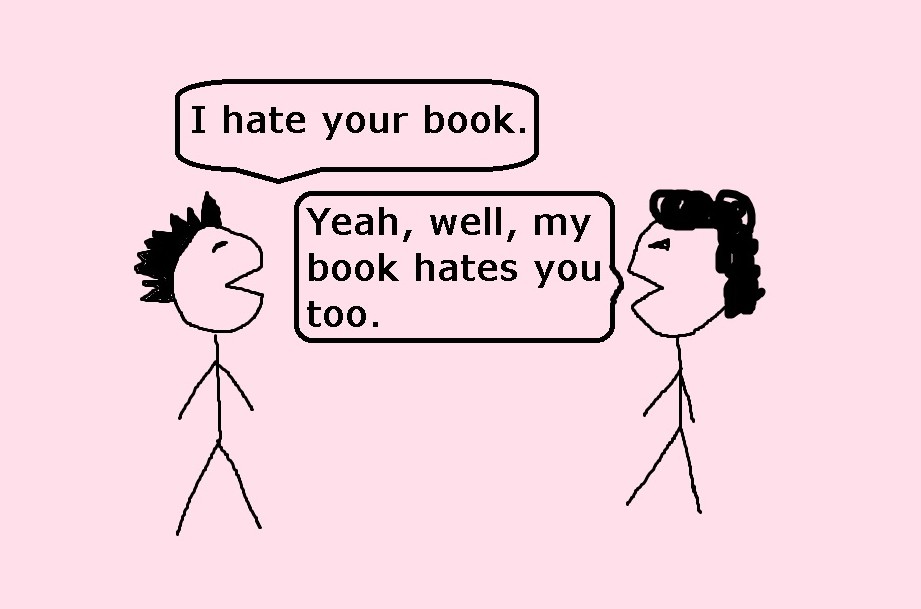
How to Give Good Critique
A friend and critique partner of mine (and she knows who she is, so this isn’t a series of hints for other crit partners!) gave me some feedback on my story a few months ago. I was quiet for a bit, because while she had some great ideas for my story, some of them came off a bit harsh. We talked about it, and she asked me for some advice, because she’d had trouble with hurting crit partners’ feelings in the past. I went through her critique line by line, and came up with a list of suggestions. She told me they were helpful, and gave me permission to share them here.
Have a sandwich
Place negative/constructive criticism in between positive criticism. What I heard about “the sandwich method” is that it helps a critique-receiver feel relaxed at the beginning, instead of under attack. And then, after all the negative criticism, the writer’s ego is reassured with more positive. [NB: Be sincere and specific, otherwise the positive criticism will sound like token positive criticism, and we’re all smart enough to see that for what it is: BS. Being positive can sometimes take a little digging.]
Embrace brevity
State your point, and move on. When something’s repeated it can make the writer doubt the critic’s belief in her intelligence. Also when something’s repeated, it can sound angry.
Embrace neutrality
I try (but don’t always succeed) in making the critique more about characters and story and less about what the writer is or isn’t doing. Homes told me that in scientific manuscript critiques, they’re supposed to say, “This doesn’t work because…” When in doubt, I pretend I’m a scientist.
Be positive
Saying something like, “Your main character makes me want to shoot myself in the bleeping head” only makes a person feel crappy. It’s best to phrase things in the positive, or phrase them as questions, like, “If Amalia instead first learned how to defend herself, she’d be a lot more sympathetic to the reader,” or “What if Amalia were to learn self-defense? Do you think it would make her less passive, yet still feisty and a person we’d cheer for?”
Be positive II
I leave out the doom and gloom messages – and the long introduction. Every time the writer hears, “You’re going to hate me for saying this,” or “this might be hard to hear,” or other statements of that ilk, it makes her worry more. The longer the introduction and disclaimers go on, the more impatient and defensive she could get.
On taking the wheel
It’s okay for some critique partners to write out short bits of dialogue or sentences for each other. I actually enjoy it. It’s good to check, though, because not everyone will be okay with someone else putting words in their characters’ mouths.
On suggestions
I’ve heard different things about suggestions. Some people say that a good critique partner only points out where something is off, and allows the writer to come up with her own fixes. Personally, I enjoy suggestions, but you may want to make sure they don’t sound like orders.
On nitpicking
I generally don’t correct punctuation/grammar/typos unless the piece is, according to the author, ready for submission. On earlier drafts, if I catch something & it’s easy to fix, sometimes I do. If I see a recurring grammatical error, I will usually call the writer’s attention to it. But little nitpicks seem like a waste of time if the story might change dramatically – entire sentences, paragraphs, pages, and chapters can be replaced or deleted, and then I’ve spent time correcting punctuation on segments that are no longer even in the story! Some people, however, cannot resist editing for grammar etc. To each her own.
*
I’m looking at these tips as a list-in-progress, so please, chime in below if you have a tip I haven’t thought of, or if you think something in my list should be adjusted/clarified.
Also, while it’s super-important to “give good critique,” it’s equally important to be a good critique receiver. Maybe I’ll write about that later, so if you have an idea you want to share, let me know and I’ll give you credit in the post.
Recommended reading: The Writing & Critique Group Survival Guide by Becky Levine.
ETA 4/10/12: Author and former literary agent Nathan Bransford just published this post on the Ten Commandments for Editing Someone’s Work. Good suggestions, all.

 Beth Hull