NiFtY Author: Matt Coonfield

I have a very special NiFtY Author Interview for you today, featuring one of my favorite people in the world: my little brother. He hasn’t always been my favorite person. There was this time once when we were playing Legos and he was obviously wrong about something, and we weren’t very good friends right then…but I digress.

Here’s his interview. You’ll laugh, you’ll cry, you’ll throw tomatoes and have to clean off your computer screen. Good luck with that.

BH: What’s your one-paragraph pitch for your work-in-progress?

MC: I don’t want to give away too much. I am actually quite paranoid. The short version is a young man named Ray starts a civil war in the ghost world in an odd and adventurous way.

BH: What was the biggest challenge in finishing your first draft?

MC: Honestly my biggest challenge has always been me. I am a big lazy hurdle that I just can’t jump. I don’t like to write when it is hard, when I have to grind it out. Generally I only like to write when it is flowing. Anyone who writes knows what I am talking about. When you can churn out twenty pages a day and the only reason you stop is fear of carpal tunnel. When your thoughts are practically jumping on to the paper for you. That is when I like to write. When this doesn’t happen I start a new book. Oddly I have never finished one until now.

BH: Can you compare Ray, the main character in your work-in-progress, to anyone you know in real life?

MC: I guess parts of him are me of course or parts of me if that makes sense. I’m not schizo or anything but I like to pretend I am Jared from The Pretender. I have hidden Matt compartments that I draw from and one of them happens to be a teenage ghost-hunting ghost, conveniently enough.

BH: I understand you’re working closely with somebody else on this project. What is his role in your project?

MC: As I mentioned earlier I am notoriously lazy when it comes to writing. My partner’s name is Don and he is basically my dentist. That is to say he pulls teeth. We have only been working together a short time and I am considering buying another cell phone and not giving him the number. Other than that he does all the things I hate: paperwork, typing, forms, queries. Once he offered to paint my garage if I promised to write more.

BH: What is your experience like, working with another person? What are the pros and cons of this arrangement?

MC: Well Don can be quite persistent sometimes calling me four or five times a day. I had to get used to it at first but we’ve come to an understanding now. He has given me 100 percent artistic say so, which was a condition when we first started, but even then sometimes he feels adamant about something and I hate to put my foot down too much. There is one scene in particular in the book that he wrote and it makes me leery but I have let it go so far.

BH: One of the things about your writing that impresses me is all the crazy ideas you come up with—ideas that you can make work. Where do you get your ideas and inspiration?

MC: Well… My faith is definitely an inspiration to me. Really I don’t think I could write without the Bible. Not that my stories are Christian but the right and wrongs for me come straight from the source. After that I steal them. I guess it sounds weird to say that right after my Jesus plug but it is honestly what happens. I always read things, good and bad, and I can see the improvements that need to happen. I see a tweak that if the author had seen could have changed his whole piece for the better. When I find those tweaks early enough in a book or combine them with other tweaks I get really excited about what I can do with it and when I get excited….

BH: What is your writing schedule like?

MC:  I try to fit it in between reading and Pokemon but too often I am forced to combine two of the three to make up for time.

BH: How has your writing changed—either the scheduling or the experience itself—after becoming a father?

MC: My scheduling has definitely become more intense. The very reason I had agreed to work with my coauthor in the first place is money. I need it. I can’t sell a book if I don’t finish one so I brought on Don to help me finish my books. The experience hasn’t changed in the least, I just have a deeper well to draw from.

BH: What does your writing workspace look like?

MC: My writing workspace looks suspiciously like the cab of a Nissan Frontier. Much to the chagrin of my typist most of my good ideas come when I should be paying attention to the road. This makes for some very peculiar handwriting and possibly the next unfinished series. We all know how well it worked out for the Canterbury Tales. Don’t judge me.

BH: Just remind me to avoid the road when inspiration hits. What is your favorite book on the craft of writing?

MC: A notebook.
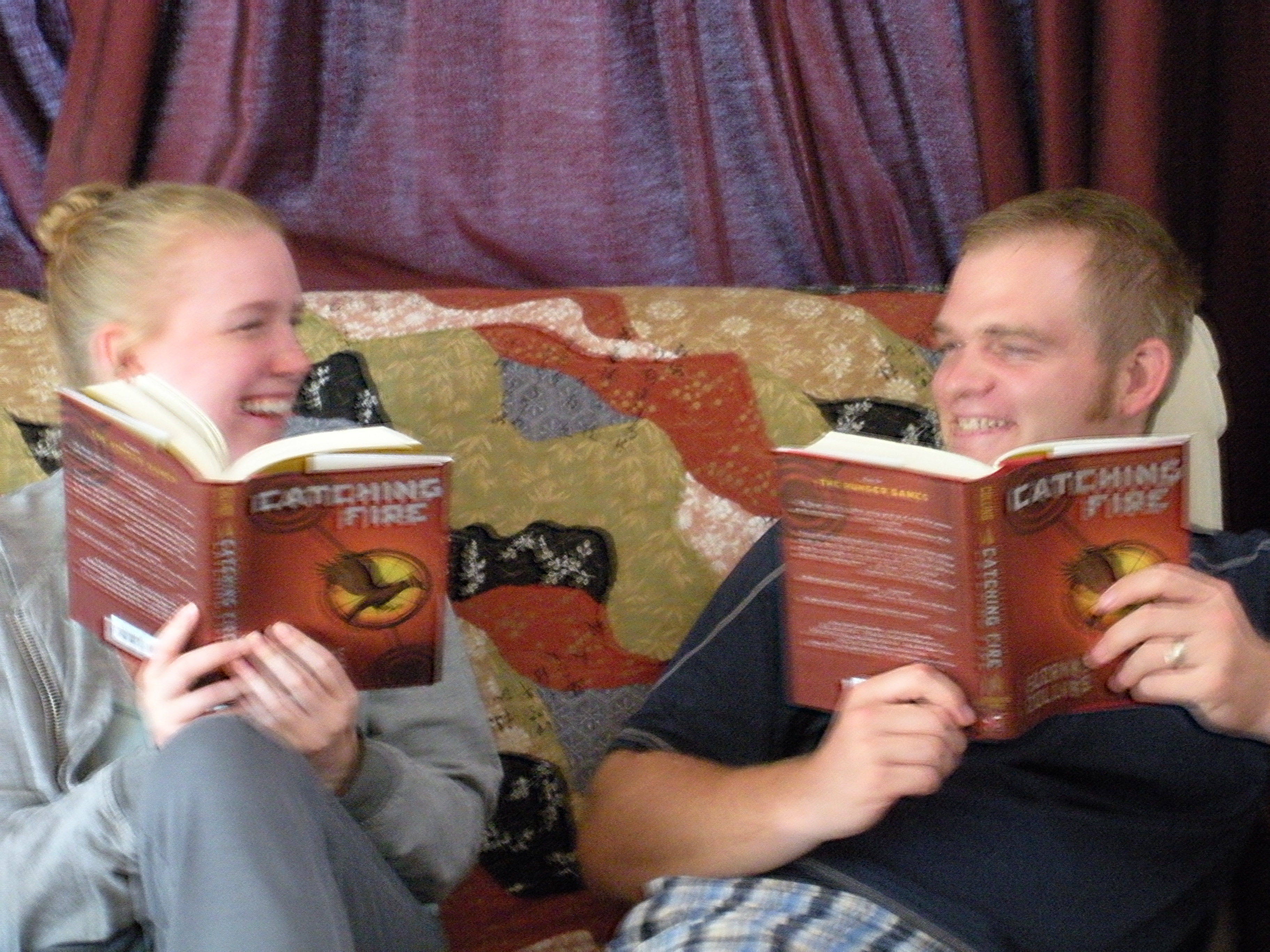
Beth and Matt Read Catching Fire

BH: You told me recently that Suzanne Collins’s The Hunger Games is not your favorite book, but it made it into your “top ten.” What is your Top Ten?

MC: The Bible, X-Men, Dracula, Death in the Long Grass, The Night the Bear Ate Goomba, Yvain, Harry Potter, Hunger Games, The Great Divorce, God’s Grandeur.

BH: Twilight didn’t make it into your Top Ten, but we both admit we enjoyed it. What, exactly, is so compelling about that Twilight series? Why are these books so popular, in your opinion?

MC: Stephenie did something real special and it took her like a whole month. She tapped into something that was important to young women and made it interesting to young men. She took elements of comic books (which is why it translated so well to graphic novel), Fabio, and Mythology and made it her own. She didn’t follow rules, and she didn’t heed the pressure to omit her beliefs, i.e. her morals. I don’t think it was the best writing in the world but I loved it and I respect what she did… except for the huge let down in the end. That pissed me off but since the plot was ripped off another story what can you say?

BH: What is the best writing advice anyone has given you?

MC: Write down what you are feeling now matter how silly it sounds. It will make sense to everyone.

BH: Why do you want to be published?

MC: I would like to be superficial and say it is to finance my laziness but the truth is I want to be able to talk about it with someone, someone who liked what I wrote and who wants to talk with me about it.

BH: Who is your real-life writing role model? [Hint: the answer should be someone you grew up with. Who maybe lived down the hall from you. She had a pink room for a few years. And a cat named Apricot.]

MC: C.S. Lewis, Stan Lee, and Patrick F. McManus. I hate to admit but my sister’s love for all things academic never made sense to me as a child. I get it now and all those years may have rubbed off on me a bit.

BH: Eh, that’s practically saying that your sister taught you everything you know. Any words or advice to other writers for keeping the hope alive?

MC: Give up. The market is closed. You can’t do it.

BH: Hmm. Yep, that’s my brother.

Thanks, Matt, for the fun interview!
Script-Side Friday

Short version: still revising Savage Autumn. I feel kinda like Mr. Mutant-Potato Head up there.

Long version….

Either I talk about my writing too much, or I don’t have much of a life otherwise (probably both), but the first words out of my friends’ mouths (after the generic hellos how are yous are out of the way) are: “How’s the writing going?”

I know I get all animated when I talk about writing. My writing, or anybody else’s, or the publishing world in general. It’s fascinating to me. And I’m not always good about pretending the same level of interest in anything else. There is probably a personality disorder out there to describe this.

Anyway. Long intro. Moving on. What’s going on with my manuscript?

For awhile there it was in mortal peril. I joined a critique group that had one member hating on my manuscript. Her points were fantastic and helpful, actually, but the delivery could have used some work. She’s not in the group anymore, but I needed about a week to nurse my ego and think about the characters and manuscript. Her comments, and the feedback from other group members, has inspired some rewrites and revisions.

Two other current critique partners have swapped manuscripts with me, and their comments have also been crucial. The whole experience reinforces that whole “writing is not a solitary effort” mumbo jumbo that you read at the beginning of acknowledgments pages (I read those. I really do).

Many of these writer friends have read more than one version of the same scene. All of them have been  spectacular in putting up with my indecisiveness, my questions, and my sometimes bitchy sensitivity.

Because Savage Autumn is nowhere near publication, and I read acknowledgments pages all the time, here is an toast to my critique partners and writing group friends:

Thank you to Seven, Jo, Pam, Seth, Robin, Helen, Mark, Jeri, Kary, Pat, Margaret, Cheryl, Theresa, and Colleen. And another thank you to my friends and family who have read the manuscript in its parts or entirety – whether you’ve given me feedback or not. Finally, thank you to the friends and family who haven’t read the manuscript but continually ask me how it’s going.

Total, abrupt subject change….

Update on next-door dogs: Yappy #3 lingers. Barks. Lingers.

Barks.

Dying for a Date by Cindy Sample

In this post, literary agent Nathan Bransford urges (begs, actually) authors not to ask whether or not we like a book, but to answer this question: did the author accomplish what she or he set out to do with her or his book?

So. Did Cindy Sample succeed in creating a gripping, humorous, and romantic mystery? The short answer: yes. I laughed, I didn’t want to put the book down, and I thoroughly enjoyed myself while reading it (even without an air conditioner. More on that later).

The long answer: there were two small problems. And I’m being extremely nitpicky here. My first issue was with the details, and this is a personal preference. In a few places, Sample provided details that I didn’t care to know. Remember I’m nitpicking here, so my example is this: the color of the daughter’s backpack. It really made me pause and ask myself: Is this relevant? Answer: Not really. But this happened maybe five or six times in the whole book, and some readers feast on those kinds of details, anyway. Nitpicking. Personal preference.

The second issue was I found it hard to believe the hottie detective (who I really liked, by the way), would put his career in jeopardy to pursue a romance with a murder suspect (i.e. the main character). However, Joe Morelli constantly does the same thing with Stephanie Plum, and Janet Evanovich’s readers don’t complain. And really, so much else is moving the plot along that I didn’t have time to worry about this until after I read the book.

More on what I liked: the main character. Laurel McKay is funny and real. I could identify with her and loved her voice, her sense of humor, and the hilarious antics she gets herself into. Sample is dead on when she describes Laurel as Stephanie Plum as a soccer mom. There’s a great scene involving a clown suit and that’s all I’ll say here.

The best thing about the book: I literally couldn’t stop reading. Even when our car’s air conditioner disintegrated in eastern Nevada at 3 p.m. on our way to Colorado and I was so bitchy and uncomfortable I would have tossed any entertainment aside in favor of napping – I read on. Great, gripping reads stand the test of a disintegrated AC.

I’m looking forward to the next book, Dying for a Dance, because I want to see more of the minor characters too: the poker-playing daughter (without her green backpack), the best friend, and some others. Oh, and especially Detective Hottie. I mean, Detective Hunter.

So, did Sample accomplish what she set out to do with Dying for a Date? Most definitely. And hey, guess what: I liked it, too.

Feel free to check out my interview with Cindy, if you haven’t already.

Update: Cindy alerted me to a total review faux-pas in how I hinted something about the ending. If you read an earlier version of this review, I apologize! And apologies to Cindy as well.

I Heart You, Georgia

I haven’t yet reviewed an entire series on this blog, but it’s slooooow going through my current (snooty-sounding) read, The Grand Permission: New Writings on Poetics and Motherhood, so I’m stepping back in time here.

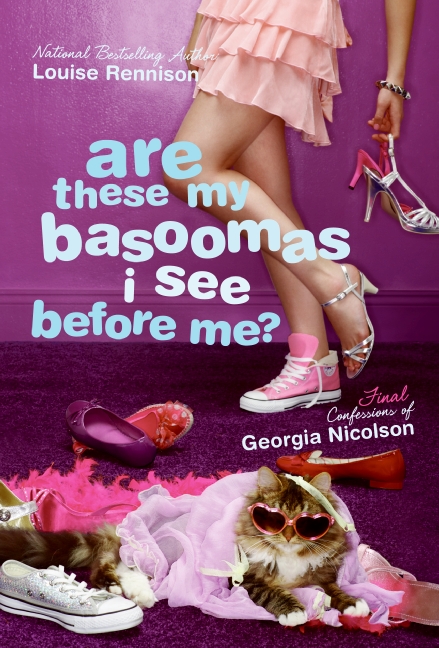
Last October, Louise Rennison published the last installment of her Georgia Nicolson series. The one with all the extremely weirdly titled books, the kind that are hard to ask book store associates about over the phone because they keep saying, “What? What? Can you repeat that? Can you spell that? Did you say ‘basoomas’?”

Yes, you did say “basoomas.” This is a series of ten young adult books featuring the hilarious heroine Georgia Nicolson, a young woman with very little tact and poise and very a lot of hormones and hijinks. She blunders her way through manipulating her parents, butchers French and German phrases on a regular basis, has a huge case of potty humor, and alienates her friends and boyfriends with almost amazing regularity.

Georgia’s voice is the absolute best part of the books. The novels are written diary-style (I’m sure there’s an academic term for that kind of novel, but as Georgia would say, “Qu’est-ce que c’est le point?”). Her adoption of French and German phrases, as well as her clique’s slang creations, only add to the humor. Add that to the run-of-the-mill linguistic differences between the US and British lexicons, and you will need the glossary provided at the back of each book. But unlike a textbook glossary, you will enjoy reading it, because Georgia is just as funny there.

The girl has her flaws, though. She’s self-absorbed, disrespectful, and can be cruel to her friends on occasion. She makes bad choices. She buys too tight shoes. She spies on her nemesis, Wet Lindsay. She’s a boyfriend stealer. However, she grows, learns lessons, kisses a bunch of guys, and finally – FINALLY! – figures out the one who is right for her. (The last three books I was practically screaming at her as I read: “It’s ____! Stop messing around, you horny minx!”)

The series goes on a bit longer than it has to, and the last few books end on cliffhangers which is a Big No-No in my House Rules. [I should clarify: The very last book obviously does not end on a cliffhanger.] However, the books are funny, fast reads. Very light. They never fail to cheer me up.

If you’re interested in reading the series, here’s a list of the Georgia books in chronological order (US titles):

1. Angus, Thongs, and Full-Frontal Snogging

2. On the Bright Side, I’m Not the Girlfriend of a Sex God

3. Knocked Out by My Nunga-Nungas

4. Dancing in My Nuddy Pants

5. Away Laughing on a Fast Camel

6. Then He Ate My Boy Entrancers

7. Startled by His Furry Shorts

8. Love is a Many Trousered Thing

9. Stop in the Name of Pants

10. Are These My Basoomas I See Before Me?

For more information on Louise Rennison’s Georgia Nicolson books, you can visit the official website here. Happy reading!

NiFtY Author: Cindy Sample

Cindy Sample doesn’t quite fit the mold for my typical, Not-Famous-Yet author interview. For one, she’s jumped ahead of the rest of us and actually published her book, and two, she’s a romance/mystery writer. She’s also funny – much funnier than I am – so without further blather, here’s the interview!

BH: So, published! How does it feel?

CS:  It feels wonderful.  Sort of like giving birth to my children.  It just took longer.

BH: Tell us a little about your book, Dying for a Date.

CS:  Dying for a Date is a humorous romantic mystery about a single mom who gets talked into joining a matchmaking service called “The Love Club,” the safe alternative to on-line dating. I discuss the trials of dating as a single mom, and throw in a few dead bodies just to keep it entertaining.

BH: Laurel McKay, the heroine in Dying for a Date, sounds funny, charming, and feisty. Is she based on anyone you know in real life?

CS:  There is a slight possibility that my protagonist is based on me twenty years ago.  I was 39 and a newly single working Mom as well.

BH: What was the greatest challenge in finishing Dying for a Date and getting it ready for publication?

CS:   The hardest part was letting it go and knowing I could never revise one more word again.

BH: Can you tell us a little about your path to publication? Did you get an agent first, or did you go directly to a publisher?

CS:  I did get an agent and we had great responses from NY publishers but February 2009 was not a great time to sell a mystery series from a debut author.  I ended up receiving offers from two smaller publishers.  I liked the feedback that I received from the other authors published with L&L Dreamspell and chose to go with them. It’s been a great experience working with my publisher. They did a great job of editing and I love the cover they designed.

BH: Where do you get most of your ideas and inspiration?

CS:  I seem to have an incredibly fertile imagination. Right now I have more plot concepts than I would ever have time to complete in this lifetime. An example would be one time when I was in a spa and they asked if I was allergic to shellfish.  Minutes later I had concocted a plot where I killed someone allergic to shellfish with a seaweed wrap.  Yes, I know I’m kind of strange but they say mystery authors are very well balanced because we just off the people who annoy us on paper.


BH: Are you currently working on another project, or are you focusing more on publicity for Dying for a Date, or something else entirely?

CS:  Right now I’m marketing and writing.  I’ve been planning events all over the 4 county area.  I’ll be visiting several local libraries in the area and giving presentations along with several other authors from Capitol Crimes, the Sacramento chapter of Sisters in Crime.  We’re a group of mystery writers (published and pre-published) as well as mystery fans. I’m also attempting to squeeze in time to complete the sequel, Dying for a Dance, a murder mystery that takes place in the glamorous world of competition ballroom dancing.

BH: Do you have a set writing schedule, or are you more of a “when the mood hits” kind of girl?

CS:  I am a very social person so the most difficult part of writing for me is to sit my butt down in my chair.  What I’ve discovered works best is to block out an entire week and just write.  On those weeks I can start at 8 AM and work until midnight almost every day.  One of my friends refers to my rather unusual technique as binge writing.

BH: Binge writing – I love it. What does your writing workspace look like?

CS:  I have a beautiful office overlooking Folsom Lake.  The walls are crammed with books and photos.  But where I write is usually in the kitchen just because it’s cozy.  Plus it’s closer to my coffeepot.

BH: You’re the first mystery writer I’ve interviewed. Can you share anything that’s unique to the mystery-writing process?

CS:  A friend of mine who has authored over 40 non-fiction books and is working on her first novel says mysteries are by far the most complex books to write. You have to ensure that your clues are subtle yet give the reader the ability to guess who the villain is, along with red herrings to lead them astray.

BH: Who is your favorite author?

CS:   Too many to choose from.  Of the greats I think Leon Uris and James Clavell.  In the mystery/thriller spectrum, I enjoy Michael Connolly, Lisa Scottoline, and Robert Crais. In Women’s fiction Jennifer Crusie, Claire Cook and Jennifer Weiner are my favorites.

BH: How about your favorite book on the writing craft?

CS:   I have two full shelves of books on the craft of writing, particularly mysteries.  I think my favorite is Writing the Breakout Novel by Donald Maass.

BH: I’m already drawing comparisons between your novel and Janet Evanovich’s writing. Have you read her books? What do you think of them?

CS:  I love her Stephanie Plum series, at least most of the books. When I was pitching my book I used the pitch that my protagonist, Laurel McKay, was like Stephanie Plum as a soccer mom.

BH: One of your strengths as a writer is your sense of humor. Do you have any tips for other writers on how to develop humor in their writing?

CS:  For some reason whatever can go wrong normally does go wrong in my life and I learned years ago that the most annoying mishaps can usually be turned into a wonderfully funny anecdote. It’s rare for anything to bother me because I know that it will become an entertaining story down the road. Many writers keep daily journals. If you’re interested in incorporating humor in your work, jot down those things that strike you as funny during the course of a normal day.  You’ll be surprised how much material you end up with.

BH: What is the best advice anyone has given you with regards to your writing?

CS:   The three P’s which are persistence, persistence, persistence. My first version of Dying for a Date was at best, mediocre.  But after taking classes and attending mystery conferences, reading every recommended book on fiction, reading and analyzing the work of my favorite authors, and being persistent with my own numerous revisions, I’m thrilled with the published version.  It is an enormous amount of work to publish a novel but the joy it brings is unparalleled. Follow your passion, be patient, and definitely be persistent.

It sounds like there are two alternate P’s there: passion and patience.

Thank you so much, Cindy, for joining me for an interview. Free t-shirts to the studio audience! (Um, there is no studio audience. And no t-shirts.)

For more information on Cindy and her writing, as well as Where To Buy Her Book (so cool!), you can visit her website.