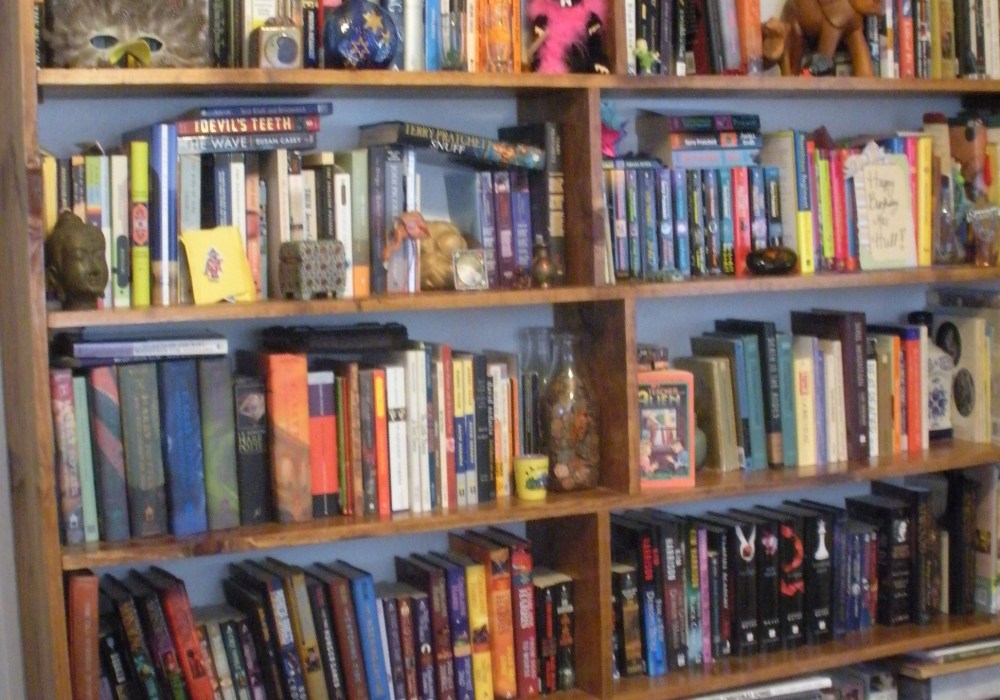
Home Library Challenge

How many times have you looked at the books on your shelf and thought, I should really stop buying books until I read the ones I have? If you’re like me, you think this all the time. I’ve expanded it to include, “I should really stop borrowing stacks of books from the library until I read the ones I have,” because I keep those library scanners going.

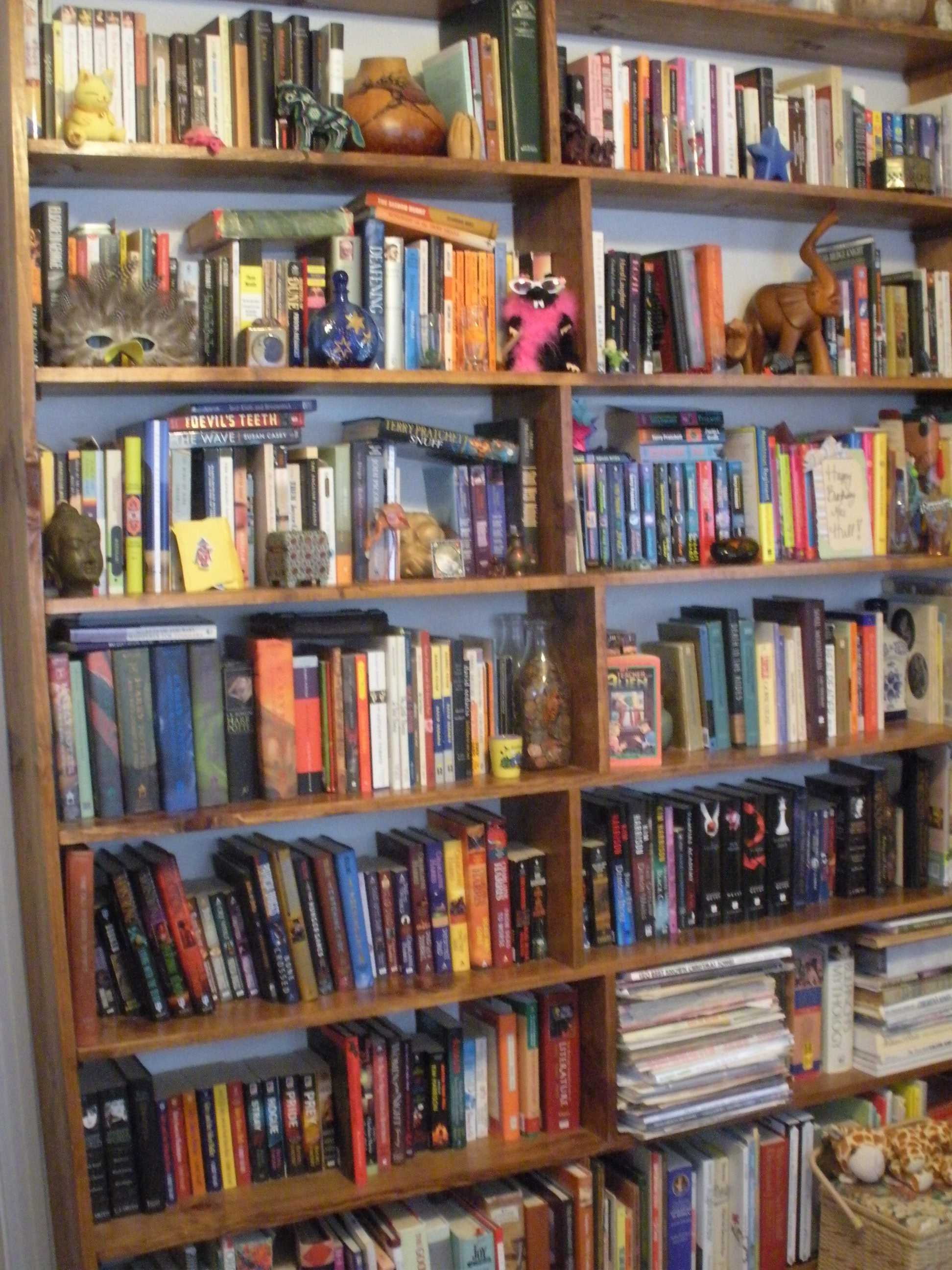
We’ve got a fairly largeish built-in bookcase (thanks Dad), and I’ve limited the books to fiction, other than the highest shelf and the lowest shelf (assorted classics in matchy-match binding on top; cookbooks (shudder) and gardening and some college literature anthologies on the bottom). So, my challenge:

I WILL READ – OR ATTEMPT TO READ – ALL THE BOOKS ON THAT BOOKCASE.

Do I need a timeline? It’s a big bookcase. But I have read a lot of them…at least half, I think. Well, let’s just see how far I can get by the end of the year, shall we?

I’m not going to finish each one, because frankly, there’s quite a bit of Kerouac. Each book will get a chance, though, of fifty pages (and that’s being darn generous, I think, because nowadays I’ll happily set a book down if it doesn’t hook me in the first five).

I’m also not going to re-read books which I have already read.

I’m also not reading the same books twice just because we have two different copies and/or editions (hello Bloomsbury Harry Potters, nestled next to their Scholastic kin!).

Some parenting and other nonfiction books have been lazily added to the bookcase. These do not count toward the challenge. They are only there because I don’t feel like carting them down to the basement (to the nonfiction bookcase) while holding a heavy baby in one arm. That sounds a bit dangerous.

YES, to answer your incredulous question, I HAVE SEPARATED MY READING MATERIAL BY GENRE. It comes from working in a bookstore. Or maybe it comes from being me.
les livres!

Sellout by Ebony Joy Wilkins

The set-up: After a horrifying onstage experience, NaTasha, the only African American in her suburban school, decides to spend a few weeks with her grandmother in Harlem, where she’ll volunteer at a crisis center for girls her age.

Main character’s goals: I don’t think NaTasha’s goal was entirely clear, at least not in her mind. At the beginning, she wants to escape her humilation. Throughout the middle I couldn’t find much of a goal except evading humiliation and bullying from girls at the crisis center. It’s at the end that NaTasha finally grows a backbone and sense of self-determination when her goal becomes clear (and now I can’t tell you what it is without giving you a big spoiler).

My reaction: The bullying was cringe-inducing. I could identify with NaTasha’s desire to be left alone, so every time she’s the center of attention and the object of hurtful words (or hands), I really felt for her. Then I was later thrilled with how she grew as a person and as a character.

Also, and I’m not saying this just because it’s Martin Luther King Jr. Day – I am white, and have not considered myself a minority (in most situations). Seeing NaTasha in her suburban town, trying to fit in with her peers, was eye-opening and took me to that place where you walk through the world in someone else’s shoes. No, this isn’t the first book I’ve read where the main character is not white. Far from it. It’s just refreshing sometimes, to get another perspective.

Of interest to writers: There are some big moments in the plot that Wilkins handles exceptionally well. The inciting incident is one of these, with NaTasha’s onstage embarrassment. Other big moments include a volleyball match, and a date at the end (can’t say more here, you know, spoilers. Sorry). If you want some solid examples of big turning points, study these.

Bottom Line: There’s a lot to be learned from this book, not just about writing, but about life.