Feed by M. T. Anderson
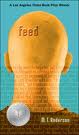
That’s the problem with literary fiction. It makes you feel.

And that’s what Feed did to me, and I actually sort of hate it for that. I don’t like sad stuff. I don’t like it when the dog dies, and I don’t like waves of hopelessness crashing into the beaches of my brain.

So, thanks a whole effing lot, M. T. Anderson. [Don’t worry, the dog doesn’t die. There is no dog, because Feed takes place on an earth where animals can’t even live anymore. All the dogs probably died way before the story begins.]

Okay, in all seriousness: Feed was amazingly written. I already heard literary agents praise its voice, so I was totally paying attention to that. I’m also really big on unique idioms and slang for unique worlds. Apparently Anderson is really big on this too, because in a couple of places the slang was nearly indecipherable. In fact, I’m still unsure of whether a “youch” girl is good-looking or just the opposite.

*vague spoiler alert*

But did it have to be so bleak? I mean, come on. There was like the barest note of positive at the end—the smallest straw of positive—so small I could barely grasp it—and the entire time I’m reading I’m quoting T. S. Eliot in my head (which you know is a bad sign):

“This is the way the world ends
This is the way the world ends
Not with a bang but a whimper.”

Let me emphasize that my discomfort with this book is more about me than the book itself. As I said, the writing’s great, as is the story. It’s just my own preference is for something a little lighter that doesn’t have me reaching for the Prozac after the story ends.

The whole thing with the lesions: disgusting.

Funniest part: the beef farm. But I had to stop eating my breakfast while I read it.

Saddest bit: disposable table. Okay, that’s not really the saddest bit, but it was pretty sad. Just, the state of the world, that people not only dine on disposable dishes, but they throw their table away at the end of the meal.

Am I glad I read it? Yes. Will I buy the book to enjoy again? Not a chance. I prefer my happy endings, thank you.
Keeping Ahead of Trends in YA Lit

Weekend Writing Special

You’ve finished the first draft of your young adult manuscript. It’s new! It’s got a great hook! Nobody has done anything like this before! It’s a reality-television-show-to-the-death featuring vampire-esque aliens. You imagine literary agents begging, no, clamoring, for your manuscript. Your idea is The Newest Thing.

Until, a few weeks later as you’re hard at work on revisions, all of a sudden everyone has done this. And their books are being published Right Now. That author of Twilight (whose name I keep forgetting) does a horror reality television show novel. Suzanne Collins has something with alien-vampires. J. K. Rowling creates a Harry Potter spin-off featuring vampires who run a television series about aliens.

My personal experience with this is not nearly as extreme or ridiculous. I had this idea for a future, post-apocalyptic setting for a novel, and I dove (dived?) right in. Minutes later, I read The Hunger Games. Then The Forest of Hands and Teeth. Then, while reading Publishers Lunch from Publishers Marketplace, I found two other post-apocalyptic YA trilogies due out in a year. How can I compete with that?

I can’t. Not as far as the general idea goes. No one can. In a lot of ways, we are all tuned into the collective unconscious. We read many of the same books, watch the same movies and television shows, hear the same news stories, and on and on. My hook has to be more than “post-apocalyptic” etcetera and so forth. An intriguing story idea can do a lot…

…but an awesome character does so much more.

An author friend of mine was worried about this a few months ago, as was I. We’d just finished revisions on our manuscripts (we thought) and we were ready to embark on our new projects. “I’m thinking vampires,” she said. “But it’s been done, you know?”

I did know. I wrote one. And then I told her something I should pay attention to myself: if the characters are memorable and compelling, it doesn’t matter what the setting is, or what creatures they are. Vampires, werewolves, telepathic fairy-kin, selkies, were-amoebas. After all, we’ve read contemporary fiction featuring regular old humans for…hmmm…just about forever. Humans? Regular people? In a regular setting? How boring…not. Most of Sarah Dessen’s books feature teenage girls in the same little town in North Carolina. I’ve read every single one of them because her characters are fabulous.

So it’s not just another vampire book, or another post-apocalyptic zombie book, or another (sigh) werewolf book. It’s a real story featuring a compelling character who deals with an intriguing, gripping conflict. You don’t need to keep ahead of trends, or even worry about them, if you’re writing what you love and focusing on your own unique characters.

First Sentences in YA Lit, Answers

In lieu of a book review, here are the authors and books matched up to the first sentences I posted on Friday. (Oh, and the parenthetical P notations indicate, where I remember, that the first sentence comes from a prologue, since I’ve been obsessed with prologues lately.)

1. We went to the moon to have fun, but the moon turned out to completely suck. -M. T. Anderson, Feed

2. It was a dark and stormy night. -Madeleine L’Engle, A Wrinkle in Time

3. I remember lying in the snow, a small red spot of warm going cold, surrounded by wolves. -Maggie Stiefvater, Shiver (P)

4. When I wake up, the other side of the bed is cold. -Suzanne Collins, The Hunger Games

5. I don’t believe in ghosts. -Gillian Shields, Immortal (P)

6. The tree woman choked on poison, the slow sap of her blood burning. -Holly Black, Valiant (P)

7. Chauncey was with a farmer’s daughter on the grassy banks of the Loire River when the storm rolled in, and having let his gelding wander in the meadow, was left to his own two feet to carry him back to the chateau. -Becca Fitzpatrick, Hush, Hush (P)

8. Blood fills my mouth. -Bree Despain, The Dark Divine (P)

9. In these dungeons the darkness was complete, but Katsa had a map in her mind. -Kristin Cashore, Graceling

10. Her parents were going to kill her for this. -Carrie Vaughn, Voices of Dragons

11. Just when I thought my day couldn’t get any worse I saw the dead guy standing next to my locker. -P. C. Cast & Kristin Cast, Marked

12. On the day Claire became a member of the Glass House, somebody stole her laundry. -Rachel Caine, Glass Houses

13. Mommy forgot to warn the new babysitter about the basement. -Kelley Armstrong, The Summoning (P)

14. Janie Hannagan’s math book slips from her fingers. -Lisa McMann, Wake

15. Mr. and Mrs. Dursley, of number four, Privet Drive, were proud to say that they were perfectly normal, thank you very much. -J. K. Rowling, Harry Potter and the Sorcerer’s Stone

16. “Please tell me that’s not going to be part of my birthday dinner this evening.” -Libba Bray, A Great and Terrible Beauty

17. There were only two kinds of people in our town. -Kami Garcia & Margaret Stohl, Beautiful Creatures

18. Around midnight, her eyes at last took shape. -Lauren Kate, Fallen (P)

19. Torrential rain was pouring the afternoon Rebecca Brown arrived in New Orleans. -Paula Morris, Ruined

20. Dad had Uncle Eddie round, so naturally they had to come and see what I was up to. -Louise Rennison, Angus, Thongs, and Full-Frontal Snogging

21. It didn’t take long for Phoebe to figure out Jeremy wasn’t coming back for her. -MINE!

22. “Guess who?” -Alyson Noel, Evermore

23. Someone was looking at me, a disturbing sensation if you’re dead. -Laura Whitcomb, A Certain Slant of Light

24. Some things start before other things. -Terry Pratchett, The Wee Free Men

25. Flames shot high, turning the night lurid with carnival light. -Annette Curtis Klause, Blood and Chocolate (P)

26. Everyone’s seen my mother naked. -Elizabeth Scott, Something, Maybe

27. Jason was going to Brain Camp. -Sarah Dessen, The Truth About Forever

28. I’d never given much thought to how I would die – though I’d had reason enough in the last few months – but even if I had, I would not have imagined it like this. -Stephenie Meyer, Twilight (P)

29. My mother used to tell me about the ocean. -Carrie Ryan, The Forest of Hands and Teeth

30. There are these bizarre people who actually like physical education class. -Carrie Jones, Captivate

So there they are. Happy Monday! It’s going to be a beautiful week!

First Sentences in YA Lit

Here are 30 first sentences. Do you know the books they go to? If you know what I’ve been reading lately you’ll have an advantage, but I threw a few old favorites in just to keep you guessing. Um, obviously if the suspense is killing you it’s easy enough to find the answers online (which is why this isn’t a contest, just an excuse to use the information from my first-line notebook). I’ll post the authors & book titles on Monday.

The interesting part of this exercise is the discovery that some first lines are definite hooks. I know which ones I think are amazing, and I know which ones, well, aren’t. And there are a few that are not winning first sentences, but if you stick around for the rest of the paragraph–Wow (I’m thinking specifically of #17 when I write this).

Take a guess if you feel like it, or just enjoy!

1. We went to the moon to have fun, but the moon turned out to completely suck.

2. It was a dark and stormy night.

3. I remember lying in the snow, a small red spot of warm going cold, surrounded by wolves.

4. When I wake up, the other side of the bed is cold.

5. I don’t believe in ghosts.

6. The tree woman choked on poison, the slow sap of her blood burning.

7. Chauncey was with a farmer’s daughter on the grassy banks of the Loire River when the storm rolled in, and having let his gelding wander in the meadow, was left to his own two feet to carry him back to the chateau.

8. Blood fills my mouth.

9. In these dungeons the darkness was complete, but Katsa had a map in her mind.

10. Her parents were going to kill her for this.

11. Just when I thought my day couldn’t get any worse I saw the dead guy standing next to my locker.

12. On the day Claire became a member of the Glass House, somebody stole her laundry.

13. Mommy forgot to warn the new babysitter about the basement.

14. Janie Hannagan’s math book slips from her fingers.

15. Mr. and Mrs. Dursley, of number four, Privet Drive, were proud to say that they were perfectly normal, thank you very much.

16. “Please tell me that’s not going to be part of my birthday dinner this evening.”

17. There were only two kinds of people in our town.

18. Around midnight, her eyes at last took shape.

19. Torrential rain was pouring the afternoon Rebecca Brown arrived in New Orleans.

20. Dad had Uncle Eddie round, so naturally they had to come and see what I was up to.

21. It didn’t take Phoebe long to figure out Jeremy wasn’t coming back for her.

22. “Guess who?”

23. Someone was looking at me, a disturbing sensation if you’re dead. 

24. Some things start before other things.

25. Flames shot high, turning the night lurid with carnival light.

26. Everyone’s seen my mother naked. 

27. Jason was going to Brain Camp. 

28. I’d never given much thought to how I would die – though I’d had reason enough in the last few months – but even if I had, I would not have imagined it like this.

29. My mother used to tell me about the ocean. 

30. There are these bizarre people who actually like physical education class.

Author Friends: I’d love to read your first sentences, too! Post them below.

Prologue Problems

A Friday Free-for-All [in which our heroine obsesses about writerly things]

I’ve been reading literary agent Mary Kole’s blog, kidlit.com. Right now she’s doing a series of critiques on story beginnings and her first critique post caught me by surprise. The author wrote one word: Preface, and Kole stopped immediately to comment “Ah, our first problem! Just kidding. Sort of. I think, in a lot of instances, a preface or a prologue is a crutch. It’s the author’s way of showing the reader something gripping in the hopes that the reader will then read through some less exciting backstory…” To me, this is very bad news. I love prologues, and I especially love writing them.

A brief history of my prologues:

House Red: The prologue is a total crutch, but c’mon, it’s my first novel. In this case, Mary Kole is right.

Savage Autumn: The prologue is not so much a crutch per se…but I’ll admit Chapter One starts off more slowly than what is currently popular in contemporary fantasy YA fiction. The prologue’s there because someone had to die before the story begins, so the reader can believe the antagonist is capable of killing.

The Black City: Brand new prologue, I fell in love with it immediately (which is a sure sign that something is very wrong). Buoyed by my success with the prologue, I started the first chapter. And it’s terrible. It’s really, absolutely terrible. It starts off slowly, with too much explanation and even more backstory, as well as very dull description of the world. So in this case, my prologue didn’t start off as a crutch, but I used that beginning as an excuse to let everything fall to poo-ness.

Granted, this is my very first draft for The Black City, and there will be plenty of time to fix those issues later on. Thank heavens.

Prologues aren’t always terrible, right? I mean, I’ve read plenty of  novels where they work beautifully. I find them all the time in my favorite mysteries and contemporary fantasies. A couple of fantasy examples I can come up with off the top of my head are: Fallen by Lauren Kate, Frostbitten, and Stolen, both by Kelley Armstrong. Hmm, looking at this short list, I realize that in order for a prologue to be successful, the novel’s title must end in “en.”

That’s easily remedied. Savage Autumnen. The Black Cityen.

All better!

Seriously, though, I will go back to my Chapter Ones and pretend the prologues don’t exist. Tighten up the chapters, bring in tension and whatever else is needed. Fireworks. Amorous alligators. Really angry toddlers with kicky feet.