NiFtY Interview with Lauren Carr
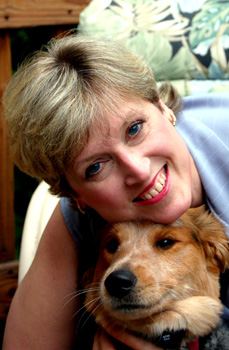
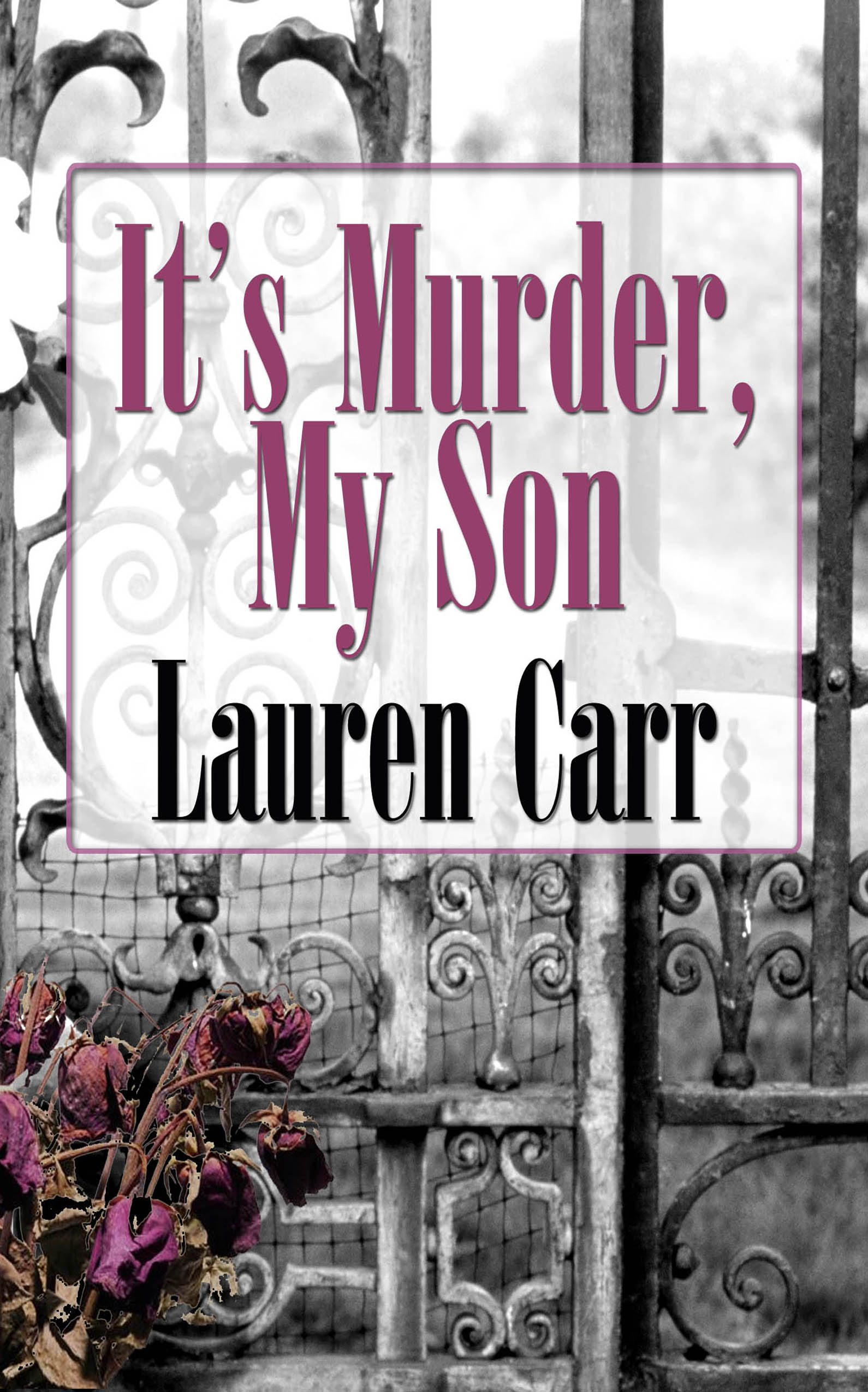
Lauren Carr is the author of three mysteries. Before she moved to novel-writing, she wrote mysteries for television and the stage. Let’s welcome Lauren Carr for my latest NiFtY (Not Famous…Yet) Author Interview!

BH: What’s your one-paragraph pitch for It’s Murder, My Son?

LC: What started out as the worst day of Mac Faraday’s life would end up being a new beginning.  After a messy divorce hearing, the last person that Mac wanted to see was another lawyer. Yet, this lawyer wore the expression of a child bursting to tell his secret. This covert would reveal Mac as heir to undreamed of fortunes, and lead him to the birthplace of America’s Queen of Mystery and an investigation that will unfold like one of her famous mystery novels.

BH: Tell us a little about your path to publication.

LC: My first book, A Small Case of Murder, was self-published and named a finalist for the Independent Publisher Book Awards in 2005. After being picked up by Five Star Mystery for my second book, A Reunion to Die For, I decided walked away from an offer from another traditional publisher to return to self-publishing for It’s Murder, My Son.

I turned down the traditional publisher to independently publish through CreateSpace for a variety of reasons. Mainly, I had all the same responsibilities and had to make the same investments of time and yes, money, toward making my book a success when I was traditionally published as I did when I self-published. I came to realize that with all of my education and experiences, I was more than capable of successfully publishing my books independently. So far I have been right. It’s Murder, My Son has received only positive reviews.

BH: Do you plan to write a sequel to It’s Murder, My Son, or have you embarked on a completely new project?

LC: I’m already working on it. In Old Loves Die Hard, Mac Faraday returns to Georgetown to clear his ex-wife’s name when she is accused of killing the assistant DA she had left Mac for.

BH: This book isn’t your first published novel, though; you’ve published two other mysteries. Are they part of a series? Can you tell us a little about them?

LC: A Small Case of Murder and A Reunion to Die For are the Joshua Thornton Mysteries. Joshua Thornton was a JAG lawyer who leaves the Navy after his wife dies, leaving him to raise five children alone. In A Small Case of Murder, Joshua returns back to Chester, West Virginia; his, and my, childhood home, where his children discover a letter that implicates a local pastor in an unreported murder.

In A Reunion to Die For, Joshua Thornton becomes the county prosecuting attorney and investigates the murder of an investigative journalist investigating the death of a high school classmate. The classmate died during their senior year in high school. Her death was classified as a suicide. Joshua begins to question if it really was.

BH: Where did you get the idea for your first novel?
LC: In 1998, my family was vacationing in Copper Harbor, Michigan. One rainy day, we decided to go antiquing. We had gone into this one shop and I found a beautiful silver tea set. The shop owner was very chatty and told me how he had acquired it. He had purchased all of the contents of an old house in which an elderly woman lived at an estate sale. While packing everything up, he was up in the master bedroom talking to the daughter of the homeowner when he turned over the box springs and found a brown cardboard box underneath. The daughter asked, “What’s that?” He replied, “Whatever it is, it’s mine.” The box contained the silver tea set, never used, completely in it’s original packaging, along with cards and letters all dating back to 1968. When he told me that story, I thought, “Suppose one of those letters implicated someone in a murder?” By the time we returned home from vacation, I had the plot for A Small Case of Murder outlined in my mind.

BH: On your website I learned that you gave up writing for television and stage to become a full-time mom, and you wrote your first book after that. How long did it take you to write the book?

LC: My “retirement” lasted about six months. Then I was back at the keyboard writing A Small Case of Murder. That was my escape. When I started writing it, I was writing only for myself. I had given up my literary agent, who never did anything for me anyway and didn’t handle novels. It took me about six months to finish the first draft. When I dug it out and dusted it off a year later, I read through it and thought I had something. So I started editing and working on it again. I spent another couple of years playing with it before I started to look into having it published.

BH: What was that like, balancing writing and motherhood?

LC: Tough.

BH: I’m listening to “Hear, hear!”s throughout our studio audience. Do you have any tips to share with other writing moms?

LC: Maybe this isn’t so much a tip about writing moms, but about life, as I see it having turned fifty this year. “When Mom’s unhappy, everybody is unhappy.” So, don’t be unhappy.

After a year of writer’s block and unhappiness, I decided last year to “give up” my career. I love the writing, not the frustration of dealing with literary agents and publishers and trying to please them, etc. So I decided to write my little mysteries and self-publish through CreateSpace and if they sold, and people liked them, great. If not, so what?

Well, when I made that decision, I was happy, and then everybody was happy. It became about the writing again. As luck would have it, I was offered a contract from a traditional publisher but turned them down in favor of self-publishing with CreateSpace. I’m sticking to my plan.

As long as it’s not self-destructive, do what makes you happy. If it makes you unhappy, stop it. Life is too short to be miserable.

BH: It seems to me that writing a mystery necessitates knowing just how much information to give, how much to hold back, and how much extra is needed to hide the important clues. Did the sense of knowing how much to include and when come naturally to you, or did it take some time developing?

LC: Both. I found that I had a sense of it, but had to develop it. It is comparable to having a natural talent like singing or throwing a football. Sure, when you first open your mouth to sing a song or get out onto the field to throw a ball, you may be really good, but you need to sing or throw that football everyday to develop it.

I write every day. I’ve written stuff that no one will ever read, until I’m long dead, if I’m lucky. But just the exercise of doing it has improved my skills at being able to write a scene and finely plant clues without giving away too much or holding back too much. I have found that by my third book I was better laying out the clues than I was with my first book.

BH: If you’re in a writing slump, what sort of things do you do to feed your inspiration?

LC: Mope a lot. During that year that I had writers block I kept trying to work it out by sitting at the laptop and staring at the screen. I would spend a day surfing the internet between sentences and find that I only wrote one paragraph at the end of the day. Finally, I decided to hang that up and started reading old mysteries that I hadn’t read in twenty years or so. I also read some inspirational books and got involved in more volunteer work at our church. Once I started meeting more people and having more experiences, I snapped out of it. I guess that was the key. I took my focus off myself and put it on the world around me.

BH: What is your writing schedule like?

LC:  Today? What it is today is different from what it will be tomorrow.

Now that I have a book out, I spend the day nine-to-five promoting it: doing interviews, making phone calls, printing up marketing materials and doing mailings.

I wake up early in the morning, six o’clock, to let the dogs out, brew coffee, and work on the next book until it is time to “go to work” doing the business end of writing. Now I am not necessarily writing that whole time. I take time out to drag my son out of bed, cook him breakfast, clean up the kitchen, etc. At five in the evening, I’ll stop “work” and cook dinner. After dinner and cleaning up the kitchen, then I will return to my writing until I go to bed. I reserve the weekends for writing, unless I have a book event.

BH: What does your workspace look like?

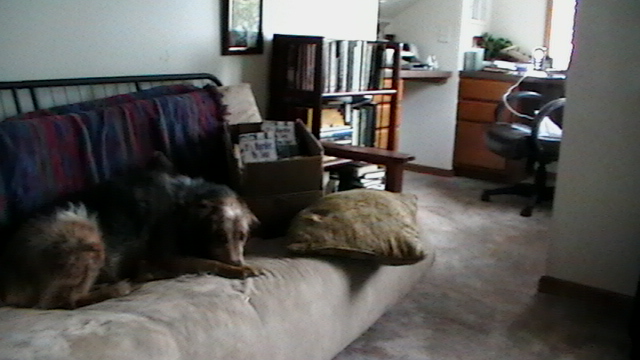
LC: I am blessed in that I have an actual writer’s studio. It is on the top floor of our house and has a fabulous view. This is my space. My husband is a neat freak. Everything has to be in it’s place and I am the opposite. This is my space, where I can be myself.
BH: [Battling jealousy over your writer’s studio….] What is your favorite book on the craft of writing?

LC: Stephen King’s On Writing. I don’t like much of Stephen King’s books. Sorry, he’s a wonderful writer, but they scare me so much. But On Writing was fabulous. He tells a lot of truths about writing techniques.

BH: Stephen King’s stories scare me too. He gives great writing advice, though. What is the best writing advice you ever received?

LC: Keep on writing. I heard it on TV once, and have no idea who said it. Reviewers, literary agents, publishers, their opinions are subjective. If you really want to be a writer and you really believe you have talent, then keep on writing and don’t give up. If you give up, then you don’t have the commitment and love for writing to succeed.

BH: Any words on advice to aspiring writers for keeping the hope alive?

LC: There is a scene in Whoopi Goldberg’s movie, Sister Act 2: Back in the Habit where she is talking to one of her students. This girl has a lovely singing voice and really wants to be a singer, but her mother has nagged her into squelching her dream. Whoopi corners this girl and tells her that either you are a singer or you aren’t. If you are a singer, then you are born a singer and you are going to sing even if you become a truck driver. You wake up singing. You sing in the shower. You sing even when you aren’t singing.

That struck me because that is what it is to be a writer. I gave up my career, what there was of it, to be a mom but in the middle of the night while holding my baby who is now one hundred and ten pounds, I was thinking up plotlines for murder the way other mothers are thinking up lullabies. I had books running through my head until after six months I had to sit down at the computer and make it into a book.

Now is the best time to be a writer because advances in both technology and the publishing world (CreateSpace, Smashwords, and other companies) have opened doors so that any writer who is serious about writing books and getting them out there to readers can do it.

BH: Thank you, Lauren, for the interview and the insights into your writing!

To visit Lauren’s website, click here. Lauren also has a fantastic blog devoted to mystery writing, named, funnily enough, “Lauren’s World of Mystery Writing.”

She’s also got a book trailer for It’s Murder, My Son, and if that whets your appetite for the book (I bet it will!), you can click here to buy the print edition on Amazon. It’s Murder, My Son is also available on Kindle and audio. You can find a pdf of the media release here, and a pdf of deserved praise for the book here.
Script-Side Friday

Short version: still revising Savage Autumn. I feel kinda like Mr. Mutant-Potato Head up there.

Long version….

Either I talk about my writing too much, or I don’t have much of a life otherwise (probably both), but the first words out of my friends’ mouths (after the generic hellos how are yous are out of the way) are: “How’s the writing going?”

I know I get all animated when I talk about writing. My writing, or anybody else’s, or the publishing world in general. It’s fascinating to me. And I’m not always good about pretending the same level of interest in anything else. There is probably a personality disorder out there to describe this.

Anyway. Long intro. Moving on. What’s going on with my manuscript?

For awhile there it was in mortal peril. I joined a critique group that had one member hating on my manuscript. Her points were fantastic and helpful, actually, but the delivery could have used some work. She’s not in the group anymore, but I needed about a week to nurse my ego and think about the characters and manuscript. Her comments, and the feedback from other group members, has inspired some rewrites and revisions.

Two other current critique partners have swapped manuscripts with me, and their comments have also been crucial. The whole experience reinforces that whole “writing is not a solitary effort” mumbo jumbo that you read at the beginning of acknowledgments pages (I read those. I really do).

Many of these writer friends have read more than one version of the same scene. All of them have been  spectacular in putting up with my indecisiveness, my questions, and my sometimes bitchy sensitivity.

Because Savage Autumn is nowhere near publication, and I read acknowledgments pages all the time, here is an toast to my critique partners and writing group friends:

Thank you to Seven, Jo, Pam, Seth, Robin, Helen, Mark, Jeri, Kary, Pat, Margaret, Cheryl, Theresa, and Colleen. And another thank you to my friends and family who have read the manuscript in its parts or entirety – whether you’ve given me feedback or not. Finally, thank you to the friends and family who haven’t read the manuscript but continually ask me how it’s going.

Total, abrupt subject change….

Update on next-door dogs: Yappy #3 lingers. Barks. Lingers.

Barks.

NiFtY Interview with Darryl Varner

Darryl Varner, organizer of the Sacramento Writers Group, is prolific,  funny, and…published. After a negative experience with the “traditional” publishing route (i.e. literary agent and publishing company), Darryl started self-publishing his books.

I met Darryl when I joined the Sacramento Writers Group last year, and have been impressed with not only his writing and his ideas, but his persistence in keeping the group going. Without further blah blah, I give you…Darryl!

BH: Tell me a little about your writing. How many books have you written?

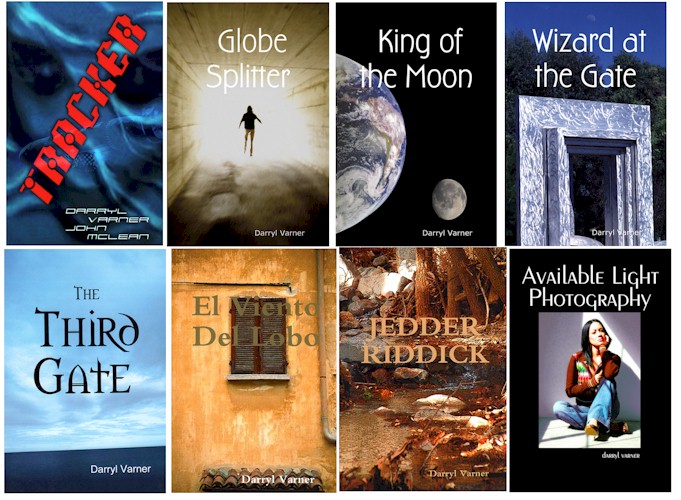
DV:  Officially, I’ve done five novels. Unofficially, I couldn’t even hazard a guess as to how many books I’ve written over the years. The first published book, Tracker, was co-written with a buddy, John McLean. It was a lot of fun having someone to share ideas and work out plot twists, but, due to our schedules, it actually took us over five years to finish it. I won’t go that route again. We did a couple of book signings and speaking appearances, which, again, was a lot of fun. John and I have personalities that naturally “clicked” in front of a group. We were kind of the Abbot and Costellos of bookdom.

BH: What did you learn from Tracker?

DV: The finished novel won a “best book” award when it came out in 2003 and was picked up for the permanent collection of the San Diego City Library. So, on one hand, it really was a shame we weren’t able to work things out to do a sequel. On the flipside, though, there were compromises which I still regret. I think it’s much better in the long run for a writer to work alone or, if you have the resources, to work with a paid staff where you can call the shots and have others do some of the heavy lifting. There’s a lot to be said for that approach for anyone who’s trying to develop a franchise in this business.

BH: After Tracker, you wrote the Methridia Chronicles, right?

DV: Yes. It was about five years later that I started writing a book entitled Globesplitter. I really enjoyed this one. It was a story that pretty much wrote itself. All I had to do was find time to sit down at the computer and whack it out. It’s set in the 1890s with a main character ala the Jules Verne/Edgar Rice Burroughs mold. A wealthy British “tinker”, Jonas Christianson, builds a machine that drills deep into the earth’s crust, breaking through to an ancient underground civilization. I just let my imagination run with it. Lots of action. It was fun inventing a hidden culture. That book took me, maybe, six weeks at the max to finish. Almost immediately, I did a sequel, King of the Moon in about the same length of time. A couple of months after that, I wrote a third novel which is entitled Wizard at the Gate. So, in essence, within a few months I’d done a complete trilogy. Not quite a year after wrapping up Wizard I woke up one morning with an idea for a fourth book and about a month and a half later, I’d finished The Third Gate. I decided to wrap them all under a blanket title of The Methridia Chronicles, named for the underground kingdom where they took place. One thing that I found especially satisfying was that these stories could be read by any age group. I’m certainly no prude, but this confirmed my opinion that it’s quite possible to write a LOT without including a single four-letter word or gratuitous sex scene.

BH: Do you think you will ever publish an e-book? Or have you already, and I just don’t know about it?

DV: I have put all publication on hold for the moment. Right now, I’m working out the “best” way for me to market my stuff and I’m not in any hurry to jump the gun. I will say, though, that there’s a lot to be appreciated by going the e-book route, not the least is the ratio of royalties to publishing expenses. Through electronic publishing it’s quite possible for an author to bring in a very respectable profit without having to have his audience spend an arm and a leg to purchase the book.

BH: What benefits do you see in self-publishing?

DV: In a word: control. Simple as that. Providing that an author is able to work out distribution – which is always an issue, regardless of how a book’s published – it can be a very good way to go. Before the Internet, “self-published” was pretty much synonymous with “vanity press”. That’s not necessarily the case today.

BH: Can you share a little bit with us about your current work-in-progress?

DV: At present, I have so many stories started that I don’t really know which one to develop. I “like” them all, but it’s similar to dating several women at the same time. Making the commitment to one is the hard part. Sooner or later, something will strike my fancy and I’ll do it. Likely as not, it will end up being a complete surprise to me when it comes along.

BH: When did you realize that you were a writer?

DV: In ninth grade. I “forgot” about a poetry assignment until I walked into my 3rd period English class on the morning when it was due.

“Wow, I completely forgot to bring it. Is it okay if I go back home and get it?”

Well, apparently the request didn’t sound unreasonable, so my teacher said it was okay and, as long as I got back before the class ended, she’d accept it. So, I wrote a poem in my head on the walk home, typed it out as soon as I got there, and was back at school in time to turn it in. Ain’t I a stinker?

BH: Where do you get most of your ideas and inspiration?

DV: I plagiarize Stephen King and Tom Clancy. 🙂 Not really. Dreams are a very frequent resource. Also, I’m constantly tuning into snatches of random conversations when I’m out and about. I write Sherlock Holmes stories because I read everything Doyle wrote and I wanted more. Doyle certainly wasn’t up to putting anything new out, so I decided I’d have to take it on as a do-it-yourself project. Ideas are never a problem. Finding time to get them on paper’s another issue, unfortunately.

BH: Do you have a set writing schedule, or do you wait for inspiration?

DV: I write 1) when I’m in the mood and 2) when I have time. The “set” part of my schedule is that I write a minimum of at least one complete scene – generally a chapter – whenever I write. If I start a second or a third chapter, I’ll almost always finish it before I call it quits. I do a little spot revision as I’m working, but generally most of my stuff ends up pretty much as I wrote it in draft form.

BH: Which of your characters do you think is most like you?

DV: I don’t write about boring characters. Can’t say any of them are much like me.

BH: Aww. Not true. What does your writing workspace look like?

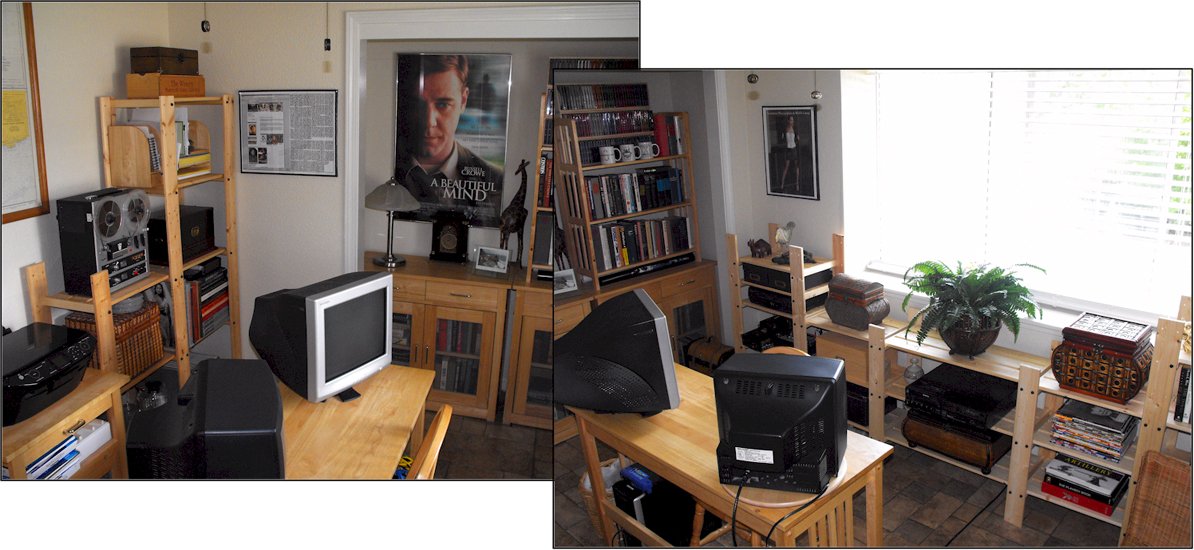
Darryl's Office

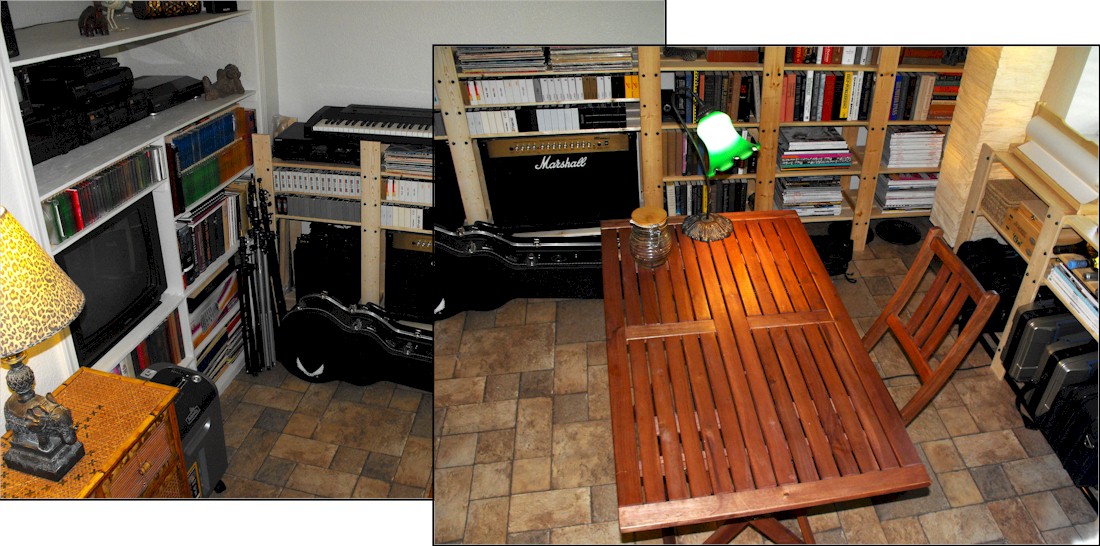
DV: Here are a few snapshots of where I write when I’m home. I wander between my library/AV room and my office. I think it’s important to have everything I need within reach, so my printer’s close at hand in the office and “the world’s best critic”, a heavy duty shredder, is a few steps away in the library. I have a great sound system, too. For me, I find that I often work best when I have music playing in the background. Generally, I listen to light classical stuff. I love rock, of course, but I can get sidetracked by listening to the lyrics, so I almost never play it while I’m writing.

When I want to get out of the house, I tend to head to either Barnes & Noble or Panera Bread. Lately, I’ve been favoring Panera because they have more variety on the menu. Now, if I could only get them to take my Barnes & Noble membership card, I’d really be a happy camper. When the weather’s nice I’ll often drag my laptop out to my deck. That’s where my photo was taken, as a matter of fact.

BH: You started the Sacramento Writers Group in 2009, right? Where do you see the group going in the future?

DV: Super Bowl. No question about it. We just gotta get our defensive squad in shape.

Actually, that’s a difficult question to answer. I’ve been disappointed that it’s been pretty much impossible to develop a core group of writers who will turn up faithfully month after month. That sort of on-going input is what’s really helpful for a writer who’s seeking meaningful help with a project. I hope it will eventually happen, but, honestly, I don’t have a clue how to make sure that it will ever come about. I find that odd, too, since I had a group in southern California that worked for years with the same group of writers showing up like clockwork.

BH: What are some of the problems or issues that go with being a group organizer?

DV: Developing a true membership is at the top of the list. Too many “joiners” and not enough “show-uppers”. I’ve gotten very jaded as to the intros of people who are joining via the Internet, too. As soon as I see the word “passionate” in someone’s bio (as in “I’m very passionate about blah-blah-blah) I figure I’ll maybe see that person at one meeting and that will be the end of it. Maybe it’s like relationships in general. Passion will carry things along only for so long. I suspect a lot of people would prefer to find a new source of inspiration rather than put out the time and effort it takes to actually develop a talent to the point where it’s actually worth something. Then again, there are a lot of “groups” in the area. Maybe a lot of people are just looking for cheap entertainment. Who knows?

BH: What is your favorite book on the writing craft?

DV: The Elements of Style.

Darryl's Library

BH: You mentioned writing Sherlock Holmes stories. I read one that I would love to see published. Do you ever submit your shorter pieces to journals or magazines?

DV: To be truthful, Beth, I’ve never submitted anything to magazines. There’s just not enough of me to go around. I’ve thought about getting an assistant to help me with that sort of thing but so far I haven’t been able to justify the expense. Maybe one of these days, though.

BH: Not only do you run the Sacramento Writers Group, but you’re the organizer for at least two others, is that correct? Where do you find the time for all these pursuits, in addition to your own photography and writing?

DV: I don’t sleep and I strap a feedbag to my face so I can eat while I’m on the run.

BH: What is the best advice anyone has given you with regards to your writing?

DV: Don’t quit your day job.

BH: At first I wanted to write off that advice as totally useless. But then I realized: this writing thing isn’t easy. If you’re filthy rich, go ahead and quit, live off your saved money in a sweet villa on the Mediterranean, and write your little heart out. But if you’re like the rest of us? Work, and then write. Go to sleep. Get up. Repeat.

Darryl, thank you so much for the interview. It was a pleasure!

Blog business note: no post on Monday, as I’ll be in the beautiful eastern Sierras, editing Savage Autumn and critiquing other fabulous pieces of writing for my writer’s groups. Oh, and relaxing with family, hiking, and trying not to get attacked by crazy insects. 🙂

NiFtY Interview with Jo Hart

Meet Jo Hart, a not-famous-yet author of picture books and a young adult fantasy work-in-progress. I met her through literary agent Mary Kole’s blog, and you can meet her here on mine.

Jo writes, teaches, moms, and lives in Australia. At the moment, we’re doing chapter-by-chapter critiques of each other’s manuscripts. The two of us have had great fun discovering grammatical, dialectical, and other linguistic differences between our uses of the English language. For instance, while I thought “mini-beasts” was a creative way to refer to toddlers, it is actually a widely-accepted term for bugs and insects in Australia.

And here…she…is!

BH: Tell me a little about your work-in-progress, The Wizard of the Middle Realm.
JH: It’s a YA fantasy novel about a 15-year-old girl named Katie. She loves to get lost in novels about wizards and magical creatures until she is thrust into the Middle Realm, a world not much different to the worlds in her books. Now all she wants to do is find a way home. Unfortunately the Middle Realm is a dangerous place and finding the one person who holds the key to her getting home will not be easy.

BH: When did you realize that you were a writer?
JH: Probably the day I learned to write, maybe even before then. I remember making a story book in kindergarten (which is what we call the year before starting school here), I had to get the teacher to write the words of course because I didn’t know how to write yet. Honestly I have always wanted to be a writer; I’ve always loved making up stories and creating characters.

BH: Where do you get most of your ideas and inspiration?
JH: Anywhere and everywhere. I get ideas from dreams, from sitting outside and observing the world around me, from an article in the paper, even books and movies can spark an idea. Take my current WIP: the world itself first came to me when I was walking around the farm with my dog, I would look at the cluster of trees and imagine a forest; the twins were inspired by two girls I went to school with; some of the other characters just spoke to me out of nowhere. I’ve always had an overactive imagination.

BH: Do you have a set writing schedule, or are you more of a “when the mood hits” kind of girl?
JH: I find it hard to schedule or write when the mood hits because I have two young children to work around. I usually take any opportunity I can when I have five minutes to myself (even if it means sometimes choosing writing over doing the dishes).

BH: AMEN on the dishes.

Katie, the main character in The Wizard of the Middle Realm, is a bit timid and lacks in the muscles department, especially compared to a lot of other popular heroes. However, she’s incredibly smart and resourceful. Can you compare her to anyone you know in real life?
JH: Katie’s actually based on me a little bit, what I was like as a teenager anyway. I was always the shy little bookworm at school, although I was a lot more sporty than her. I thought to myself, there are so many heroes out there who are strong and confidant, but what if the hero was just an average teen, someone shy and weak. I think it gives her more room for development as a character; and all the bookworms reading can relate to her.

BH: What does your writing workspace look like?
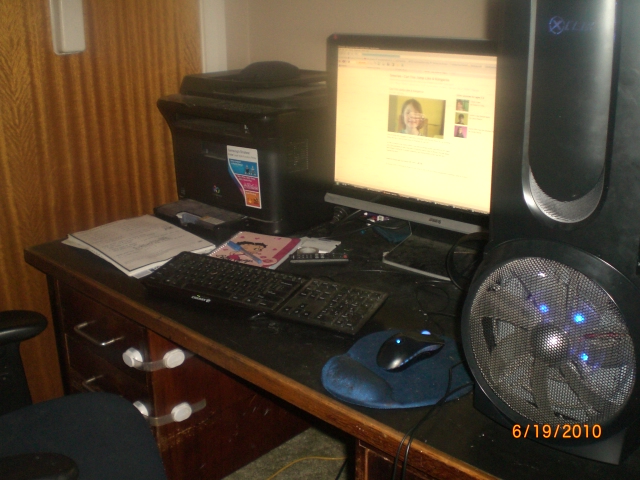
JH: I write on my computer at my desk usually (although occasionally I use my laptop). The desk is generally untidy, covered in papers and odds and ends (mostly things my children pass to me like books and toys). The desk is in the lounge room so I can type and watch the kids at the same time, it used to be by the window overlooking the garden, but at the moment it’s been shoved into a little alcove in the corner while we’re getting ready to move house (which is where it is in the photo).

BH: Your picture book story, “Can You Jump Like a Kangaroo?” was shortlisted in the smories (original stories for kids) contest. Was this your first short story, or have you written others?
JH: I love writing short stories and children’s stories and have written many in the past. I have a couple of short stories posted on my blog actually.

BH: What is your experience like, balancing writing and motherhood?
JH: It can be hard to balance sometimes. I would love to be able to get lost in my story whenever the mood hits, but my kids are my priority so that doesn’t happen. My youngest naps in the middle of the day, so I usually take the opportunity to write then. My eldest has lunch and plays quietly in the room with me and I eat lunch at the computer while I write. Then if I’m not too tired after they go to bed I do some more writing then. I work as a substitute teacher too, so some days I don’t get any writing done at all.

BH: What is your favorite YA book of all time?
JH: John Marsden’s Tomorrow series (the first book is Tomorrow When the War Began and they’ve just made a movie from it). I first read the series as a teenager and loved them (as did every other teenager I knew back then, boys included). John Marsden has a great talent for writing YA, I used to read all his YA books as a teen and even once got to meet him! If you’ve never heard of him, check out his website. I highly recommend all his books.

And then there’s the Harry Potter series by J.K. Rowling, which I first read as an adult, and fell in love with right away. For me it’s a close competition between Marsden and Rowling.

BH: How about your favorite book on the writing craft?
JH: Kate Grenville’s The Writing Book. It was actually one of the prescribed texts for my Writing major at university, but unlike most other textbooks I had to buy and that ended up in a cupboard never to be read again, I keep Grenville’s book close by my computer as a valuable resource. There are some great writing prompts and activities in there that I even use in the classroom sometimes. It has great advice for all aspects of the writing process from character to dialogue to description. You can check it out here.

BH: Why do you want to be published?
JH: I think it would be amazing to walk into a bookstore and see a book I wrote sitting on a shelf with my name emblazoned across the jacket. It’s always been my biggest dream to be a published author, for my words and ideas to be immortalised in print and live on after I’m gone.

BH: Lately in the publishing blogosphere there’s been a lot of talk about how to craft a good setting for a novel. Because you’re writing a fantasy, I’m wondering what sort of challenges you’ve faced with the setting in your novel, and how you have worked through them.
JH: I suppose the biggest challenge would be conveying the image I see into my head onto the page so the reader can see the world the way I envision it. Of course every reader will interpret and see the world differently, but I want them to get a general sense of the world. Like in the woodland scene in the beginning I want to convey a place that feels lifeless. Usually when I’m describing a setting in my novel I close my eyes to get a clear picture in my head. As I write I think about not just what my characters can see, but how the bark feels on the trees, what smells are in the air, what sounds they can hear. It’s more than just painting a picture with words; creating a setting is about getting the reader to experience it as though they were standing right there alongside your characters.

BH: One thing you do especially well in your writing is convey suspense through narration. Do you have any tips for other writers on how to do this well?
JH: Use the five senses. Get into the main character’s head and imagine yourself in the same situation, what sounds, sights, scents, etc. would make your heart beat faster? And use short sharp sentences, but make sure they vary in length so they don’t become monotonous.

BH: What is the best advice anyone has given you with regards to your writing?
JH: Show, don’t tell. It’s my writing mantra.

You can see a video of a very expressive girl reading Jo’s story “Can You Jump Like a Kangaroo?” here. And for more info and insights into Jo’s life and writing, you can visit her blog.

Thanks for the interview, Jo!

Not My Daughter, You Bitch! (Swearing in YA Lit)

So I’m jumping on this subject bandwagon pretty late. I spoke with literary agent Mary Kole about this issue at a conference in April, and apparently it was a popular topic, because she wrote a blog about it. Because so many people feel strongly about this issue, I figure I may as well use my platform and voice my opinion. This is my website, after all. What would it be without a spewing forth of Beth’s Opinions?

When I think of “bad” words in young adult literature, so many things come to mind. There’s the famous line from the last Harry Potter book (see title above) that shocked Potter fans. In this case I think the word was so shocking because the series started out as a middle-grade series, and then matured along with the characters. Who would even imagine reading the word “bitch” in Harry Potter and the Sorcerer’s Stone? Another reason for the shock factor: Rowling’s books had so little profanity in even the later books, and this says something for her skill as a writer. Voldemort didn’t need to drop an F-bomb to cement his villainy because he was so evidently evil in reputation and action. Ron used the word “bloody” on occasion, but this barely registered with American readers. Uncle Vernon said something about “effing owls” once. So the “bitch” in the final book was so unexpected. It didn’t really fit. I can see why Mrs. Weasley would be driven to use it, but if I’d written the book, I’d be super-rich and would have invested some time in finding an alternative.

I don’t have a single problem with profanity in young adult literature. I wouldn’t necessarily let f-bombs explode all over the place in my own manuscript, but they didn’t stop me from reading Lisa McMann’s Wake series. Cursing sounds pretty natural amongst the young adult set. Not all of them, mind you. (Although I admit surprise to some of the things I saw on former students’ facebook posts. Not all are as innocent as they seem. Frightening for me, as a mother.)

My own manuscript had exactly four f-words for awhile, and they didn’t bother me spaced out and spoken by college-aged characters. When I did some snipping (okay, I lopped off the first 50 pages) and had to move some conversations around, all of a sudden three of those f-words appeared in the first chapter.

Not the sort of set-up I had in mind. I don’t expect every book to have universal appeal, but I knew that three f-words in the first chapter would turn a lot of people (parents especially, who often buy the books) off. With some ideas from a critique partner I was able to change two of them. The other one is just too natural to the character speaking, I am convinced no other word will do.

And that’s when a swear word belongs in your manuscript. When it’s true to the character and no other word will do.