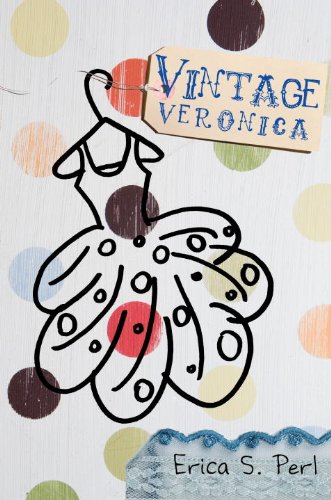
Vintage Veronica by Erica Perl

I’ve been having a lot of luck with my pull-a-random-book-from-the-library-shelf method. It’s not that random, I suppose. I’m looking for new books (within the last year), and I’m looking for things without any supernatural elements. Pretty soon I’ll be able to return to the fantasy realm…but I’m really enjoying my time here on Mundane Lane. Besides, I get plenty of fantasy with my own work-in-progress.

Oh right! The book review!

Vintage Veronica takes place in one of the coolest settings imaginable: the Clothing Bonanza. It’s a humongous building full of vintage clothing, decorated with (cool) old crap (like an old motorcycle and a VW Bug). Veronica has the great fortune to get a job taking in and processing the consignments, and she often finds amazing articles of clothing. Unfortunately, she can’t wear most of these clothes, as she’s too big. Fat, in her words.

Veronica’s obesity has some impact on her characterization. She’s never been able to keep friends, she hates crowds, and she equates fat with ugly, leaving her with low self-esteem. However, what I really like about this book (beyond the fantastic clothes and the drama with the floor-sale bitches and the romance with Lenny the Lizard Boy) is that Veronica’s obesity is not the focus of anything. It’s a part of who she is, but it doesn’t define the entire plot.

I love an ugly duckling story as much as the next girl, but it doesn’t always have to be that way. What if we discovered we were beautiful without turning into swans? If we stayed socially awkward, or overweight, or attitudinal, or whatever, and could be happy that way? This is not a message the book tells us, because it doesn’t have to. Veronica does her thing, and we come to see past her appearance…just as she does.

Veronica’s voice comes across whether she’s being funny, bitchy, insecure, or smitten. A few times I wanted to put the book down because I could see where it was going as soon as she became “friends” with the two wild girls who rule the sales floor, but I had to keep reading.

*very mild spoilers here*

There was a great sense of fate in this book, like wisdom coming from the mouth of an oddball pothead (is anyone else thinking of The Big Lebowski when they read this book, I wonder?), or Veronica’s epiphany dawning with the falling of clothes from a giant chute. I came out of the book feeling pretty good about the world.

And that Clothing Bonanza? I want to go there.

To learn more about Erica Perl and her books, you can visit her website.

Portable Writing Workshop

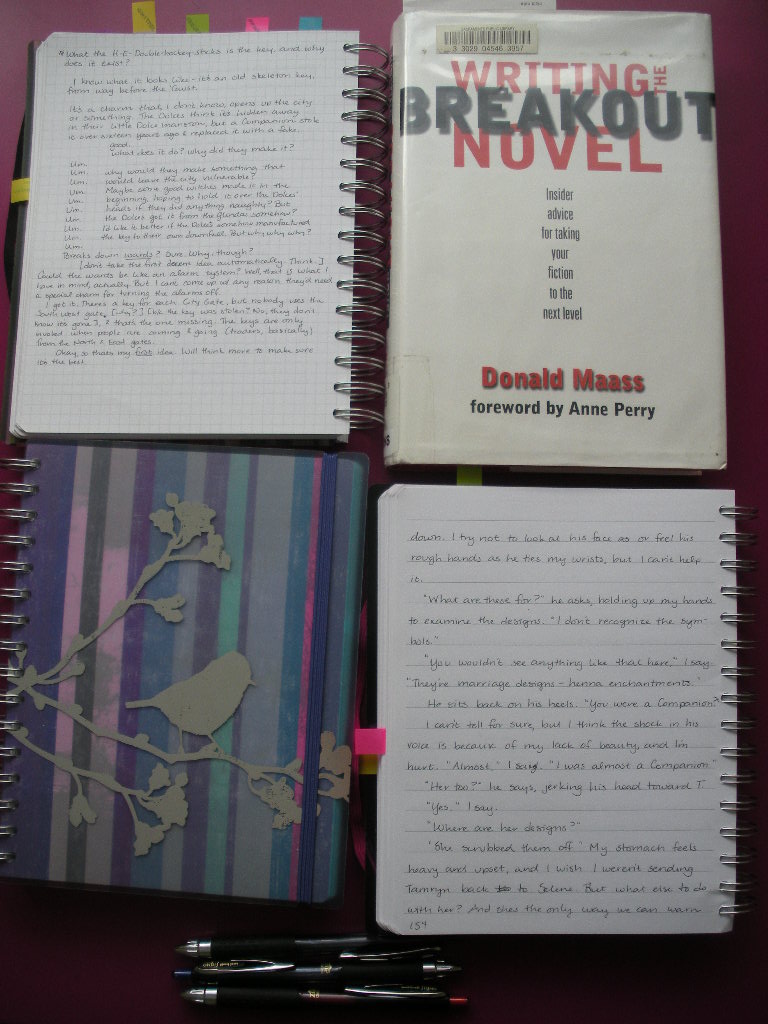
What you see here are seven stalkers that haunt me during Z’s nap, after her bedtime, and all those hours in between. They follow me to the front room: “Don’t read to your daughter. Instead, zone out and think about plot.” They gaze at me from the nightstand while I try to fall asleep: “Why are you sleeping? You’re wasting precious writing time.” They lounge next to me on the couch in a way that says, “We’re watching you. Pick up that Nintendo DS and you can forget having a breakout novel.” They join me at the table: “Are you going to eat that? Should your main character eat things like that? If she doesn’t want to, will you put her in a situation where she has to in order to, say, save the world? Just how important is ice cream to your novel?”

From the top left, the stalkers are:

1. Idea notebook for The Black City (working title of my current project/new manuscript). Please note (and admire) the bright Post-it tabs adorning the top. They divide the notebook into the following sections: Plot, Characters, Setting, Creatures, and Magic. The Creatures tab is so far kind of pointless. I might replace it with Ice Cream.

2. Writing the Breakout Novel by Donald Maass. The gimmicky title turned me off, but after being stalked by the title through various literary agent and writer blogs, I finally decided to give it a chance. (Much like Jacob in the Eclipse movie. Cringeworthy and excessively stalker-ish on the outside, but sincere and…never mind. The comparison doesn’t work at all.) (Really. Forget the Jacob comparison. It never happened.) Another bonus for this book is that it’s a library copy, well worn in, and I can prop it open with one of my other notebooks and have two hands free for eating…ice cream.

3. Manuscript book. I hate sitting at a computer and trying to create something, so I write by hand instead. At the computer there’s so much pressure. Most of it is behind my eyeballs somewhere, but also in my neck and back a little. Plus our computer’s in the basement, and I don’t want to spend that much time down here if I can help it. Unless I’m reading blogs and eating ice cream.

4. Black pen. Used for pretty much all writing. Diary. Notes. Manuscript. So far ineffective as spoon for ice cream.

5. Blue pen. Essential to snarky comments in margins of manuscript, and note-taking. It’s a pleasing color, a welcome relief from the Black pen. Also not a spoon.

6. Red pen. For heavy-duty editing. Great also for recording Unforgettable Fabulous and Difficult-to-Convey Ideas of Inspiration (example: DUDE. Make her have crush on old guy) that may never come to fruition, but probably will because according to #2 above, a writer needs to make things as difficult as possible for her protagonist. The red pen is also not a spoon.

7. My current diary book. Full of notes on Maass’s book. And the occasional glob of melted ice cream.

Everything a writing mother needs to get herself through the day. Notebooks, pens, a gem-book on the writing craft, and…stupid Twilight comparisons. No! Ice cream!

It’s the Friday before Labor Day, which means I’m in the mountains somewhere, or on my way at least. I won’t have internet access to moderate comments until Monday, so if you haven’t commented before and your wonderful words of wisdom don’t show up right away, they will soon.

Oh, ALSO. My writing “pardner” Seven and I have made a pact to write 1200 words, six days a week, so by the end of October we’ll have finished the first drafts of our works-in-progress. Does anyone out there want to join up? If you’re interested, you can contact me through my contact page, or leave a comment here.

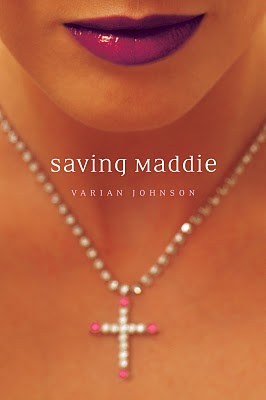
Saving Maddie by Varian Johnson

Every now and then it’s healthy to go to the library and grab a random book off the shelf.

Okay, my search wasn’t entirely random. I desperately wanted something with no supernatural elements (yes, you read that right). Quick explanation: I’m tired of paranormal books, mostly because I’ve been revising my own for far too long.

So after a brief jacket check to make sure Saving Maddie had no vampires or were-amoebas in it, I brought it home and, one afternoon, I read it. The story is told in first-person point of view by Joshua Wynn, the seventeen-year-old son of a preacher. His childhood best friend, Maddie, returns to town and she’s no longer the young, innocent(ish) girl he’d known. Not only does Joshua battle with conflicting directives from his parents (help Maddie/stay away from that girl), but he’s also battling conflicting desires (be a good boy/have fun).

Joshua’s conflict was well-written. The pacing and tension alone kept me going, as well as the mystery as to why Maddie turned out to be such a “bad girl.” The prose itself, though, was sensual and sensuous. This paragraph illustrates this nicely:

She closed her eyes and I closed mine. I took in her scent again – I didn’t think I’d ever eat another scoop of vanilla ice cream without dreaming about her.

I’m a huge fan of sensory description, and Johnson does this all over the place (honestly, I just picked a page at random and found that paragraph).

Another interesting point: Johnson took a young adult male protagonist and added tons of girl appeal (a phrase I read in Mary Kole’s blog entry Boy Protagonists in YA). The “girl appeal” reminded me a lot of Beautiful Creatures (which I reviewed awhile ago), and strangely enough, The Virgin Suicides (which I read a long time ago). Which brings me to a total sideways thought: does “girl appeal” mean that the male protagonist has to be totally smitten with a girl character, in order to appeal to female readers? Based on Kole’s post, and my own reading, this might be the case.

But now it’s time to wrap up my review.

Saving Maddie was a refreshing trip back into a time when the end of the world seemed to balance on adolescent moral dilemmas, and everything felt so real, so crucial, and so brand-new.

You can visit Varian Johnson’s website here.

NiFtY Author: Matt Coonfield

I have a very special NiFtY Author Interview for you today, featuring one of my favorite people in the world: my little brother. He hasn’t always been my favorite person. There was this time once when we were playing Legos and he was obviously wrong about something, and we weren’t very good friends right then…but I digress.

Here’s his interview. You’ll laugh, you’ll cry, you’ll throw tomatoes and have to clean off your computer screen. Good luck with that.

BH: What’s your one-paragraph pitch for your work-in-progress?

MC: I don’t want to give away too much. I am actually quite paranoid. The short version is a young man named Ray starts a civil war in the ghost world in an odd and adventurous way.

BH: What was the biggest challenge in finishing your first draft?

MC: Honestly my biggest challenge has always been me. I am a big lazy hurdle that I just can’t jump. I don’t like to write when it is hard, when I have to grind it out. Generally I only like to write when it is flowing. Anyone who writes knows what I am talking about. When you can churn out twenty pages a day and the only reason you stop is fear of carpal tunnel. When your thoughts are practically jumping on to the paper for you. That is when I like to write. When this doesn’t happen I start a new book. Oddly I have never finished one until now.

BH: Can you compare Ray, the main character in your work-in-progress, to anyone you know in real life?

MC: I guess parts of him are me of course or parts of me if that makes sense. I’m not schizo or anything but I like to pretend I am Jared from The Pretender. I have hidden Matt compartments that I draw from and one of them happens to be a teenage ghost-hunting ghost, conveniently enough.

BH: I understand you’re working closely with somebody else on this project. What is his role in your project?

MC: As I mentioned earlier I am notoriously lazy when it comes to writing. My partner’s name is Don and he is basically my dentist. That is to say he pulls teeth. We have only been working together a short time and I am considering buying another cell phone and not giving him the number. Other than that he does all the things I hate: paperwork, typing, forms, queries. Once he offered to paint my garage if I promised to write more.

BH: What is your experience like, working with another person? What are the pros and cons of this arrangement?

MC: Well Don can be quite persistent sometimes calling me four or five times a day. I had to get used to it at first but we’ve come to an understanding now. He has given me 100 percent artistic say so, which was a condition when we first started, but even then sometimes he feels adamant about something and I hate to put my foot down too much. There is one scene in particular in the book that he wrote and it makes me leery but I have let it go so far.

BH: One of the things about your writing that impresses me is all the crazy ideas you come up with—ideas that you can make work. Where do you get your ideas and inspiration?

MC: Well… My faith is definitely an inspiration to me. Really I don’t think I could write without the Bible. Not that my stories are Christian but the right and wrongs for me come straight from the source. After that I steal them. I guess it sounds weird to say that right after my Jesus plug but it is honestly what happens. I always read things, good and bad, and I can see the improvements that need to happen. I see a tweak that if the author had seen could have changed his whole piece for the better. When I find those tweaks early enough in a book or combine them with other tweaks I get really excited about what I can do with it and when I get excited….

BH: What is your writing schedule like?

MC:  I try to fit it in between reading and Pokemon but too often I am forced to combine two of the three to make up for time.

BH: How has your writing changed—either the scheduling or the experience itself—after becoming a father?

MC: My scheduling has definitely become more intense. The very reason I had agreed to work with my coauthor in the first place is money. I need it. I can’t sell a book if I don’t finish one so I brought on Don to help me finish my books. The experience hasn’t changed in the least, I just have a deeper well to draw from.

BH: What does your writing workspace look like?

MC: My writing workspace looks suspiciously like the cab of a Nissan Frontier. Much to the chagrin of my typist most of my good ideas come when I should be paying attention to the road. This makes for some very peculiar handwriting and possibly the next unfinished series. We all know how well it worked out for the Canterbury Tales. Don’t judge me.

BH: Just remind me to avoid the road when inspiration hits. What is your favorite book on the craft of writing?

MC: A notebook.

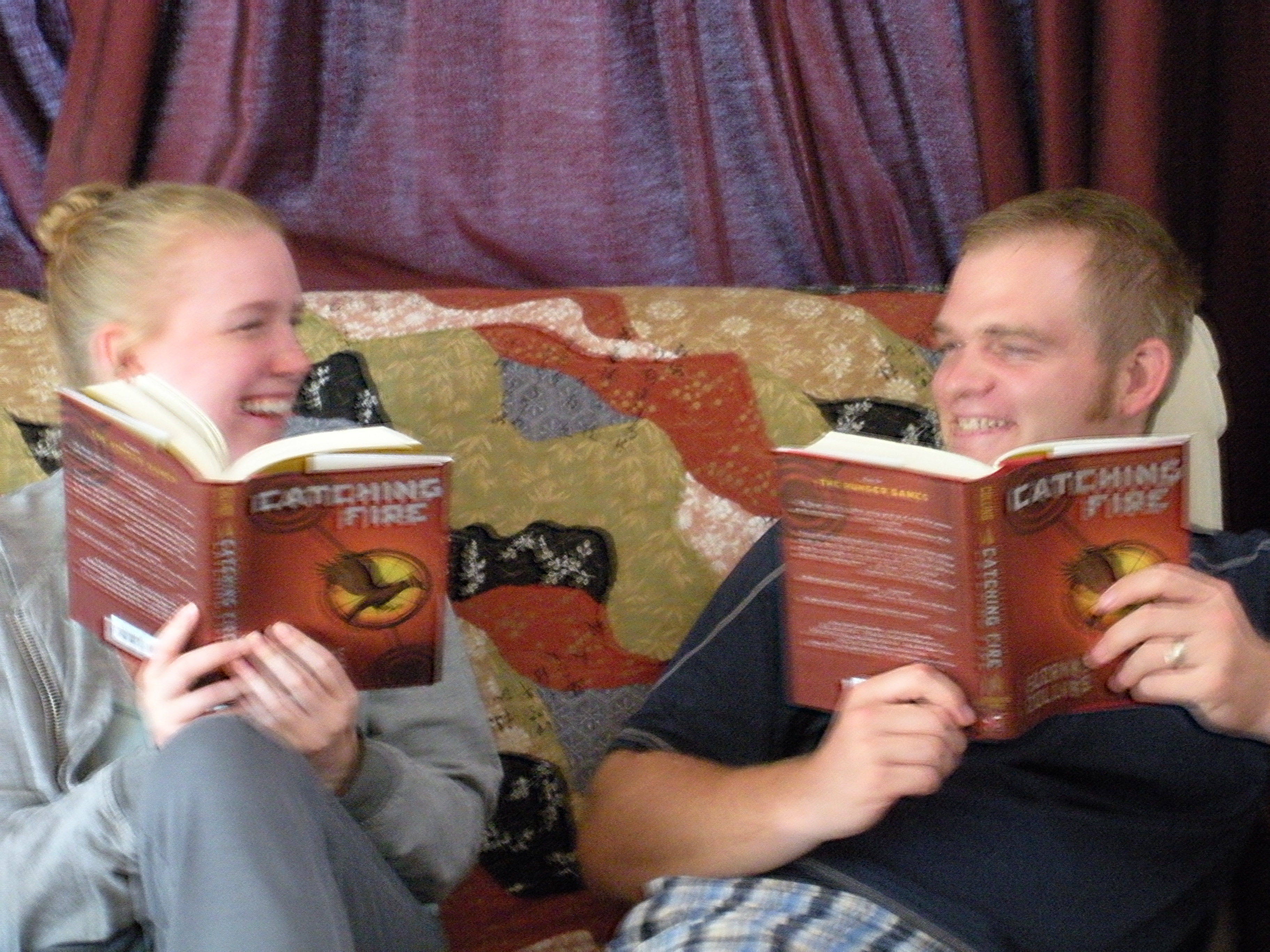
Beth and Matt Read Catching Fire

BH: You told me recently that Suzanne Collins’s The Hunger Games is not your favorite book, but it made it into your “top ten.” What is your Top Ten?

MC: The Bible, X-Men, Dracula, Death in the Long Grass, The Night the Bear Ate Goomba, Yvain, Harry Potter, Hunger Games, The Great Divorce, God’s Grandeur.

BH: Twilight didn’t make it into your Top Ten, but we both admit we enjoyed it. What, exactly, is so compelling about that Twilight series? Why are these books so popular, in your opinion?

MC: Stephenie did something real special and it took her like a whole month. She tapped into something that was important to young women and made it interesting to young men. She took elements of comic books (which is why it translated so well to graphic novel), Fabio, and Mythology and made it her own. She didn’t follow rules, and she didn’t heed the pressure to omit her beliefs, i.e. her morals. I don’t think it was the best writing in the world but I loved it and I respect what she did… except for the huge let down in the end. That pissed me off but since the plot was ripped off another story what can you say?

BH: What is the best writing advice anyone has given you?

MC: Write down what you are feeling now matter how silly it sounds. It will make sense to everyone.

BH: Why do you want to be published?

MC: I would like to be superficial and say it is to finance my laziness but the truth is I want to be able to talk about it with someone, someone who liked what I wrote and who wants to talk with me about it.

BH: Who is your real-life writing role model? [Hint: the answer should be someone you grew up with. Who maybe lived down the hall from you. She had a pink room for a few years. And a cat named Apricot.]

MC: C.S. Lewis, Stan Lee, and Patrick F. McManus. I hate to admit but my sister’s love for all things academic never made sense to me as a child. I get it now and all those years may have rubbed off on me a bit.

BH: Eh, that’s practically saying that your sister taught you everything you know. Any words or advice to other writers for keeping the hope alive?

MC: Give up. The market is closed. You can’t do it.

BH: Hmm. Yep, that’s my brother.

Thanks, Matt, for the fun interview!
Script-Side Friday

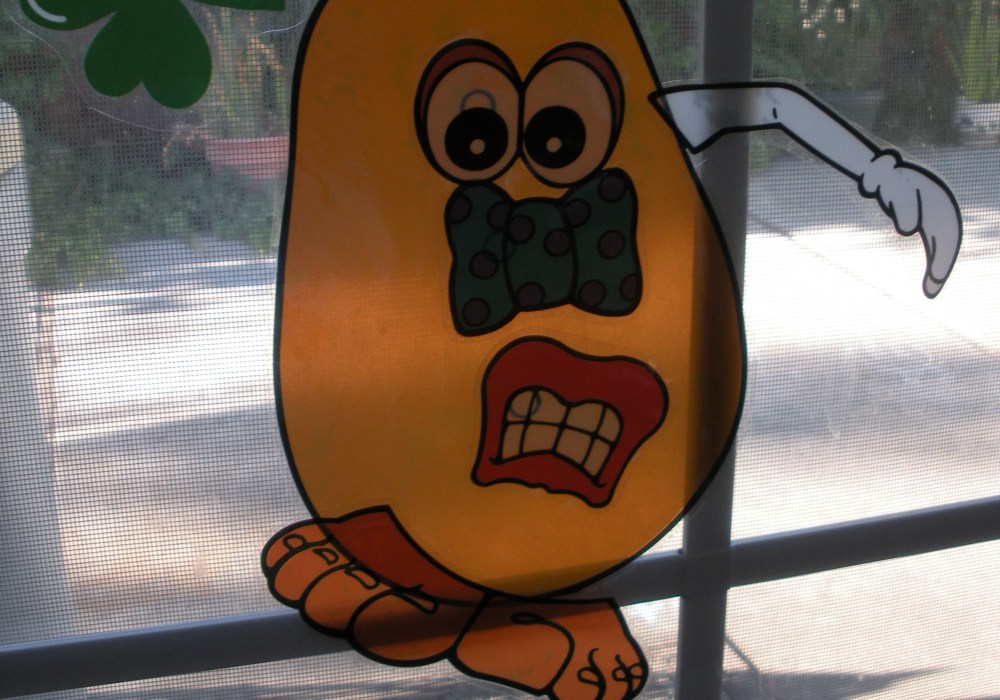
Short version: still revising Savage Autumn. I feel kinda like Mr. Mutant-Potato Head up there.

Long version….

Either I talk about my writing too much, or I don’t have much of a life otherwise (probably both), but the first words out of my friends’ mouths (after the generic hellos how are yous are out of the way) are: “How’s the writing going?”

I know I get all animated when I talk about writing. My writing, or anybody else’s, or the publishing world in general. It’s fascinating to me. And I’m not always good about pretending the same level of interest in anything else. There is probably a personality disorder out there to describe this.

Anyway. Long intro. Moving on. What’s going on with my manuscript?

For awhile there it was in mortal peril. I joined a critique group that had one member hating on my manuscript. Her points were fantastic and helpful, actually, but the delivery could have used some work. She’s not in the group anymore, but I needed about a week to nurse my ego and think about the characters and manuscript. Her comments, and the feedback from other group members, has inspired some rewrites and revisions.

Two other current critique partners have swapped manuscripts with me, and their comments have also been crucial. The whole experience reinforces that whole “writing is not a solitary effort” mumbo jumbo that you read at the beginning of acknowledgments pages (I read those. I really do).

Many of these writer friends have read more than one version of the same scene. All of them have been  spectacular in putting up with my indecisiveness, my questions, and my sometimes bitchy sensitivity.

Because Savage Autumn is nowhere near publication, and I read acknowledgments pages all the time, here is an toast to my critique partners and writing group friends:

Thank you to Seven, Jo, Pam, Seth, Robin, Helen, Mark, Jeri, Kary, Pat, Margaret, Cheryl, Theresa, and Colleen. And another thank you to my friends and family who have read the manuscript in its parts or entirety – whether you’ve given me feedback or not. Finally, thank you to the friends and family who haven’t read the manuscript but continually ask me how it’s going.

Total, abrupt subject change….

Update on next-door dogs: Yappy #3 lingers. Barks. Lingers.

Barks.