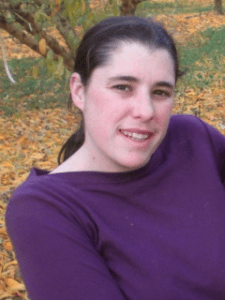
 Meet Jo Hart, a not-famous-yet author of picture books and a young adult fantasy work-in-progress. I met her through literary agent Mary Kole’s blog, and you can meet her here on mine.
Jo writes, teaches, moms, and lives in Australia. At the moment, we’re doing chapter-by-chapter critiques of each other’s manuscripts. The two of us have had great fun discovering grammatical, dialectical, and other linguistic differences between our uses of the English language. For instance, while I thought “mini-beasts” was a creative way to refer to toddlers, it is actually a widely-accepted term for bugs and insects in Australia.
And here…she…is!
BH: Tell me a little about your work-in-progress, The Wizard of the Middle Realm.
JH: It’s a YA fantasy novel about a 15-year-old girl named Katie. She loves to get lost in novels about wizards and magical creatures until she is thrust into the Middle Realm, a world not much different to the worlds in her books. Now all she wants to do is find a way home. Unfortunately the Middle Realm is a dangerous place and finding the one person who holds the key to her getting home will not be easy.
BH: When did you realize that you were a writer?
JH: Probably the day I learned to write, maybe even before then. I remember making a story book in kindergarten (which is what we call the year before starting school here), I had to get the teacher to write the words of course because I didn’t know how to write yet. Honestly I have always wanted to be a writer; I’ve always loved making up stories and creating characters.
BH: Where do you get most of your ideas and inspiration?
JH: Anywhere and everywhere. I get ideas from dreams, from sitting outside and observing the world around me, from an article in the paper, even books and movies can spark an idea. Take my current WIP: the world itself first came to me when I was walking around the farm with my dog, I would look at the cluster of trees and imagine a forest; the twins were inspired by two girls I went to school with; some of the other characters just spoke to me out of nowhere. I’ve always had an overactive imagination.
BH: Do you have a set writing schedule, or are you more of a “when the mood hits” kind of girl?
JH: I find it hard to schedule or write when the mood hits because I have two young children to work around. I usually take any opportunity I can when I have five minutes to myself (even if it means sometimes choosing writing over doing the dishes).
BH: AMEN on the dishes.
Katie, the main character in The Wizard of the Middle Realm, is a bit timid and lacks in the muscles department, especially compared to a lot of other popular heroes. However, she’s incredibly smart and resourceful. Can you compare her to anyone you know in real life?
JH: Katie’s actually based on me a little bit, what I was like as a teenager anyway. I was always the shy little bookworm at school, although I was a lot more sporty than her. I thought to myself, there are so many heroes out there who are strong and confidant, but what if the hero was just an average teen, someone shy and weak. I think it gives her more room for development as a character; and all the bookworms reading can relate to her.
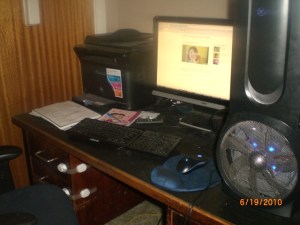 BH: What does your writing workspace look like?
JH: I write on my computer at my desk usually (although occasionally I use my laptop). The desk is generally untidy, covered in papers and odds and ends (mostly things my children pass to me like books and toys). The desk is in the lounge room so I can type and watch the kids at the same time, it used to be by the window overlooking the garden, but at the moment it’s been shoved into a little alcove in the corner while we’re getting ready to move house (which is where it is in the photo).
BH: Your picture book story, “Can You Jump Like a Kangaroo?” was shortlisted in the smories (original stories for kids) contest. Was this your first short story, or have you written others?
JH: I love writing short stories and children’s stories and have written many in the past. I have a couple of short stories posted on my blog actually.
BH: What is your experience like, balancing writing and motherhood?
JH: It can be hard to balance sometimes. I would love to be able to get lost in my story whenever the mood hits, but my kids are my priority so that doesn’t happen. My youngest naps in the middle of the day, so I usually take the opportunity to write then. My eldest has lunch and plays quietly in the room with me and I eat lunch at the computer while I write. Then if I’m not too tired after they go to bed I do some more writing then. I work as a substitute teacher too, so some days I don’t get any writing done at all.
BH: What is your favorite YA book of all time?
JH: John Marsden’s Tomorrow series (the first book is Tomorrow When the War Began and they’ve just made a movie from it). I first read the series as a teenager and loved them (as did every other teenager I knew back then, boys included). John Marsden has a great talent for writing YA, I used to read all his YA books as a teen and even once got to meet him! If you’ve never heard of him, check out his website. I highly recommend all his books.
And then there’s the Harry Potter series by J.K. Rowling, which I first read as an adult, and fell in love with right away. For me it’s a close competition between Marsden and Rowling.
BH: How about your favorite book on the writing craft?
JH: Kate Grenville’s The Writing Book. It was actually one of the prescribed texts for my Writing major at university, but unlike most other textbooks I had to buy and that ended up in a cupboard never to be read again, I keep Grenville’s book close by my computer as a valuable resource. There are some great writing prompts and activities in there that I even use in the classroom sometimes. It has great advice for all aspects of the writing process from character to dialogue to description. You can check it out here.
BH: Why do you want to be published?
JH: I think it would be amazing to walk into a bookstore and see a book I wrote sitting on a shelf with my name emblazoned across the jacket. It’s always been my biggest dream to be a published author, for my words and ideas to be immortalised in print and live on after I’m gone.
BH: Lately in the publishing blogosphere there’s been a lot of talk about how to craft a good setting for a novel. Because you’re writing a fantasy, I’m wondering what sort of challenges you’ve faced with the setting in your novel, and how you have worked through them.
JH: I suppose the biggest challenge would be conveying the image I see into my head onto the page so the reader can see the world the way I envision it. Of course every reader will interpret and see the world differently, but I want them to get a general sense of the world. Like in the woodland scene in the beginning I want to convey a place that feels lifeless. Usually when I’m describing a setting in my novel I close my eyes to get a clear picture in my head. As I write I think about not just what my characters can see, but how the bark feels on the trees, what smells are in the air, what sounds they can hear. It’s more than just painting a picture with words; creating a setting is about getting the reader to experience it as though they were standing right there alongside your characters.
BH: One thing you do especially well in your writing is convey suspense through narration. Do you have any tips for other writers on how to do this well?
JH: Use the five senses. Get into the main character’s head and imagine yourself in the same situation, what sounds, sights, scents, etc. would make your heart beat faster? And use short sharp sentences, but make sure they vary in length so they don’t become monotonous.
BH: What is the best advice anyone has given you with regards to your writing?
JH: Show, don’t tell. It’s my writing mantra.
You can see a video of a very expressive girl reading Jo’s story “Can You Jump Like a Kangaroo?” here. And for more info and insights into Jo’s life and writing, you can visit her blog.
Thanks for the interview, Jo!
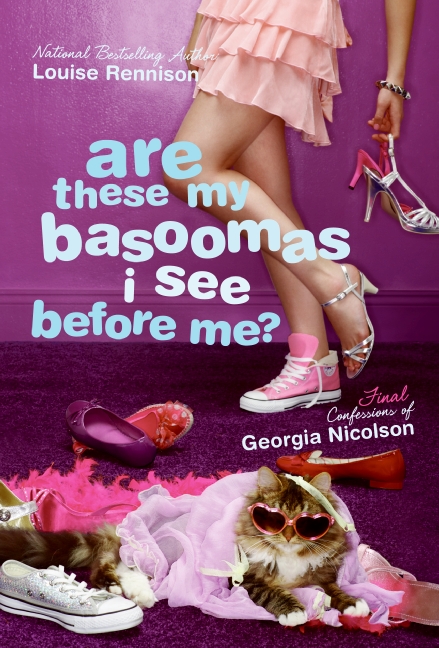 Last October, Louise Rennison published the last installment of her Georgia Nicolson series. The one with all the extremely weirdly titled books, the kind that are hard to ask book store associates about over the phone because they keep saying, “What? What? Can you repeat that? Can you spell that? Did you say ‘basoomas’?”
 Georgia’s voice is the absolute best part of the books. The novels are written diary-style (I’m sure there’s an academic term for that kind of novel, but as Georgia would say, “Qu’est-ce que c’est le point?”). Her adoption of French and German phrases, as well as her clique’s slang creations, only add to the humor. Add that to the run-of-the-mill linguistic differences between the US and British lexicons, and you will need the glossary provided at the back of each book. But unlike a textbook glossary, you will enjoy reading it, because Georgia is just as funny there.

 Beth Hull