NiFtY Author: Katie Pickard Fawcett

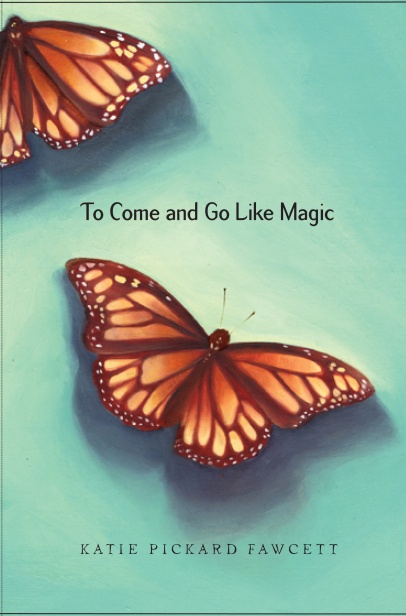
A few months ago I reviewed Katie Pickard Fawcett’s book To Come and Go Like Magic (click here for the review), and I was delighted when she agreed to an interview on my blog. So without further blather on my part…here’s a truly inspiring interview!

BH: I could be wrong, but To Come and Go Like Magic seems like one of those books that the author just had to write…like you couldn’t not write it. What inspired the story?

KF: My own childhood growing up in Appalachia was the inspiration for the setting, characters, and experiences.  Some years back I read The House on Mango Street by Sandra Cisneros and loved the way she told the story in vignettes.  I was excited to write a book about Appalachia in this style with glimpses into the lives of many different characters.

BH: Chili, the main character, longs to see the world. Then she befriends her teacher Miss Matlock, who has traveled extensively. Did you ever have a Miss Matlock in your life?

KF: No.  I didn’t have a teacher who had traveled the world and came back with stories to tell.  I did, however, have several wonderful teachers who read great books to us, encouraged me to write stories, and offered interesting classroom activities.  The trip to Mexico chapter in To Come and Go Like Magic was very similar to a geography activity we did in fifth grade.  Miss Matlock’s travels, her interest in the Monarch butterflies, in hiking in the Andes, and in the rainforests of Central America come from my own experiences.

BH: Another fantastic element of To Come and Go Like Magic is the setting. How much of the story’s setting is based on your imagination, and how much is based on your actual experiences in Appalachia?

KF:  I grew up in Eastern Kentucky so the setting is based entirely on the actual area and the environment, activities, problems, and concerns of the 1970s.  The characters, story, and most of the place names are fictitious.  I kept the name (Cumberland) of the real river.

BH: Your book is told in vignettes, and in some places these vignettes have such flowing language I think of them as prose poems. Was this your intent from the beginning, or did the format emerge as you told the story?

KF:  I love poetry and I enjoy writing “snapshot” pieces, so my writing tends toward the poetic.

BH: Can you tell us about your experience publishing To Come and Go Like Magic?
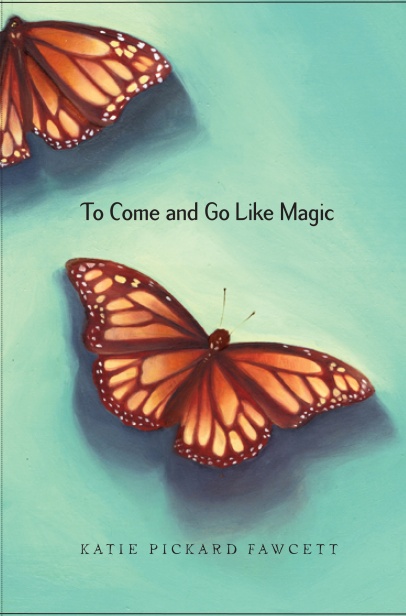
KF: I sent To Come and Go Like Magic to Random House and got a call and a contract within the month.  Sound too good to be true?  The complete story is a bit longer.  I worked for ten years in the publishing department of an international organization writing pieces for the house journal, summaries of development projects, and publicity pieces, and didn’t have much time to write fiction.  I was also a social worker in Kentucky, worked for a consulting firm in Washington, DC, and spent three years at various jobs at a university.  I majored in psychology, sociology, and education in college.  I also tutor and teach writing workshops and SAT prep on occasion.  I wrote a young adult book several years ago and sent it to Dutton.  They had me do two rewrites and then rejected it.  Ditto for Scholastic.  Then off to Random House.  After the second rewrite, my editor said she was willing to read it one more time.  I figured it wouldn’t fly.  So I asked if I could send her another manuscript I had lying around and she agreed.  That was To Come and Go Like Magic.  I spent about 6 years researching, writing, and revising the first book that got rejected by three big publishers over a period of 3 or 4 years.  I spent about 6 weeks writing To Come and Go. Just goes to show that “write what you know” makes sense.  Research was limited primarily to fact checking the dates for songs and foods and movies mentioned in the book.

BH: That is amazing, and heartening at the same time. I’m not surprised, though – I really get that “inspired” feeling from To Come and Go.
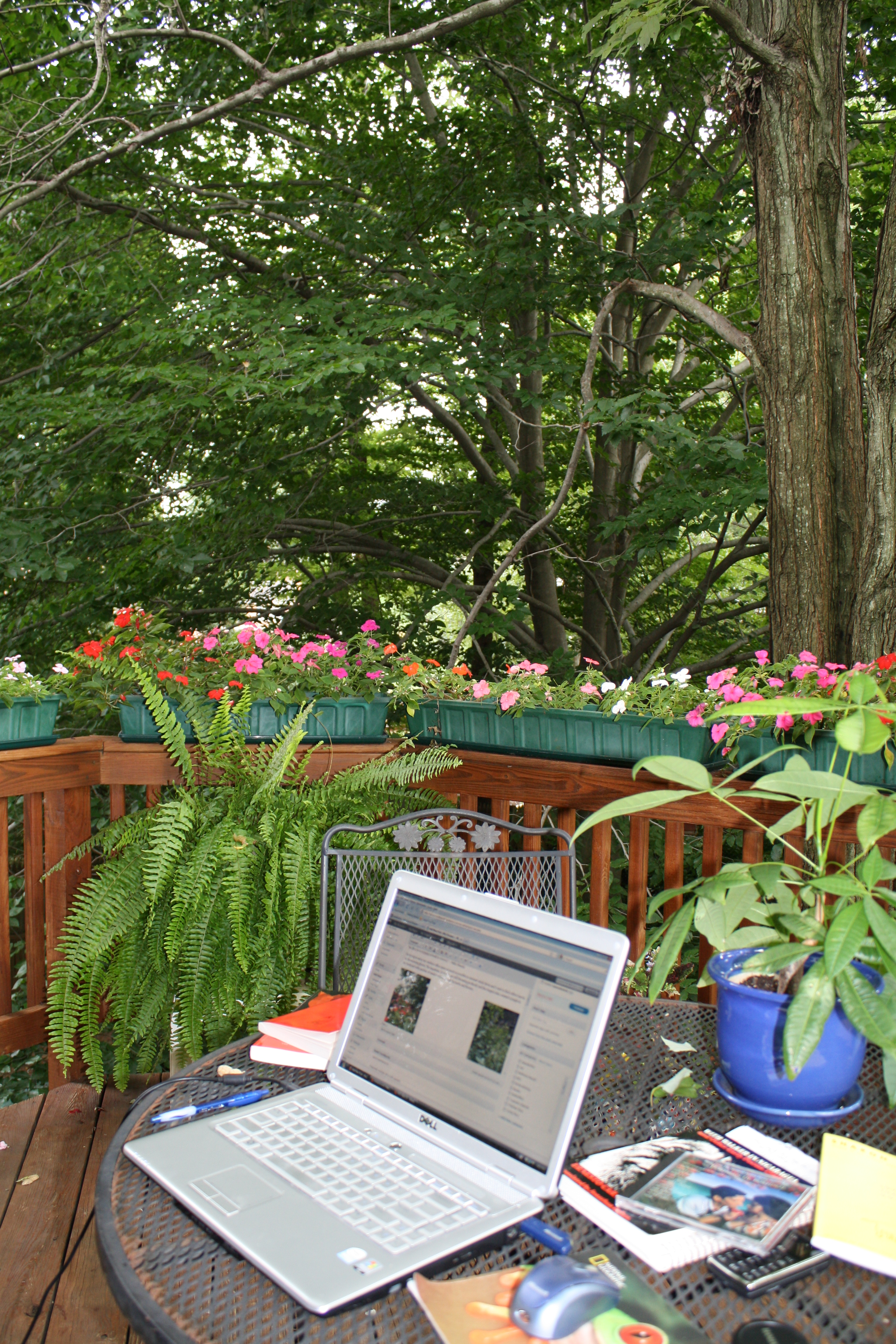
What does your workspace look like?

KF: My preference by far is to work outside and I love my laptop.  I enjoy the flowers and birds and furry critters that visit.  When it’s raining or too cold to be outside I work in my study.  I have a window that looks down to the front garden and three bird feeders – two for the squirrels and one that’s squirrel-proof.  A family of blue jays comes by almost every morning for peanuts.  They often respond to my whistle if they’re in the vicinity.  My study is filled with books and doo dads.  I have a hummingbird mobile above my desk, starfish on the window sill, green plants, and a CD player because I like music in the background while I’m working.

BH: What is your favorite book on the craft of writing?

KF: I have three books that I enjoy opening and reading a chapter or two when the mood strikes.  Reading Like a Writer: A Guide for People Who Love Books and for Those Who Want to Write Them by Francine Prose is entertaining and filled with great humor and wisdom and excerpts from some of the best writers past and present.  On Writing Well: The Classic Guide to Writing Nonfiction by William Zinsser has been around since the late 1970s and is still an excellent guide.  Many of these fundamental principles can be applied to fiction as well as nonfiction.   If I had to choose a favorite, however, it would be a little book published in 1996 titled Poemcrazy: Freeing Your Life With Words by Susan Goldsmith Wooldridge.  This is a marvelous little book filled with many inspiring exercises for getting the creative juices stirring.

BH: Any words on advice to aspiring writers for keeping the hope alive?

KF: I have been writing stories for almost as long as I can remember.  I passed stories around in elementary school and in high school study hall.  It seems that I have always needed to write and, although it can be physically tiring and mentally exhausting at times and rejection is always disappointing, it has never truly felt like work.  Publication is a big plus, but has never been a necessity for me.  The old saying that “it’s only work if you’d rather be doing something else” applies.  I love to write and it’s the passion, I believe, that keeps the hope alive.

BH: Thank you, Katie, for the great interview. I learned from this, and I appreciate your responses, insights, and inspiration.

Studio Audience! For more of Katie Fawcett, and where to order her book, check out the links below.

Links:

http://katiepickardfawcett.wordpress.com/ (On my blog I write about Kentucky, DC, Mexico, Costa Rica, Ecuador, the Caribbean, books, food, flowers, squirrels, and anything else that strikes me.)

Order from Amazon –

http://www.amazon.com/Come-Go-Like-Magic/dp/0375858466/ref=sr_1_1?ie=UTF8&s=books&qid=1287454169&sr=1-1

Order from Random House — http://www.randomhouse.com/kids/catalog/results.pperl?keyword=to+come+and+go+like+magic&submit.x=17&submit.y=10&submit=submit

To Come and Go Like Magic was a Parents’ Choice Award Winner in the fiction category for Spring 2010   http://www.parents-choice.org/award.cfm?thePage=books&p_code=p_boo&c_code=c_fic&orderby=award

Also nominated on October 9 for the Amelia Bloomer Project Award – an annual booklist of the best feminist books for young readers chosen by the Social Responsibilities Roundtable of the American Library Association  http://ameliabloomer.wordpress.com/
One Fish, Two Fish, Blue-fish, Blue-fish, Blue-fish

In which the Ever-Suffering Mother gets crafty.

Last year's Red-winged Blackbird costume. I'm smiling 'cause the sewing is OVER.

This Halloween, Z is old enough to choose what she wants to be. Her first Halloween she wasn’t even three months old, so I got to decide (butterfly). Second Halloween,  I got to decide (Red-winged Blackbird). Third Halloween: she wants to be a fish (not what I would have chosen).

"Baby" as model.

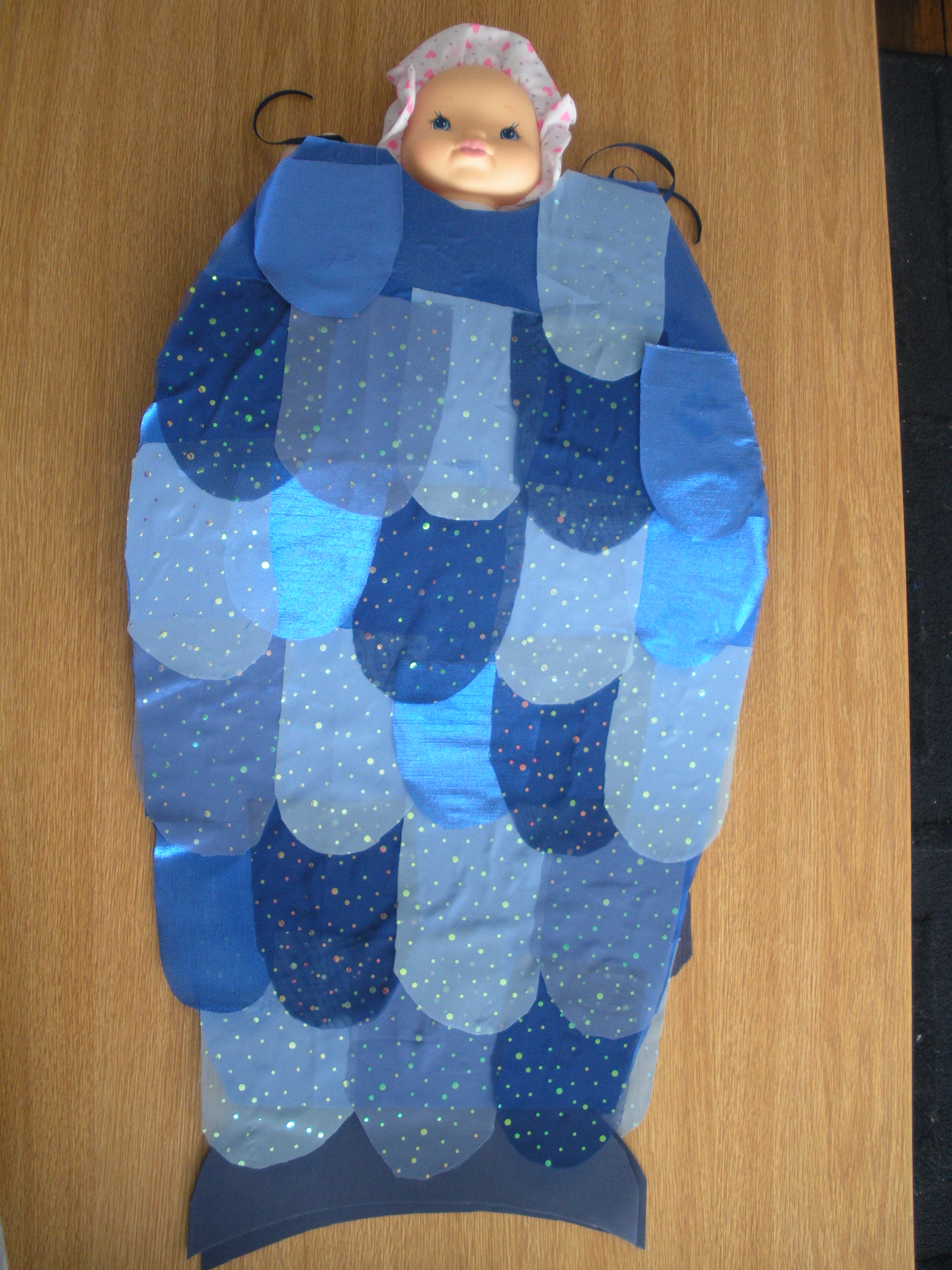
So here’s how I made a very easy fish costume. Some assembly required. But no sewing.

Step One: Find a babysitter. You do NOT want to take your two-year-old into Jo-Ann’s Fabrics. Bad idea.

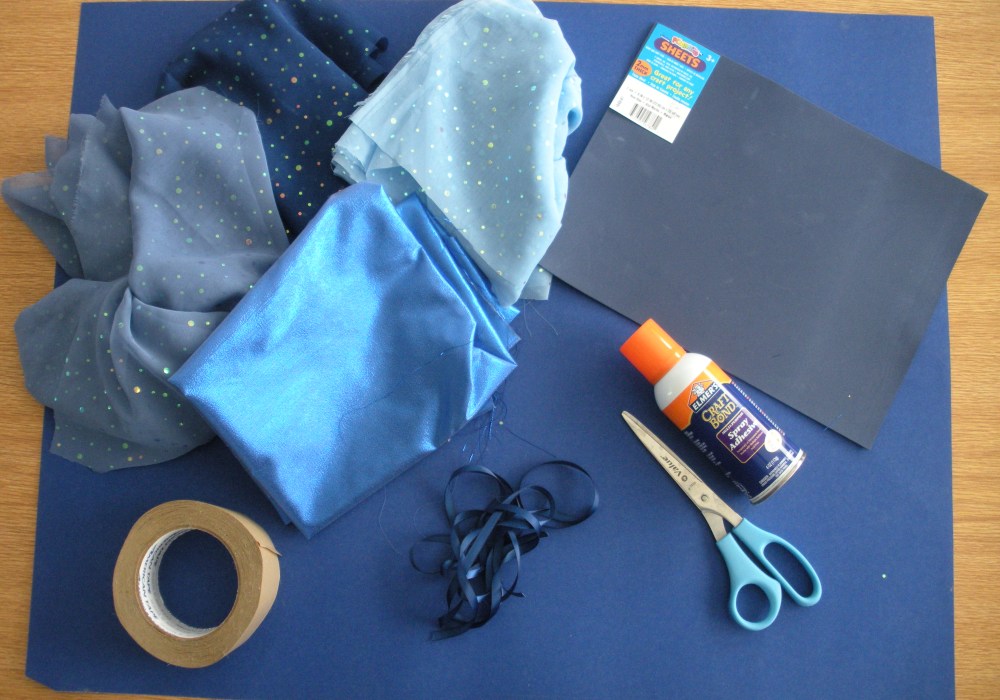
Step Two: Head to a craft and fabric store to gather materials needed. You will need:

  • 2 pieces of poster board. I chose blue because she wants to be a blue fish, but it doesn’t really matter.
  • fabric. Two yards total would have been fine for my two-year-old. I went overboard, buying four different shades of blue, some with bling, some shiny. It depends on what you want for the end result. One yard should be your “base” for the fish, so when scales don’t match up right, you don’t have poster board showing through. Note: I think I got extra mileage from my “yard” because the fabric is sheer and was doubled up.
  • 2 9X12-inch foam sheets (the ones I bought are 2 mm thick)
  • dark blue ribbon
  • spray glue
  • strong masking tape
  • a lot of hope
  • prayer won’t hurt

Step Three: Cut a toddler-sized fish shape (minus fins – so basically an oval) from both pieces of poster board (just grit your teeth and eyeball it, then cut away). I used Z to measure how long to make the ovals.

Step Four: Cut out the fins for the bottom. Z’s fins are one foot wide.

Step Five: Cut two ovals from your large piece of base fabric to roughly match size of poster board ovals

Step Six: Cut out lots and lots of “scales” from the fabric. I was not exact on this, and I think the more size/shape variation you have for the scales, the cooler it will look. The scales I cut were anywhere from 5 inches long to 6.5 inches long, and between 3 and 4 inches wide.

Step Seven: Using the spray glue, glue the base fabric onto the poster board. If it’s wrinkly, don’t worry, it’ll barely show after the scales are on. Trim off excess fabric.

Step Eight: Use masking tape to attach the fins to the bottom (tape them to the reverse side of the poster board so the tape doesn’t show).

Step Nine: (the fun part!) Glue on the scales. I started at the bottom and used spray glue. I glued the bottom row first, then moved up to the next row, trying to vary the ways the scales overlapped within rows. I don’t think it really matters.

Step Ten: Using whatever genius is left over in your craft-fried brain, figure out a way to attach the two pieces of poster board to make a front and back of the fish. I used ribbon (fixing it in place with extra masking tape), but I will probably change this before the Big Day, because I don’t think ribbon is strong enough to withstand a toddler running around. I might use leftover scraps from the poster board (and more masking tape. Love masking tape).

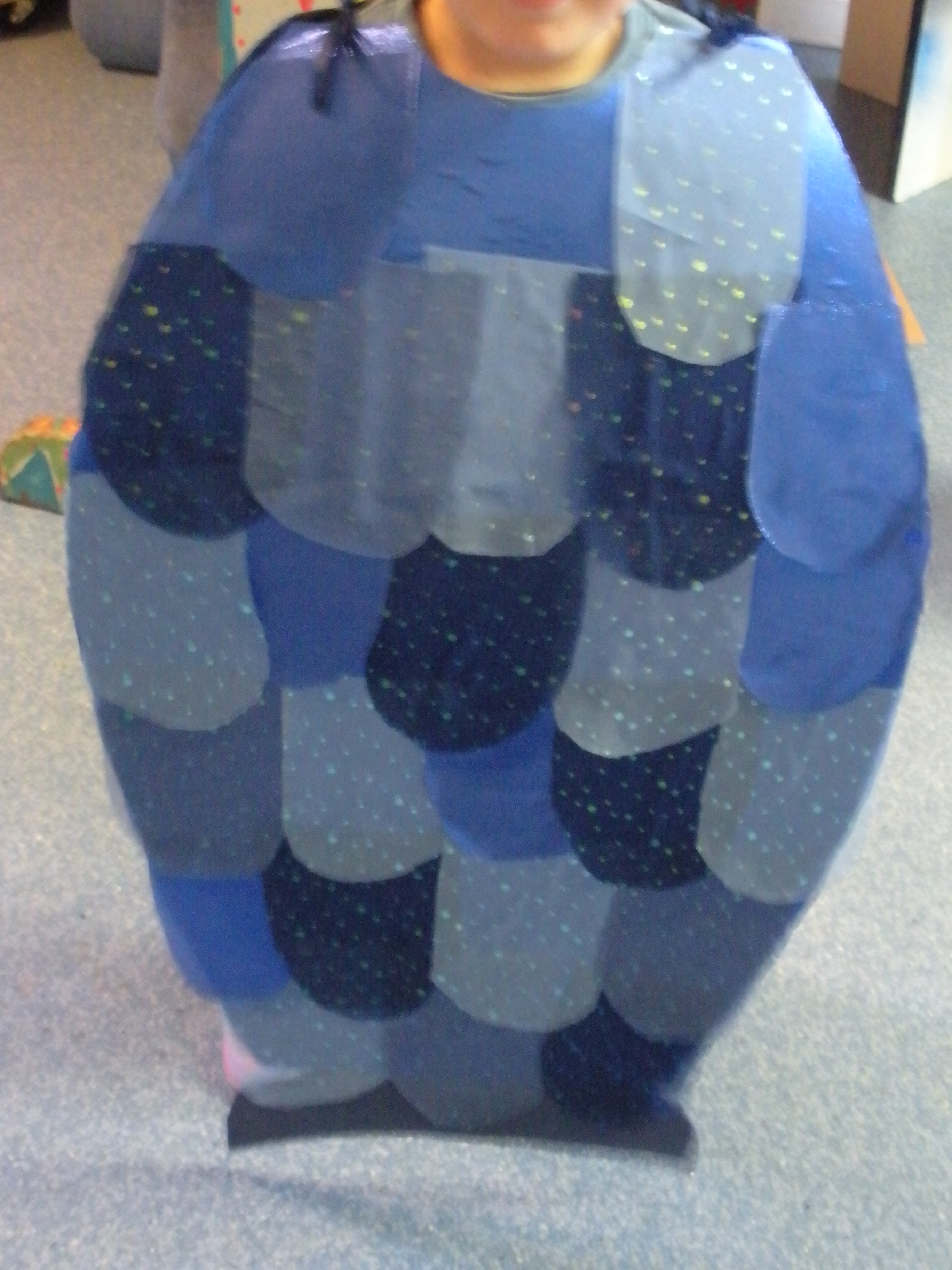
I am not worrying about extra fins or anything. The scales and tail fins peg it as a fish. I only lost one night of writing by working on it, and Z LOVES it, so I’m a happy mom.

Z modeling her costume at school


Mommy Goes To Los Angeles

My first weekend away from home since Z’s birth deserves a tribute, and Z deserves a new book. So I made one for her. It cost no money and took approximately forty minutes to create. The illustrations especially are an indication of the book’s hasty publishing.

Z has been without her father for weeks at a time (usually for work), so she’s used to him being gone (although she never likes it). Because I’m always around, I thought a book might be a good way to explain what’s going on. I could just tell her, but that would be boring.

Plus, I love making books.

So here’s the text:

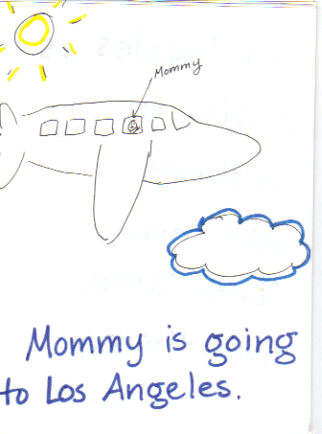
Mommy is going to Los Angeles.

Los Angeles is a city in southern California. Auntie Dana lives there.

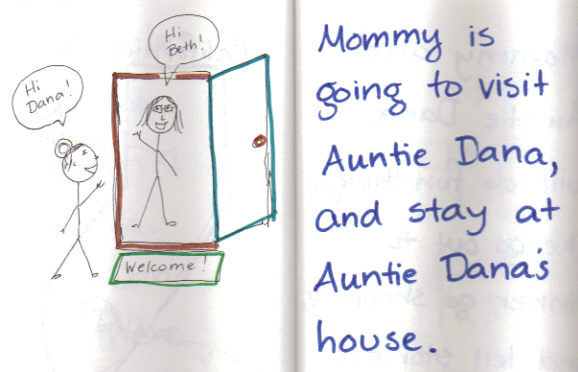
Mommy is going to visit Auntie Dana, and stay at Auntie Dana’s house.

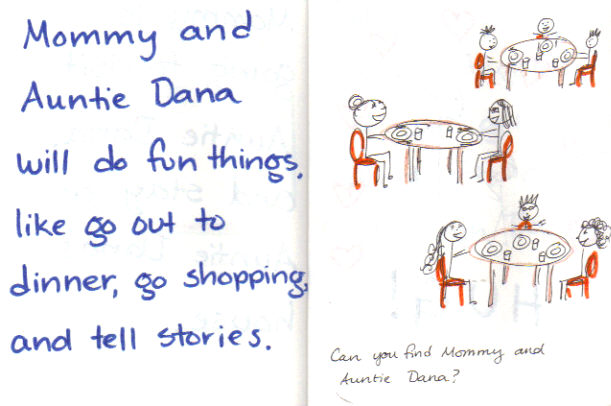
Mommy and Auntie Dana will do fun things, like go out to dinner, go shopping, and tell stories.

While Mommy is in Los Angeles, Z will get to spend lots of time with Daddy!

Z and Daddy will eat together, play together, and do naptime and bedtime. Maybe they’ll read lots of stories, like this one.

Even though Mommy will have fun with Auntie Dana, she will miss Z and Daddy and Clark very much!

But remember, whenever Mommy goes away…

Mommy comes back!

Kids are so easy to impress. She LOVES the book. She especially liked how I used her markers to make it.

Quick bit of blog business (three things):

1) No post on Monday. I have a great book to review for you (Plain Kate by Erin Bow) and I want to do it justice, not, like, write it while I’m in an airplane.

2) Starting in December we’re going down to two author interviews per month. I’ve been missing my free-for-all entries. Starting next Friday, interviews will be shorter.

3) I’m thinking of going down to two updates per week. I need to focus on my fiction, which was the whole reason for starting this blog-website. If the blog is taking over fiction time (or family time), that’s a problem.

Happy weekending, everyone!

NiFtY Author: Jeri Westerson

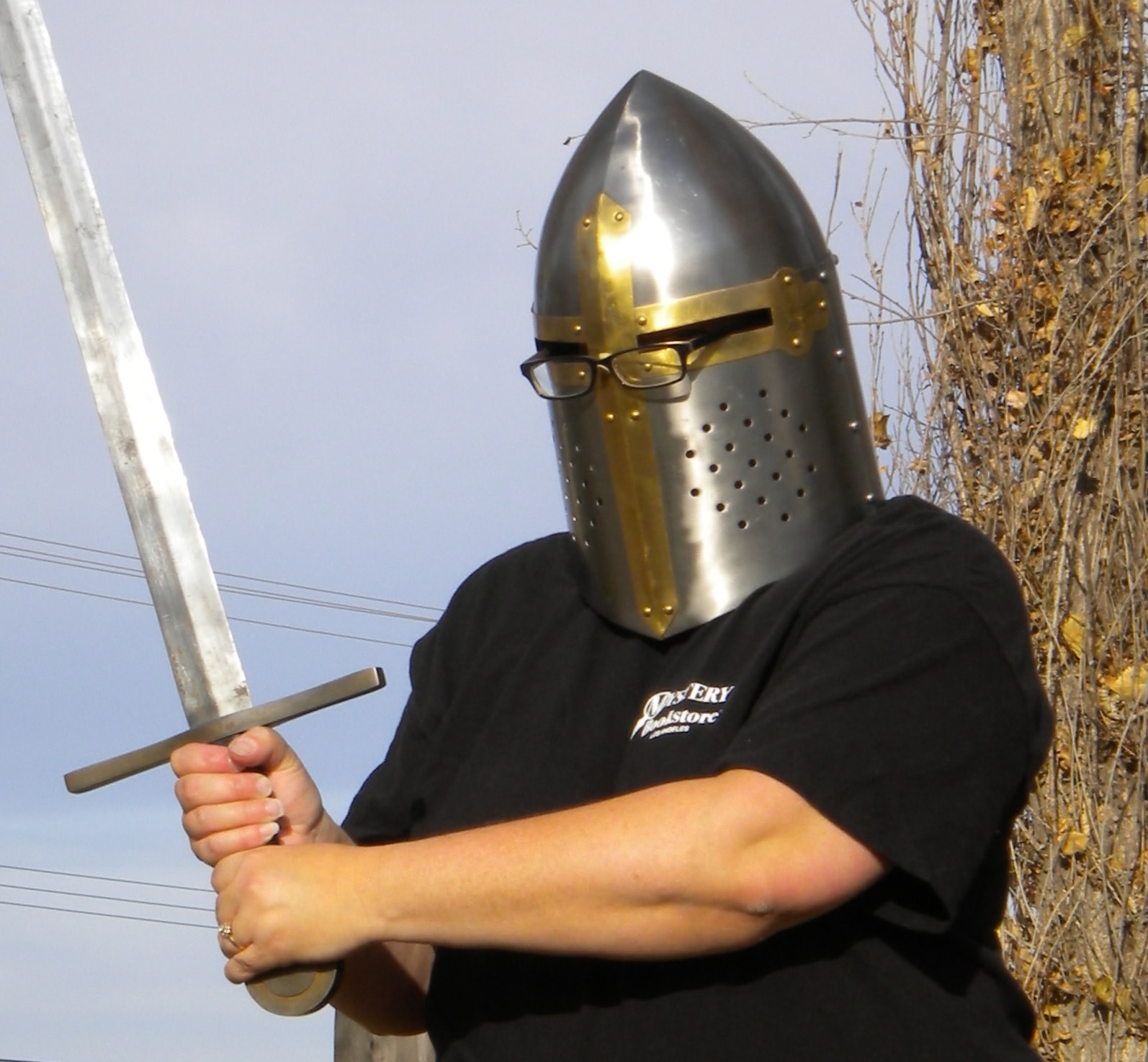
We’re taking a break from contemporary mysteries and moving back in time…far back in time. Try…the Middle Ages. Meet Jeri Westerson, author of the Crispin Guest medieval mystery series. In addition to writing great books, she’s not afraid to don a helmet and wield a sword (see photo below!).

BH: What’s your one-paragraph pitch for the latest novel in your Crispin Guest series?

JW:  In THE DEMON’S PARCHMENT, Jacob of Provencal is a Jewish physician at the king’s court, even though all Jews were expelled from England nearly a century before. Jacob wants Crispin to find stolen parchments that might be behind the recent gruesome murders of young boys, parchments that someone might have used to summon a demon which now stalks the streets and alleys of London.

BH: The Demon’s Parchment, due out October 12, is the third book in this series. When you wrote the first novel, did you plan to create a series mystery?

JW: Yes, it was always designed that way. I had never written a series before so when I completed the first one I just jumped right into the next book, first to see if I could write a series and second because I really liked my character.

BH: What are some of the joys of writing a series character?

JW: Writing series fiction is wonderful because you can really have a chance to explore your character fully, and in my case, to see him age. His story arc can go on a long time. At least for as long as the publisher wants to publish the books. I hope that will be a long time because I have quite an extensive timeline for Crispin. I think that it’s a good idea to have some idea how the series will conclude and then all the background story arcs can lead inevitably to that conclusion. I really don’t know of any series that should go on forever. The stories can get too trite, too clichéd. Best to conclude them in a timely fashion. That being said, I’ve got some thirteen more novels in mind before I’m done with Crispin.

BH: Crispin Guest sounds intriguing: flawed, enigmatic, sexy…Where did you get the idea for this character?

JW: I wanted to write a medieval detective story, not like a Brother Cadfael with an amateur sleuth, but something more along the line of a medieval Sam Spade, a tough guy who’s hired specifically to do the dirty work. I thought that this Dashiell Hammett/Raymond Chandler kind of hard-boiled detective would translate well into the Middle Ages. No one else was doing it. As far as I could tell, authors were churning out the same old medieval mysteries they always had, and that was fine, but I wanted to write something a little different, with a little more action, a little more violence, and sex! They say you should write what you can’t find out there to read. The trope of the hard-boiled detective as a loner, someone who has a chip on their shoulder, who has run-ins with the cops is a familiar one. Raymond Chandler’s Philip Marlowe was designed as a white knight with his own code of honor, and so I thought that a real knight—disgraced or otherwise—would work as well. Everything is kept true to the time period, including Crispin’s feelings about honor, faith, and other cultural necessities. (And actually, all the sex is off screen so no worries for all the fan boys and girls out there, and there are quite a few young male readers.)

BH: And who’s the hottie posing as Crispin on your website header? I have some single friends who may want to get in touch with him.

JW: Mmm. Yes, he’s got quite the following now. He’s the fellow on all the book covers. All I know is that he is a model named Wes and probably lives in Oregon. Before we changed the covers from the rather static VEIL OF LIES hardcover, my editor showed me Wes’ model sheet and I said oh yes. He’ll do. The paperback division didn’t like the hardcover VEIL cover image and so St. Martin’s went back to the drawing board to come up with something else, something different. Something like I wanted in the first place! Since my novels are very character driven, I thought it would be better and more interesting to have a figure on the cover in a moody London background and they certainly delivered. It makes it look very different from your average medieval mystery. I love my book covers now. I think they are very cinematic. Hollywood, take note!

BH: Do you plan to stick with Crispin for awhile, or do you have other project ideas (or both)?

JW: I certainly have a lot of Crispin’s story to tell, but currently I am working on a second medieval mystery series, one that’s a little more light-hearted than Crispin’s tales. If that one doesn’t work out I’ll have to think of another one. It’s a good idea to have a few series out there, something else for fans to sink their teeth into. But I fully intend to continue with the Crispin novels. Number four, called TROUBLED BONES, comes out Fall 2011.

BH: Is it hard to write from a male perspective? Do you have any tips for authors who wish to write from the perspective of the opposite sex?

JW: I don’t find it hard at all. In fact, in all the novels I have written (some twenty-two) I’ve only written from the female perspective three times. I don’t enjoy that. I enjoy getting into the male mindset, all that uniquely male thinking. I find that whole “band of brothers” thing fascinating. There is no female equivalent. I was a tomboy growing up and I think I’m still a bit of a tomboy. I always gravitate toward the groups of men at parties…unless they’re talking about sports. Can’t get into that at all.

The only advice I have to offer on writing the opposite sex is observation. I hate reading a female character who does guy things or a male character who does girl things. You shouldn’t be able to tell whether the author is male or female either. It shouldn’t matter if the characters are well written.

BH: Do you write full-time?

JW: I have had the luxury of writing full time only since June but that won’t last. When the money runs out you might see me at your local McDonald’s behind the counter. If you think you are getting into writing novels for the money you are sadly mistaken. Even writing for a big publisher does not guarantee a living wage, at least not at first. They say that it takes till the fifth book for the author to make a profit. I have to pay my own way to mystery fan conventions, book touring, and something as innocuous as getting bookmarks printed. All my advances go back into promotion. So I do a lot of traveling and a lot of public speaking. It’s all about sales. So buy, buy, buy! Fortunately for readers of all stripes, my books are available in a few formats: hardcover, paperback, and e-books. (The SERPENT IN THE THORNS paperback was released September 28.) And readers should check out my series book trailer on my website. It gives you a good idea of what the series is all about. Very moody. Talk about cinematic. And you get to hear Crispin speak!

BH: What is your writing schedule like?

JW:  I do my writing business in the morning, answering emails, going on Facebook, Twitter, blogging (I have two blogs; mine called www.Getting-Medieval.com. It’s like a magazine of articles on history and mystery, and Crispin’s blog at www.CrispinGuest.com. It’s his Facebook page, by the way, so look for his name, not mine.) I do a little writing and/or research in the late morning, some reading during the middle of the day, then do more writing late afternoon and into the evening. I’m also trying to write some short stories and a barrel of blog posts for my fall blog tour.

BH: What does your workspace look like?

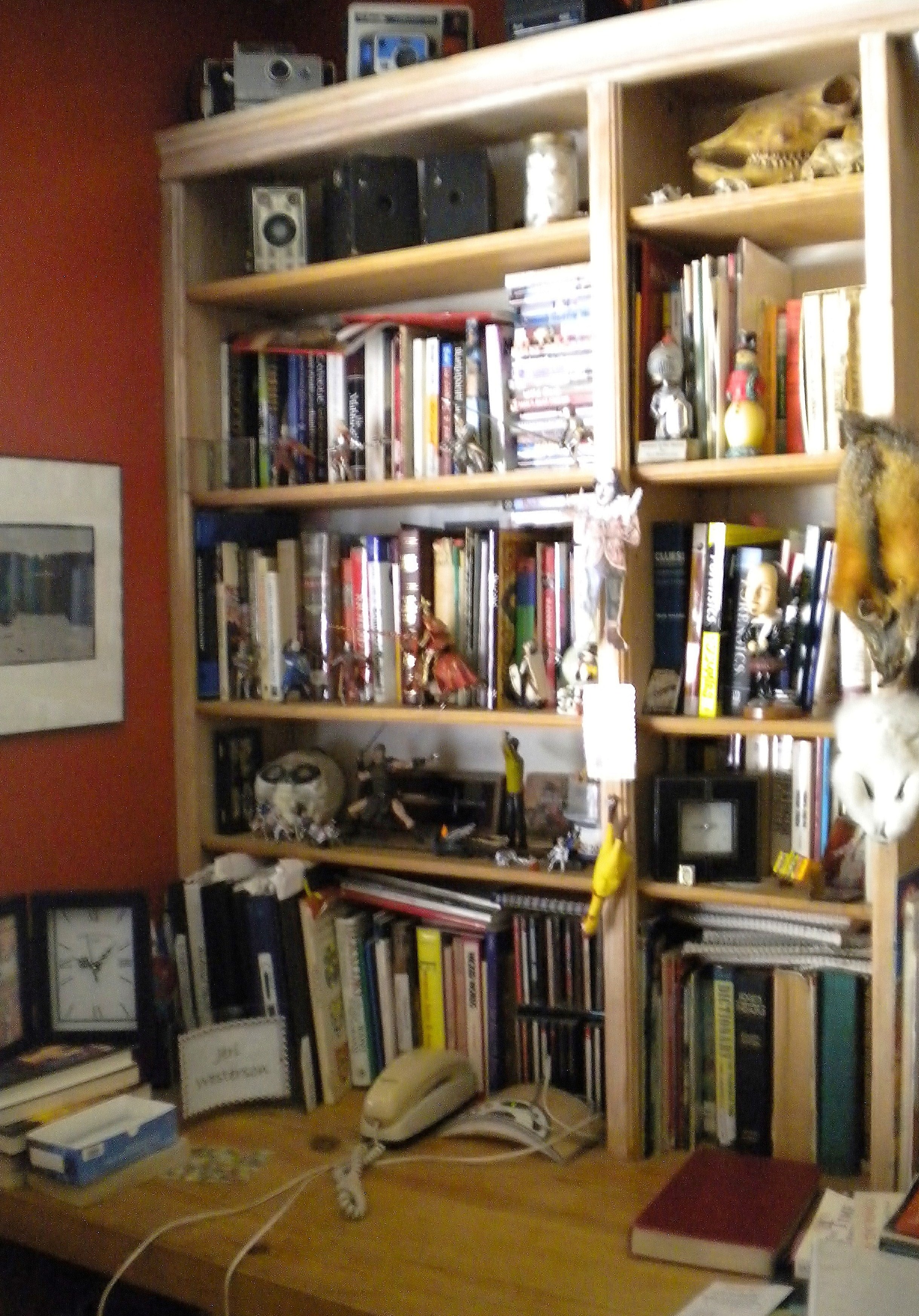
JW: I have a home office chock full of books, books, and more books. My desk is, in fact, specially built just for me (by me and my husband. We are truly Renaissance people with many hands-on skills) with a ten foot long flat surface (covered in papers and notes) with shelves above and behind me with another ten foot long surface mirroring my desk. I have a lot of research books about knighthood, everyday life in the Middle Ages, medieval words, cookbooks, commerce, religion, forensics, people, roads, maps, clothing, woodlands…you name it, I’ve got it. I also have a lot of toys, a lot of knights in battle all over the shelves; some Harry Potter stuff like a Time Turner; a couple of fox pelts hanging on the shelf; some assorted snowmen (because I collect them); a bunch of old cameras (because my photographer husband collects them); some skulls (a sheep, a goat, a cat, a rabbit, a mouse—all collected from our yard or surrounding area when it used to be more rural); a dagger I like to play with while I write; a small figurine of Death; a rubber chicken; a Shakespeare bobble head; two framed posters (one of a Klee the other a Kandinsky); a rather dashing picture of my hubby; a candy dish, empty; a figurine of a Golem; my “Box of Death” which I cart around to my speaking engagements which includes a helm and a bunch of medieval weapons; a coffee cup warmer; computers and printers (of course); and a comfy swivel chair that has seen better days. And two cats who are really not supposed to be in there, but they worm their way in with big soppy eyes and soft furry faces and type in my novels and leave hair absolutely everywhere.

BH: What is your favorite book on the craft of writing?

JW: The last really great novel I read.

BH: What is the best writing advice anyone has given you?

JW: Don’t give up. That would be from my long-suffering husband.

BH: Any words of advice to aspiring writers for keeping the hope alive?

JW: Learn the business. Don’t be an amateur, be a professional and learn your craft, research the industry before you start to ask questions. Then network with other authors. Keep on writing and reading. As you finish one novel, start writing the next. Don’t wait around for the first one to sell before you start another. The first one may never sell. Mine didn’t. Write the best darn books you can. Take the advice of professionals. Don’t dismiss it just because you don’t want to hear it. And don’t self publish just because you can’t place that one darling manuscript. Maybe there’s a reason for its being rejected over and over. Write the next book, and the next. Hone your craft.

Thank you, Jeri, for telling us about your books, sharing your insights about the writing life, and bringing us one step closer to Wes, your Crispin cover model.

For first chapters of Jeri’s novels, book discussion guides, and her fabulous series book trailer, go to her website at www.JeriWesterson.com.

Click the titles to view each book on Amazon.com:

The Demon’s Parchment (third in the series)

Serpent in the Thorns (second in the series)

Veil of Lies (first in the series)

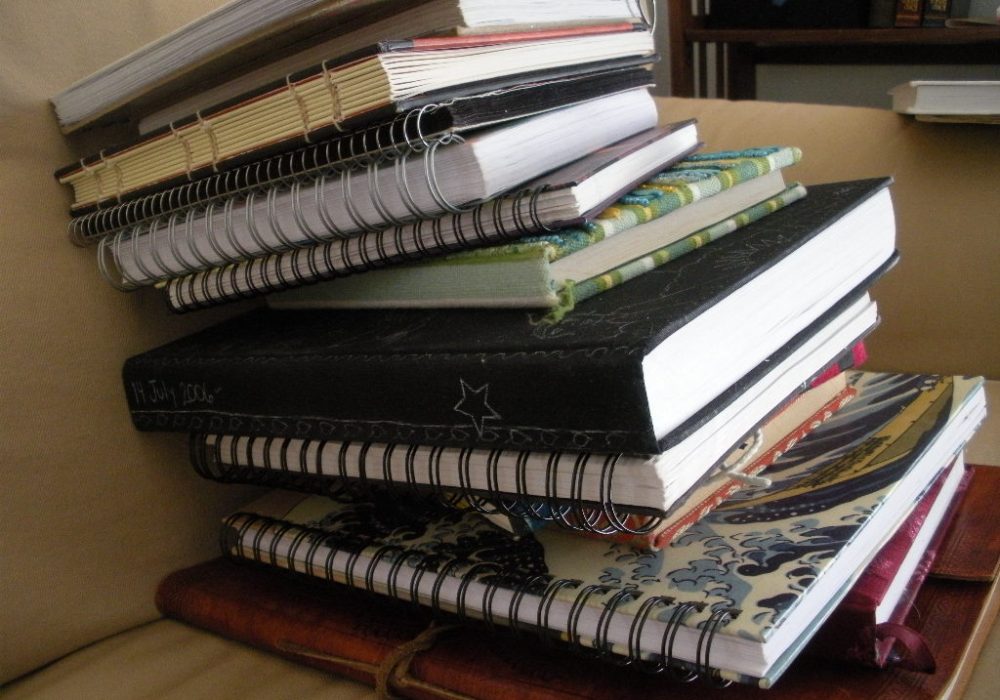
Diary Books I Have Known and Loved

The topic today is diaries. I have more books than I care to count, and most of them are full (although I just bought two new blank ones when I was picking up my copy of Mockingjay).

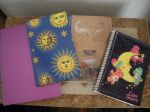
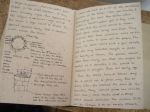
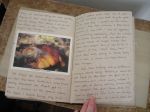
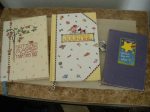
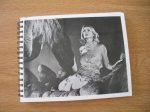
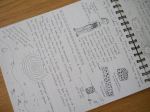
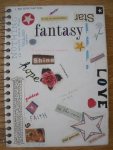
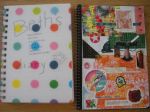
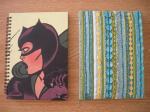
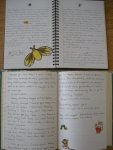
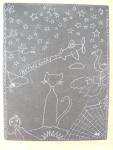
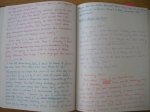
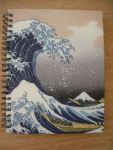
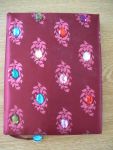
So here are photos of the book covers and some of the pages, in all their glory, spanning over ten years of writing. Except for one, every one of these has been filled up with my (often pointless, repetitive, self-obsessed) writing (something like this blog, actually).

By the way, I had quite a few extra “excerpt” photos, chosen for their bright, colorful pages and/or illustrations. Upon closer examination, though, I found either embarrassing confessions or cruel, vindictive entries (usually about ex-boyfriends. Sorry boys).

What makes a good diary? An accidentally pornographic cover is always a plus (see black & white photo diary, above). My preferences include plain, quality paper so I can use a variety of pens and they won’t bleed through. Spiral-bound is easier to write in. I prefer somewhere in the ballpark of 6 by 8 inches, although some of my favorites are 8.5 by 11.

If you have a favorite diary, or diary preferences, I’d love to hear about them.