Friday Five – Revisionist Edition

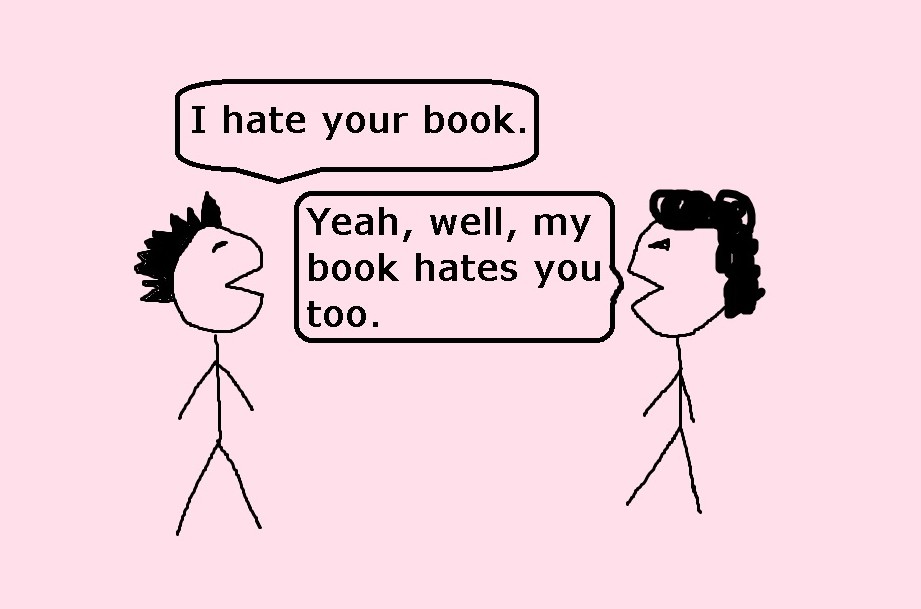
1. My first idea for today’s post was a scripted fight between the main character of The Black City/The Key to Selene/The Whatever It’s Called, and the main character of my new work-in-progress. The main character of the new WIP is a bit miffed because I keep shunting her aside to revisit revisions on TBC/KTS/WIC. I ended up not writing the scripted fight because it would probably only be funny to people who have read those manuscripts. Or, worse, it would only be funny to me.

2. I am, once again, pleased/humbled/overcome with gratitude for the people who listen to me obsess and gripe about writing. While I do attempt to curb the writing talk, I rarely succeed. So thanks for listening.

3. That said – why are titles so hard? I joked with my friend D-Chan that I’ll just call it “UNTITLED WITH WITCHES AND MAGIC AND BETRAYAL.” She suggested a subtitle, making the whole thing “UNTITLED WITH WITCHES AND MAGIC AND BETRAYAL (and maybe a bear on a motorcycle but no promises),” and I kind of like that.

4. Am currently enjoying the ARC of BITTERBLUE. How I’d missed the Graceling realm, without even knowing it! High fantasy isn’t usually something I’m drawn to, but Kristin Cashore has pulled me in and made me care. The only problem: it’s been over a year since I read Fire or Graceling, and I’ve forgotten who some of the minor characters are. Am a little confused about backstories and princes and such. But Bitterblue is awesome!

5. 34 weeks pregnant as of Wednesday. Am huge. Am starting to attract the attention of strangers, who shift to the side, probably worried my stomach is going to explode into a mess of baby any second. Tick tock tick tock tick tock…. And still no name, no satisfactory sleeping arrangements, no carseat installed. Mayhap we are a bit too cocky having already done this before? Like, “Eh, a baby. Big deal. Been there, done that. It’ll all work out.” Oh, reality will soon slap us in the face….

How to Give Good Critique

A friend and critique partner of mine (and she knows who she is, so this isn’t a series  of hints for other crit partners!) gave me some feedback on my story a few months ago. I was quiet for a bit, because while she had some great ideas for my story, some of them came off a bit harsh. We talked about it, and she asked me for some advice, because she’d had trouble with hurting crit partners’ feelings in the past. I went through her critique line by line, and came up with a list of suggestions. She told me they were helpful, and gave me permission to share them here.

Have a sandwich

Place negative/constructive criticism in between positive criticism. What I heard about “the sandwich method” is that it helps a critique-receiver feel relaxed at the beginning, instead of under attack. And then, after all the negative criticism, the writer’s ego is reassured with more positive. [NB: Be sincere and specific, otherwise the positive criticism will sound like token positive criticism, and we’re all smart enough to see that for what it is: BS. Being positive can sometimes take a little digging.]

Embrace brevity

State your point, and move on. When something’s repeated it can make the writer doubt the critic’s belief in her intelligence. Also when something’s repeated, it can sound angry.

Embrace neutrality

I try (but don’t always succeed) in making the critique more about characters and story and less about what the writer is or isn’t doing. Homes told me that in scientific manuscript critiques, they’re supposed to say, “This doesn’t work because…” When in doubt, I pretend I’m a scientist.

Be positive

Saying something like, “Your main character makes me want to shoot myself in the bleeping head” only makes a person feel crappy. It’s best to phrase things in the positive, or phrase them as questions, like, “If Amalia instead first learned how to defend herself, she’d be a lot more sympathetic to the reader,” or “What if Amalia were to learn self-defense? Do you think it would make her less passive, yet still feisty and a person we’d cheer for?”

Be positive II

I leave out the doom and gloom messages – and the long introduction. Every time the writer hears, “You’re going to hate me for saying this,” or “this might be hard to hear,” or other statements of that ilk, it makes her worry more. The longer the introduction and disclaimers go on, the more impatient and defensive she could get.

On taking the wheel

It’s okay for some critique partners to write out short bits of dialogue or sentences for each other. I actually enjoy it. It’s good to check, though, because not everyone will be okay with someone else putting words in their characters’ mouths.

On suggestions

I’ve heard different things about suggestions. Some people say that a good critique partner only points out where something is off, and allows the writer to come up with her own fixes. Personally, I enjoy suggestions, but you may want to make sure they don’t sound like orders.

On nitpicking

I generally don’t correct punctuation/grammar/typos unless the piece is, according to the author, ready for submission. On earlier drafts, if I catch something & it’s easy to fix, sometimes I do. If I see a recurring grammatical error, I will usually call the writer’s attention to it. But little nitpicks seem like a waste of time if the story might change dramatically – entire sentences, paragraphs, pages, and chapters can be replaced or deleted, and then I’ve spent time correcting punctuation on segments that are no longer even in the story! Some people, however, cannot resist editing for grammar etc. To each her own.

*

I’m looking at these tips as a list-in-progress, so please, chime in below if you have a tip I haven’t thought of, or if you think something in my list should be adjusted/clarified.

Also, while it’s super-important to “give good critique,” it’s equally important to be a good critique receiver. Maybe I’ll write about that later, so if you have an idea you want to share, let me know and I’ll give you credit in the post.

Recommended reading: The Writing & Critique Group Survival Guide by Becky Levine.

ETA 4/10/12: Author and former literary agent Nathan Bransford just published this post on the Ten Commandments for Editing Someone’s Work. Good suggestions, all.
Friday Five

The quick-and-dirty-I-just-had-a-life-changing-ham-and-cheese-croissant-version…

1. I just had a life-changing ham and cheese croissant. I got it at the Nugget and had it grilled, added mayonnaise and lettuce. Paired it with a vanilla cream soda. Bestlunchever.

2. Forever revising. Revising doesn’t end until I shelve it in a cruddy hand-me-down binder, or until it’s shelved at a bookstore (there is still hope).

3. Belly button update: still an Innie! But just barely.

4. Might go back to the Nugget for a dinnertime ham and cheese croissant.

5. So excited about having finished the first draft of my latest work-in-progress. It’s hard to step back and let it breathe, but thankfully (?!) I have these other revisions to distract me.

6. I’m such a cheater.

Why I Write

Friend and critique partner Jo Hart wrote a post on the Top 5 Reasons Why I Write, and it got me thinking about my own reasons.

1. I’m in love with words. Any language. Ever read a story, poem, or novel, and just hug the book to yourself afterward? And think, “Wow, I can only think ‘wow'”? And sometimes, finding the exact right word for what you mean feels like an adrenaline high? And Word-of-the-Day calendars are great & all, but they only give you 365 words, and that’s not quite enough?

2. Writing feels good. If I can string words together in what I think is a pleasing way, I read them over and over and feel really good. Sometimes it doesn’t even have to be a string of words (see above) – it can be one, e.g. “epiphany.”

epiphany.

(Yup, brilliant. Feels good, doesn’t it?)

3. I can’t not write. I’ve always written things down. The only times I’ve imagined a world in which I don’t write are times when I’ve been severely depressed. Which is, you know, not fun for anyone.

4. It’s cathartic. Depressed, bitchy, manic – it all goes into the diary at some point; it all goes into the stories.

5. I’m self-absorbed. If ever fiction fails me, I can fill up diary books (and, sorry, yes, blog posts) all about ME.

6. Sometimes I get an idea or have a dream that I have to write down (e.g. girls sneak out of beautiful city to explore ravaged city full of scary creatures)

7. I’m too in love with office supplies to stop. Notebooks, diaries, pens, markers, dry erase boards, index cards…writing is a great excuse to buy these things.

So, how about you?

Writing Tip: Break on Through

The last couple of weeks have been tough as far as writing. The book I’m working on has this awesome character and awesome set-up (I think so anyway, and every first draft is for ME). But for two weeks I’ve been struggling with the ending. The idea I had in mind, when I actually got closer and closer to it, seemed suckier and suckier.

Until finally I couldn’t write the story at all.

Instead I whined in my diary for approximately three hours every morning. “What am I doing, this ending is horrible. Maybe I should go herd goats in a cold remote country….”

Oh yeah, writing tip. Not long meandering whiny story.

Steps I took:

1. I read the YA Muses posts this week on endings (how timely!). Especially helpful was the guest post by Elle Cosimano, but really, all week, their blog has been like my own personal support group.

2. I listed 20 other ideas of steps my main character could take for achieving her ultimate goal. TWENTY. Don’t short yourself, because the best ideas are usually found in the last five. (I think I got this tip from a talk Bruce Coville gave at an SCBWI conference last April.)

3. I did some exercises from Donald Maass’s book, Writing the Breakout Novel Workbook. I was saving this bad boy for after I’d finished the draft, but, seeing that nothing else was working, I did the exercises on Theme (specifically, “Alternate Endings,” (pp 200-201), “The Larger Problem” (pp 202-203), and “Same Problem, Other Characters” (pp 204-205)).

4. I made a list of what I thought made for a fantastic climactic ending in one of my favorite contemporary YA novels, The Truth About Forever, by Sarah Dessen. My list looked like this:

  • huge storm (sorta cliche/plot device, but works for story)
  • tons of people, Macy demanded everywhere at once
  • two guys – the one she wants & the one she must deal with first
  • needing to face her fear/hang-up and RUN for the guy she wants
  • overall: choices, weather, too many people, TONS of conflict

5. Then I made a wish list of elements I’d like for my own wacky wonderful ending (including, but not limited to, a brawl involving the strippers and this total Creeper McCreeperson).

6. Finally I had enough ideas to make a new outline for a new shiny ending that hopefully will not be so horrible that the very thought of it paralyzes my writing.

And I share these ideas with you, free of charge. (Because, yes, they might be worthless.)