NiFtY Author: Elizabeth Kolodziej

Gods, witches, werewolves, and…vampires! Timed just right for Halloween weekend, I give you a NiFtY Interview with Elizabeth Kolodziej, author of Vampyre Kisses.

BH: What’s your one-paragraph pitch for your novel, Vampyre Kisses?

EK: Vampyre Kisses is an enthralling story about a young woman, Faith, who meets a 400-year-old vampire named Trent. It isn’t long before Faith learns that she herself is a witch with a long family history. After finding out that Trent is a vampire along with being a terrific kisser he helps her find a way to take control of her powers. Soon powerful gems are stolen from the werewolf royalty and vampire master and they must be found. The reader will take a journey through a new kind of universe that is full of gods, vampires, witches and werewolves.

BH: Tell us a little about your path to publication.

EK: Well, I did try to go the traditional route, but I didn’t have any agents that wanted to take my story on. After awhile I decided to self publish my book. I truly believe that the book is great and with good marketing on my part I can get a wide range of people interested in it. I have readers all over the USA along with readers in the UK, Spain, and India. But I would warn anyone thinking of self-publishing that it is not easy. It takes you putting in your own money, lots of time, and being very open minded to do well.

BH: Okay, your bio saying that you’re a “young fiction writer” begs the rather rude question: how old are you? “Young” could be twelve or eighty-five, depending on perspective.

EK: hehe. I haven’t gotten this question yet! To be honest, I am a little over 90. Haha. J/K. Actually I am 25, which is young. I don’t care what anyone says!

BH: How long have you been writing fiction?

EK: I don’t remember the exact age I began, but I have been writing since I was around 8. I would read books on whales and then write research papers on them. I did this for fun; yes I was a nerd and still am. I wrote a few short stories when I was around 10 that were fiction. When I was 13 I began my first book but I never completed it though I was pretty much at the end of it.

I have always been the imaginative type though. I like to make up fantasies in my head. It actually really helps my writing because I can see the character in my head and the gestures that they make.

BH: I read on your website that Vampyre Kisses is the first in a planned series. How many books do you have planned? Have you outlined them all, or do you have a more general vision of the series?

EK: Right now I am almost half way through the second book. It is going to be called something like Lupine Secrets or Lupine Seductions. I haven’t decided yet. This book is outlines. For the third book I have an idea of what I want to do but nothing on paper yet. I think I could get a good five books or more out of this series. I have many ideas going on in my head when it comes to these characters.

BH: Faith is described as a girl who is mostly content but craves excitement. What sets her apart from the average young woman?

EK: Faith is a young adult in her early twenties and truthfully, I wanted Faith to be not average but just a regular person with a working job and dreams. When she finds out that she is a witch is when she starts having to learn and grow up quickly. What may make her unique is how she easily embraces the supernatural world she is thrust into. I find that it is easy for her because a part of her as been searching for where she belongs, for her witch side to be let out. I really hope that is apparent to readers in the book.

BH: The model wearing the Vampyre Kisses T-Shirt on your website is obviously not you. Any clues to the mystery man’s identity?

EK: I guess I can let that cat out of the bag. The mystery man is my muse. He is the one who would comfort me during my most depressing writers block and help me by letting me bounce ideas off of him. My number one cheerleader and someone who without, this book might not be written the way that is.

BH: What is your favorite book on the craft of writing?

EK: I would say one of my favs is the book, Book in a Month by Victoria Lynn Schmidt. I am very big on organization and this book offered me this. That book or The Art of War for Writers by James Scott Bell. I think that book is just fantastic in what it can teach you with such few words.

BH: What is the best writing advice anyone has given you?

EK: The best advice I ever got was from my professors at George Mason University who told me that to write a good book one must read many books, even the ones you don’t think you’ll like. This proved to be very correct. Even reading Milton’s Paradise Lost, which was the most difficult thing ever, really showed me other ways to make descriptions and connect with my own characters.

BH: Thank you, Elizabeth, for answering my questions and sharing your book, as well as your thoughts on the writing life!

Want more? You can visit Elizabeth on her website, as well as Facebook and Twitter (see below)…and if you’d like some vampire along with your Halloween, websites where you can purchase Vampyre Kisses are listed below as well.

Publisher’s Website: http://bit.ly/9aYtXo

Barnes and Noble: http://bit.ly/dpJsLC

Amazon: http://amzn.to/byci6O

Kindle: http://amzn.to/bMzSKN

Facebook.com/kweenkitten

Twitter.com/ejkolodziej

NiFtY Author: John Lindermuth

Today’s NiFtY Author features writer John Lindermuth, author of the Sticks Hetrick mystery series. In addition to the Sticks Hetrick series, he’s written four other novels, three of those historical fiction.

BH: What’s your one-paragraph pitch for the latest novel in your Sticks Hetrick series, Being Someone Else?

JL: When an out-of-state reporter is found murdered at a disreputable bar the tendency to violence spirals and the investigative trail keeps bringing Hetrick and his team back to the family of a wealthy doctor who has retired in his hometown.

BH: Dan “Sticks” Hetrick is a retired police chief who acts as a consultant to his successor. What are some of the challenges he faces due to his less-than-official standing?

JL: He has no ‘official’ status and constantly clashes with a town official who is an old enemy. In this novel there’s also Police Chief Aaron Brubaker’s fear Hetrick wants his job back.

BH: The setting of your series is a fictionalized town in rural Pennsylvania. How big of a role does the setting play in your mysteries? Would you describe it as a character in itself, or is it more of a backdrop highlighting the actions and personalities of your characters?

JL: I do see the town as a character. Its rural nature and attitude of the inhabitants is often juxtaposed to that of the ‘big city’ of Harrisburg. The nature of the small community is also constantly exposed to change which impacts on the residents.

BH: I am thinking of turning my work-in-progress into a series. What recommendations do you have for developing a far-reaching character arc? The idea is we want our heroes to grow…but not too much in one book, right? Do you have any advice or tips on how to accomplish this?

JL: It’s a gradual process. Hetrick was a widower and retired in the first novel. His offer to assist Brubaker wasn’t altogether altruistic. He was bored and irked over having been forced into retirement. In subsequent novels, he and Brubaker have become closer. Hetrick’s protégés Harry Minnich and Flora Vastine also became more important members of the cast. In the latest novel I’ve introduced Brubaker’s suspicion and a new love interest for Hetrick.

BH: Tell us about your path to publication.

JL: It has been a long road. Throughout my career as a newspaper reporter and editor I wrote and submitted and garnered enough rejections to paper a room. My first novel, Schlussel’s Woman, was accepted after my retirement in 2000 by a publisher who shortly  went bust. Frustrated, I published it through iUniverse. After more submissions and rejections, Whiskey Creek Press (www.whiskeycreekpress.com) offered me a contract for Something In Common, first of the Hetrick novels, in 2005. I now have five novels with WCP. I published another historical novel, The Accidental Spy, with Lachesis Publishing (www.lachesispublishing.com) in 2007 and just signed a contract with Oak Tree Press (www.oaktreebooks.com) for Fallen From Grace in their new Western line.

BH: What does your workspace look like?

JL: Usually a mess—sticky notes, stacks of paper, reference volumes, etc., crowding the space. As the mood takes me, I move between my desktop and the laptop (which may be in use anywhere in the house).

BH: What is your favorite book on the craft of writing?

JL: I actually have two: Stephen King’s On Writing and Elizabeth George’s Write Away.

BH: What is the best writing advice anyone has given you?

JL: The best advice I ever had actually came from a painter. When I was in high school I had hopes of becoming a painter. I wrote Thomas Hart Benton, one of my idols, for advice of succeeding. His reply was one word: paint.

I think the suggestion is equally applicable to writing. If you want to succeed, write. We learn best by experience. Write, read and persevere.

BH: Thank you, John, for joining us today and sharing your insights into your books and writing!

For more information on John and his writing, you can visit these sites:

Website: http://jrlindermuth.com

Blog: http://jrlindermuth.blogspot.com

Books link: http://whiskeycreekpress.com/authors/JRLindermuth.shtml

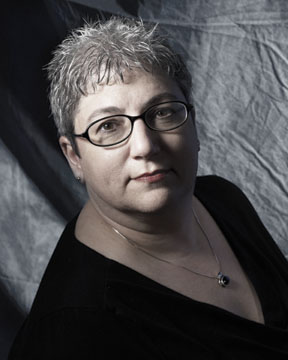
NiFtY Author: Jeri Westerson

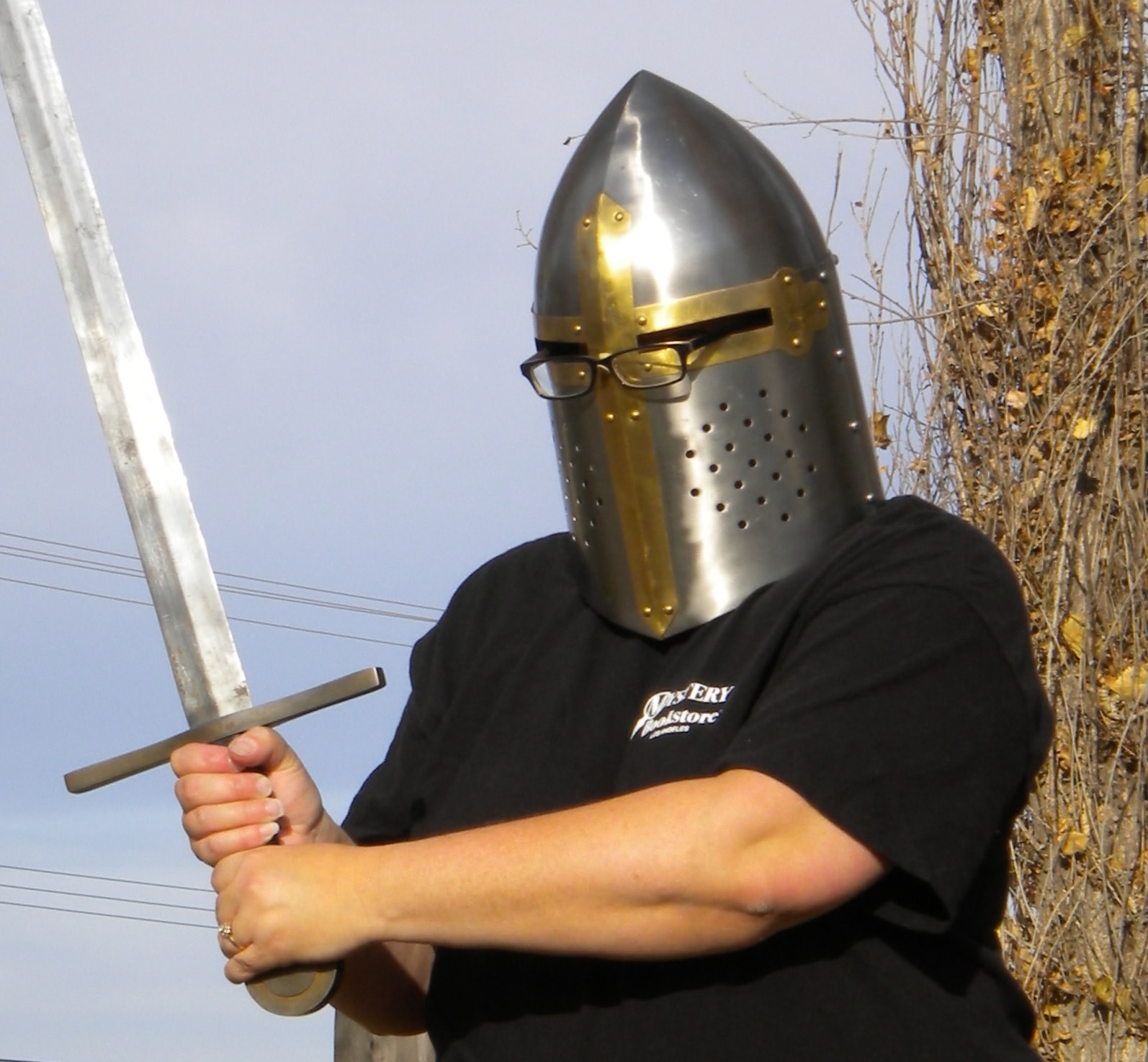
We’re taking a break from contemporary mysteries and moving back in time…far back in time. Try…the Middle Ages. Meet Jeri Westerson, author of the Crispin Guest medieval mystery series. In addition to writing great books, she’s not afraid to don a helmet and wield a sword (see photo below!).

BH: What’s your one-paragraph pitch for the latest novel in your Crispin Guest series?

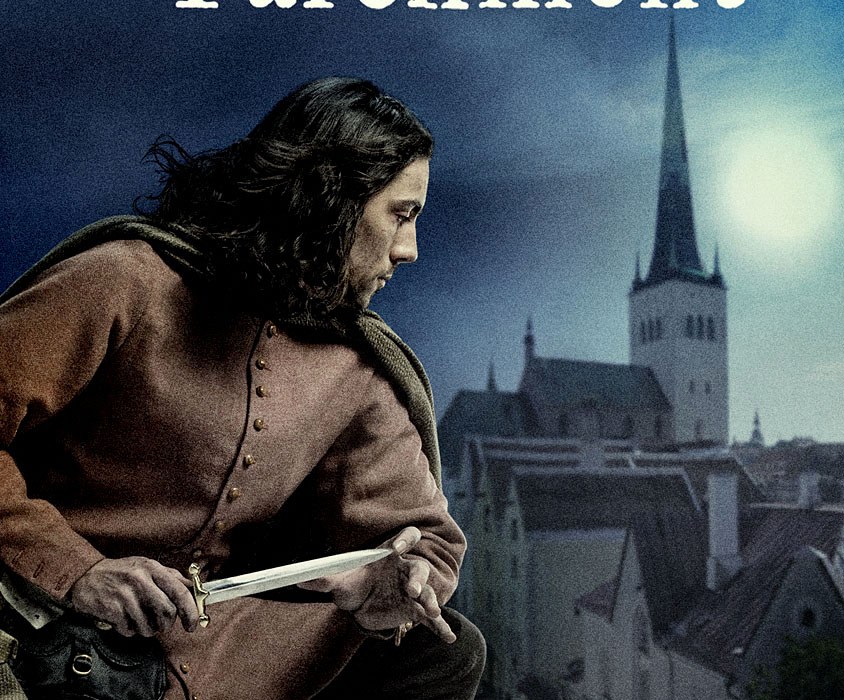
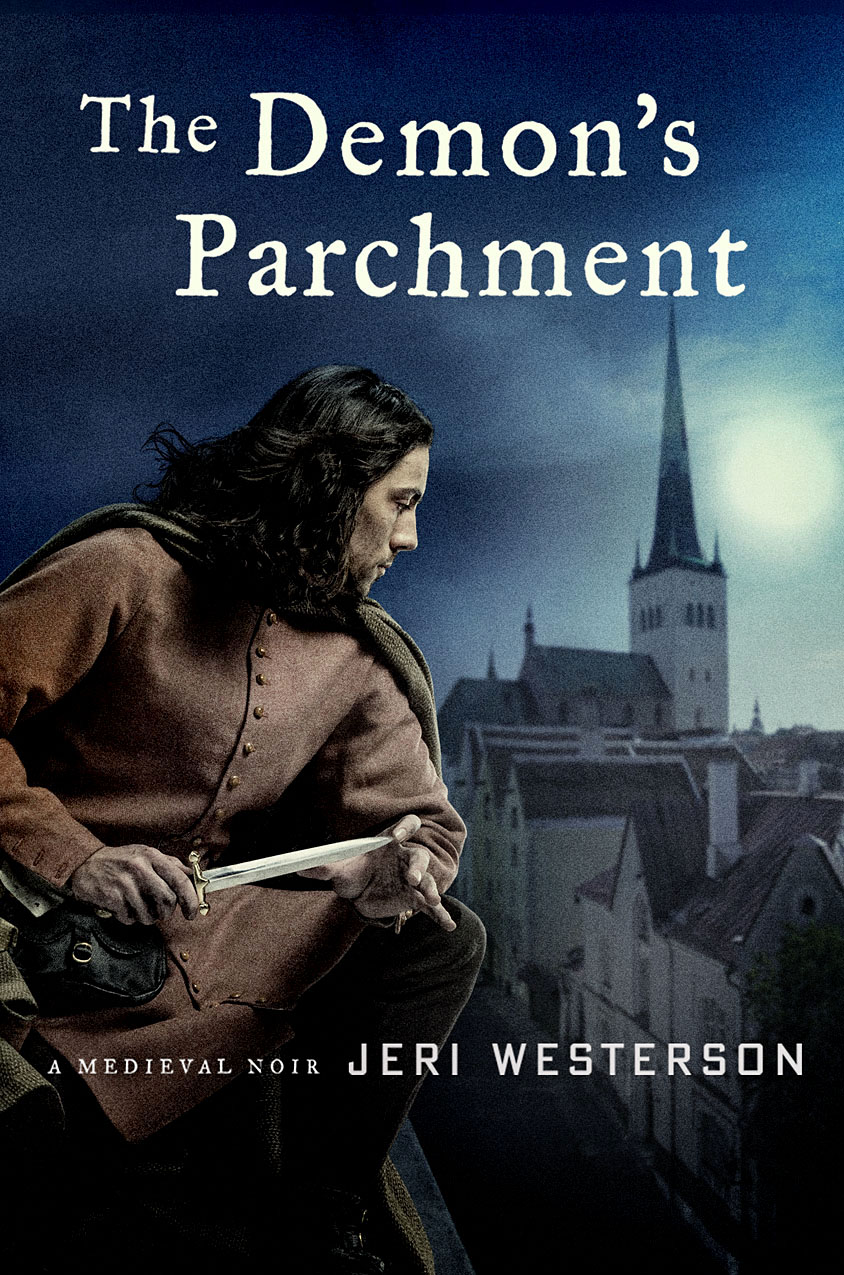
JW:  In THE DEMON’S PARCHMENT, Jacob of Provencal is a Jewish physician at the king’s court, even though all Jews were expelled from England nearly a century before. Jacob wants Crispin to find stolen parchments that might be behind the recent gruesome murders of young boys, parchments that someone might have used to summon a demon which now stalks the streets and alleys of London.

BH: The Demon’s Parchment, due out October 12, is the third book in this series. When you wrote the first novel, did you plan to create a series mystery?

JW: Yes, it was always designed that way. I had never written a series before so when I completed the first one I just jumped right into the next book, first to see if I could write a series and second because I really liked my character.

BH: What are some of the joys of writing a series character?

JW: Writing series fiction is wonderful because you can really have a chance to explore your character fully, and in my case, to see him age. His story arc can go on a long time. At least for as long as the publisher wants to publish the books. I hope that will be a long time because I have quite an extensive timeline for Crispin. I think that it’s a good idea to have some idea how the series will conclude and then all the background story arcs can lead inevitably to that conclusion. I really don’t know of any series that should go on forever. The stories can get too trite, too clichéd. Best to conclude them in a timely fashion. That being said, I’ve got some thirteen more novels in mind before I’m done with Crispin.

BH: Crispin Guest sounds intriguing: flawed, enigmatic, sexy…Where did you get the idea for this character?

JW: I wanted to write a medieval detective story, not like a Brother Cadfael with an amateur sleuth, but something more along the line of a medieval Sam Spade, a tough guy who’s hired specifically to do the dirty work. I thought that this Dashiell Hammett/Raymond Chandler kind of hard-boiled detective would translate well into the Middle Ages. No one else was doing it. As far as I could tell, authors were churning out the same old medieval mysteries they always had, and that was fine, but I wanted to write something a little different, with a little more action, a little more violence, and sex! They say you should write what you can’t find out there to read. The trope of the hard-boiled detective as a loner, someone who has a chip on their shoulder, who has run-ins with the cops is a familiar one. Raymond Chandler’s Philip Marlowe was designed as a white knight with his own code of honor, and so I thought that a real knight—disgraced or otherwise—would work as well. Everything is kept true to the time period, including Crispin’s feelings about honor, faith, and other cultural necessities. (And actually, all the sex is off screen so no worries for all the fan boys and girls out there, and there are quite a few young male readers.)

BH: And who’s the hottie posing as Crispin on your website header? I have some single friends who may want to get in touch with him.

JW: Mmm. Yes, he’s got quite the following now. He’s the fellow on all the book covers. All I know is that he is a model named Wes and probably lives in Oregon. Before we changed the covers from the rather static VEIL OF LIES hardcover, my editor showed me Wes’ model sheet and I said oh yes. He’ll do. The paperback division didn’t like the hardcover VEIL cover image and so St. Martin’s went back to the drawing board to come up with something else, something different. Something like I wanted in the first place! Since my novels are very character driven, I thought it would be better and more interesting to have a figure on the cover in a moody London background and they certainly delivered. It makes it look very different from your average medieval mystery. I love my book covers now. I think they are very cinematic. Hollywood, take note!

BH: Do you plan to stick with Crispin for awhile, or do you have other project ideas (or both)?

JW: I certainly have a lot of Crispin’s story to tell, but currently I am working on a second medieval mystery series, one that’s a little more light-hearted than Crispin’s tales. If that one doesn’t work out I’ll have to think of another one. It’s a good idea to have a few series out there, something else for fans to sink their teeth into. But I fully intend to continue with the Crispin novels. Number four, called TROUBLED BONES, comes out Fall 2011.

BH: Is it hard to write from a male perspective? Do you have any tips for authors who wish to write from the perspective of the opposite sex?

JW: I don’t find it hard at all. In fact, in all the novels I have written (some twenty-two) I’ve only written from the female perspective three times. I don’t enjoy that. I enjoy getting into the male mindset, all that uniquely male thinking. I find that whole “band of brothers” thing fascinating. There is no female equivalent. I was a tomboy growing up and I think I’m still a bit of a tomboy. I always gravitate toward the groups of men at parties…unless they’re talking about sports. Can’t get into that at all.

The only advice I have to offer on writing the opposite sex is observation. I hate reading a female character who does guy things or a male character who does girl things. You shouldn’t be able to tell whether the author is male or female either. It shouldn’t matter if the characters are well written.

BH: Do you write full-time?

JW: I have had the luxury of writing full time only since June but that won’t last. When the money runs out you might see me at your local McDonald’s behind the counter. If you think you are getting into writing novels for the money you are sadly mistaken. Even writing for a big publisher does not guarantee a living wage, at least not at first. They say that it takes till the fifth book for the author to make a profit. I have to pay my own way to mystery fan conventions, book touring, and something as innocuous as getting bookmarks printed. All my advances go back into promotion. So I do a lot of traveling and a lot of public speaking. It’s all about sales. So buy, buy, buy! Fortunately for readers of all stripes, my books are available in a few formats: hardcover, paperback, and e-books. (The SERPENT IN THE THORNS paperback was released September 28.) And readers should check out my series book trailer on my website. It gives you a good idea of what the series is all about. Very moody. Talk about cinematic. And you get to hear Crispin speak!

BH: What is your writing schedule like?

JW:  I do my writing business in the morning, answering emails, going on Facebook, Twitter, blogging (I have two blogs; mine called www.Getting-Medieval.com. It’s like a magazine of articles on history and mystery, and Crispin’s blog at www.CrispinGuest.com. It’s his Facebook page, by the way, so look for his name, not mine.) I do a little writing and/or research in the late morning, some reading during the middle of the day, then do more writing late afternoon and into the evening. I’m also trying to write some short stories and a barrel of blog posts for my fall blog tour.

BH: What does your workspace look like?

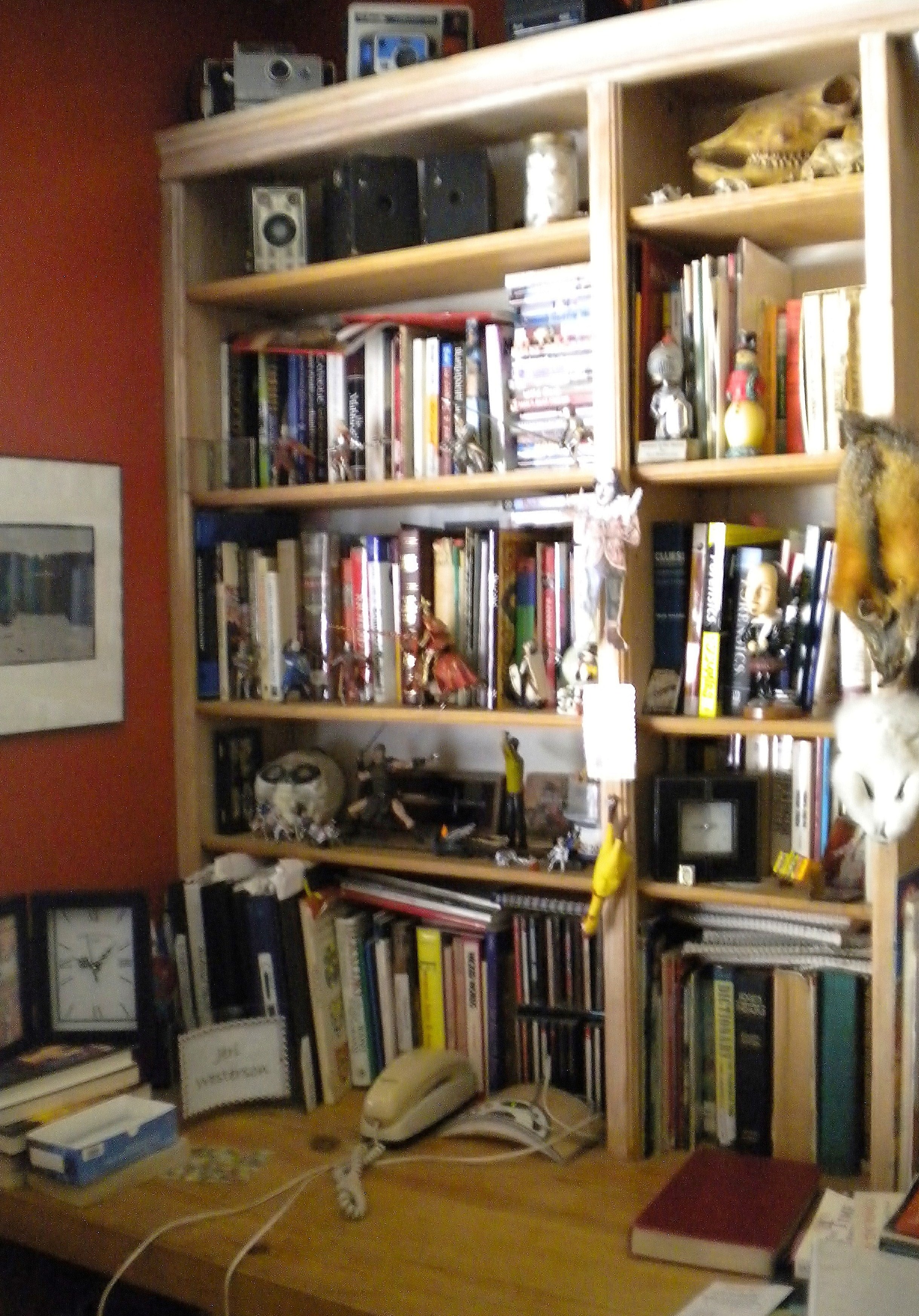
JW: I have a home office chock full of books, books, and more books. My desk is, in fact, specially built just for me (by me and my husband. We are truly Renaissance people with many hands-on skills) with a ten foot long flat surface (covered in papers and notes) with shelves above and behind me with another ten foot long surface mirroring my desk. I have a lot of research books about knighthood, everyday life in the Middle Ages, medieval words, cookbooks, commerce, religion, forensics, people, roads, maps, clothing, woodlands…you name it, I’ve got it. I also have a lot of toys, a lot of knights in battle all over the shelves; some Harry Potter stuff like a Time Turner; a couple of fox pelts hanging on the shelf; some assorted snowmen (because I collect them); a bunch of old cameras (because my photographer husband collects them); some skulls (a sheep, a goat, a cat, a rabbit, a mouse—all collected from our yard or surrounding area when it used to be more rural); a dagger I like to play with while I write; a small figurine of Death; a rubber chicken; a Shakespeare bobble head; two framed posters (one of a Klee the other a Kandinsky); a rather dashing picture of my hubby; a candy dish, empty; a figurine of a Golem; my “Box of Death” which I cart around to my speaking engagements which includes a helm and a bunch of medieval weapons; a coffee cup warmer; computers and printers (of course); and a comfy swivel chair that has seen better days. And two cats who are really not supposed to be in there, but they worm their way in with big soppy eyes and soft furry faces and type in my novels and leave hair absolutely everywhere.

BH: What is your favorite book on the craft of writing?

JW: The last really great novel I read.

BH: What is the best writing advice anyone has given you?

JW: Don’t give up. That would be from my long-suffering husband.

BH: Any words of advice to aspiring writers for keeping the hope alive?

JW: Learn the business. Don’t be an amateur, be a professional and learn your craft, research the industry before you start to ask questions. Then network with other authors. Keep on writing and reading. As you finish one novel, start writing the next. Don’t wait around for the first one to sell before you start another. The first one may never sell. Mine didn’t. Write the best darn books you can. Take the advice of professionals. Don’t dismiss it just because you don’t want to hear it. And don’t self publish just because you can’t place that one darling manuscript. Maybe there’s a reason for its being rejected over and over. Write the next book, and the next. Hone your craft.

Thank you, Jeri, for telling us about your books, sharing your insights about the writing life, and bringing us one step closer to Wes, your Crispin cover model.

For first chapters of Jeri’s novels, book discussion guides, and her fabulous series book trailer, go to her website at www.JeriWesterson.com.

Click the titles to view each book on Amazon.com:

The Demon’s Parchment (third in the series)

Serpent in the Thorns (second in the series)

Veil of Lies (first in the series)

NiFtY Author: Sunny Frazier

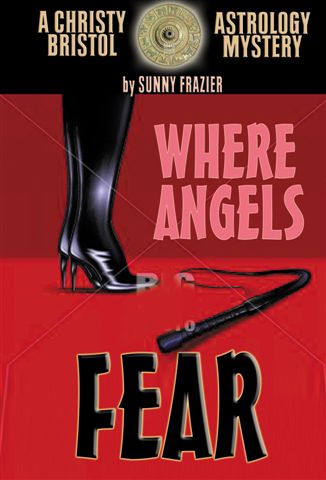
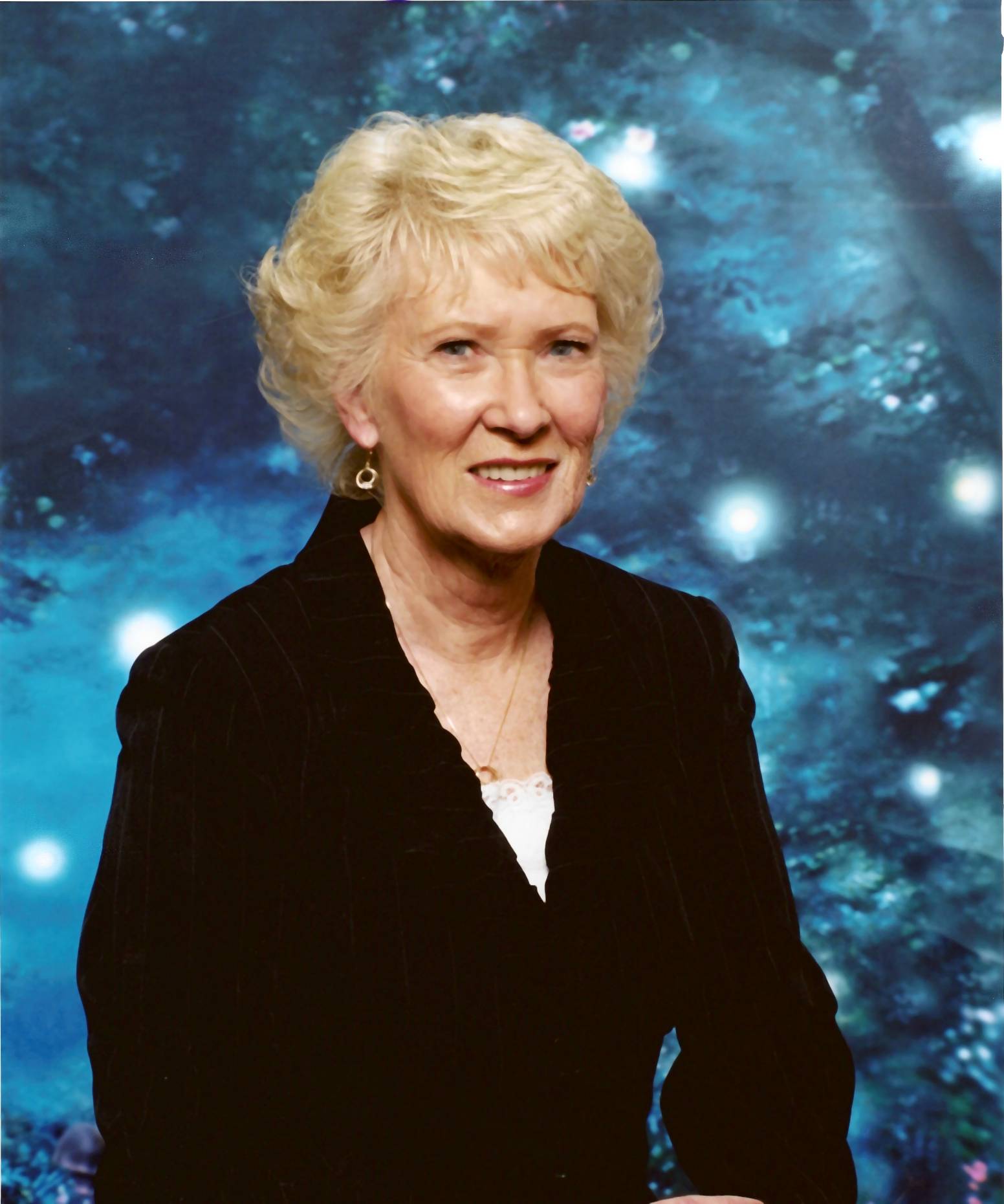
For today’s NiFtY Author I give you…drum roll…Sunny Frazier! Sunny has published two mysteries, Fools Rush In, and Where Angels Fear, as well as contributed to numerous anthologies. She’s also active in her publishing house, and works to help other authors promote their work. Keep on reading to learn more about this nifty author!

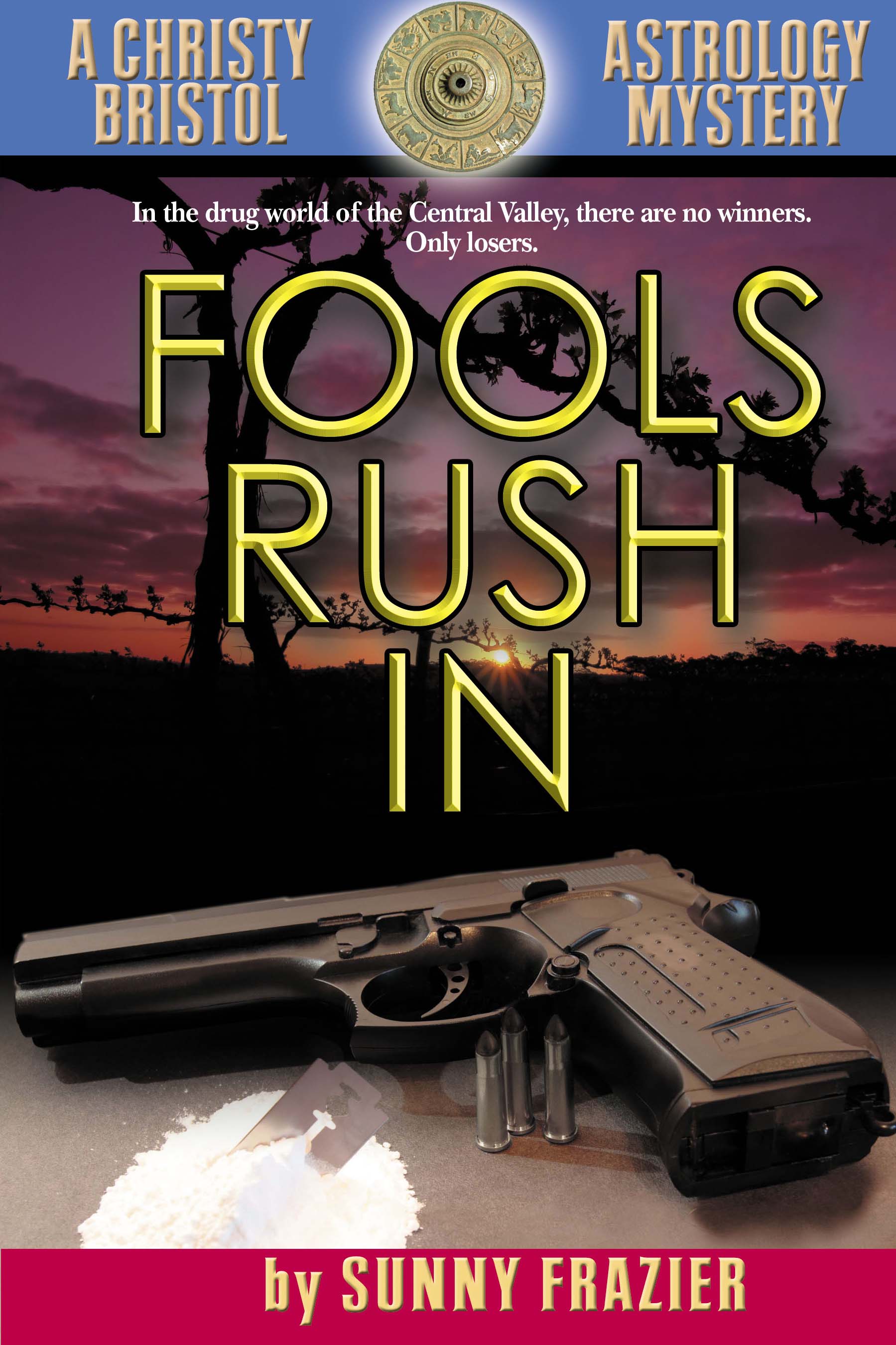
BH: What’s your one-paragraph pitch for the first Christy Bristol book, Fools Rush In?

SF: Astrologer Christy Bristol is egged on by a former boyfriend to do a horoscope for a drug dealer and finds herself the one with a precarious future.

BH: Can you tell us a little about your path to publication? Did you go the traditional “agent” route, or did you use some other scheme?

SF: I won a spot as one of the seven authors chosen for the Seven By Seven anthology. The publisher liked my flash fiction so much that he offered me a contract for my book.

BH: Ah, that’s the kind of success story we unpublished authors salivate over. What are some of the challenges you faced by not working with an agent? Were there benefits as well?

SF: I only experienced the benefits. I got not only a lot of say with how my own books were published, but both my past publisher and my current publisher have looked to me for input on picking manuscripts for the publishing house. They also picked my brain for marketing ideas.

BH: Your publisher, Oak Tree Press, is an independent publisher. What are some of the benefits of working with an independent publisher?

SF: Trust and immediate access. We communicate constantly, by e-mail and phone. I am now acquisitions editor for the Dark Oak mystery line. I also introduced two new lines: Wild Oaks Westerns and Mystic Oak for paranormal novels.

BH: Are there any disadvantages to working with an independent publisher?

SF: It’s never easy to get books into brick and mortar book stores. However, many are closing and the reading public is ordering on Amazon. Also, e-readers are finally finding acceptance with Kindle and the I-Pad. Aggressive Internet marketing is leveling the playing field for authors with smaller houses.

Sunny standing with publisher Billie Johnson at a pitch session in Las Vegas

BH: I tried to write a mystery—once. It quickly turned into a (not very good) thriller/suspense novel because I couldn’t figure out how to give just enough information without making the killer’s identity obvious. Do you have any tips on this for aspiring mystery writers?

SF: I think the definition of “mystery” has blurred considerably. The “puzzle” type mysteries such as Agatha Christie wrote are not common these days. Instead of being plot driven, we are seeing more character-driven story arcs. I don’t write whodunits, I write whydunits. In fact, I tell you who the victim is and who the killer is on the first page—the “Colombo” formula. The reader keeps reading to see how my character Christy uses astrology to her advantage.

You should have stuck with your suspense novel.

BH: Oh, I did. Unfortunately the premise wasn’t a wowzer, so I’ve moved on, and I read other peoples’ mysteries now.

Every unpublished author thinks all her problems will be solved as soon as she gets her name in print…even though published writers tell us this isn’t true. Did you have any unfortunate wake-up calls?

SF: What I try to instill in writers is to start promoting as soon as you decide you want to write a book. Name recognition is very important. Getting people accustomed to your “voice” through blogging, learning about the industry by monitoring group sites, getting comfortable with promotion. People want to make it a chore and it’s more of a mindset. I work on promotion on Sundays. I have 35 sites I belong to, all are professional sites for writers, readers and publishers. They each give you your own page, so it’s like having 35 websites. I developed what I call “the posse” to teach people how to effectively promote. All I need is an e-mail and attentiveness to my nudges. It takes years off people’s careers, unless they want to start from scratch and reinvent the wheel.

BH: When you first wrote Fools Rush In, were you already planning a sequel?

SF:  I had six books in mind: titles, plots, characters.

BH: What was the most enjoyable part of writing the sequel, Where Angels Fear?

SF:  I didn’t realize that Fools Rush In was one of the hardest types of mysteries to write. My protagonist was stuck in a room for most of the book. In the sequel, Christy and her sidekick Lennie get to traipse all over the Central County uncovering clues to a sex club. There’s more humor as well. I had a hard time keeping a straight face while writing.

BH: Is a third book in the works?

SF:  Slowly but surely, A Snitch In Time is making its way on paper. I’m so busy speaking at conferences and conventions as well as reading query letters for Oak Tree Press that my own work suffers.

BH: Can you compare your series character, Christy Bristol, to anyone you know in real life?

SF: Uh—me. I worked as an office assistant with an undercover narc team for 17 years in the sheriff’s department and I’ve done astrology for nearly 40 years. Christy is much like I was in my earlier years.

BH: What is your writing schedule like?

SF:  My computer is on for 12 hours a day. I write in small clumps, fitting in the novel when I get tired of reading manuscripts and conducting business via e-mail. My eyes get so tired staring at the screen, sometimes I just hit the couch and close them. My brain keeps going over the story until I’m ready to tackle the keyboard.

Oh, and I don’t have kids, a husband or a job to interrupt me. Just a bunch of cats who give me space when I’m at the desk. If not, they have to go out in the yard and play.

BH: What does your writing workspace look like?

SF: It’s usually a mess with notes scattered all over. I have a rolodex, a Victorian calendar, and a pen carousel with a fake raven stuck in the center. For some reason I work well in chaos.

BH: What is your favorite book on the craft of writing?

SF: Self-Editing For Fiction Writers—How To Edit Yourself Into Print by Renni Browne and Dave King. I checked it out at the library and loved it so much I ordered a copy from Amazon.

BH: What is the best writing advice anyone has given you?

SF:  Early on I heard authors say “Enjoy the journey, not the destination.” That’s the truth. If writers fret too much about publication they will miss the whole point of writing. It’s all about the people you meet, the sharing of minds, the art of creating, giving your ideas to the world. Money is usually lousy, hours are bad, solitude wears on you and there are no health benefits. But still, it’s a wild ride.

BH: Any words on advice to unpublished writers for keeping the hope alive?

SF:  Small presses are worth taking a chance on. I always tell writers “You can’t promote what doesn’t exist.” Get that first book out there and get the machine rolling. Don’t think the first book you’ve written is the only one you have in you. Start another right away.

Sunny, thank you so much for the interview, and for sharing your books and insights. To our studio audience: don’t forget to check out the links below to learn more about Sunny, her books, and her publisher! Simply click on a description to reach the site.

Sunny’s website. This is where you can find The Murder Circle.

Oak Tree Authors are assigned blog dates. Meet us!

Order Oak Tree Titles, learn about our contests, get the latest info on what we’re doing in the publishing world.

NiFtY Author: Marja McGraw

This week’s NiFtY Author is none other than Marja McGraw, author of the Sandi Webster mystery series. Now she’s branching out into a new series, The Bogey Mysteries, which also promises to delight readers. Details on Marja’s books, as well as her thoughts on research, writing, and how pets enrich a story, can all be found below!

BH: What’s your one-paragraph pitch for the latest novel in your Sandi Webster series?

MM:  Imagine you’re a young, female P.I., it’s late at night and you’re watching the motel room of an errant husband. Surveillance can be so boring, you think to yourself, until the angry wife shows up and blows your cover, and the husband comes after you. Now imagine that Humphrey Bogart, who’s been gone for many years, comes to your rescue. Huh?

BH: How many books have you published, and which is your favorite?

MM: I’ve published four books in the Sandi Webster series, one stand alone book, and the first book in a new series (The Bogey Mysteries) is due out before long.

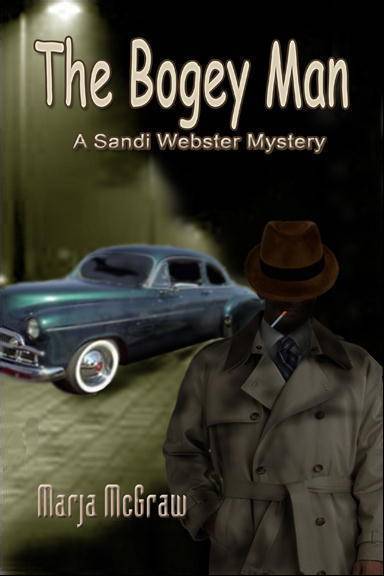
Hmm. My favorite would probably be The Bogey Man, because not only was it fun to write, but I was able to research and use a lot of 1940’s slang. Chris Cross, whom Sandi refers to as the Bogey Man, really wants to emulate Bogart as he was in his private investigator roles in the movies. Also, the new series is a spinoff from this book, which is opening new doors for me.

BH: Tell us a little bit about Sandi. What makes her unique and engaging as a series character?

MM: Sandi is relatively young and a little naïve for a private investigator.  She tends to romanticize her job, which isn’t very realistic. She grew up watching the old P.I. movies, and she’s tried to model herself after the vintage gumshoes. Her partner, Pete, balances her attitude with his own ex-cop demeanor. She has an overbearing, menopausal mother who inadvertently teaches her about being tough. She’s constantly growing and changing as a character. She often feels she has to prove herself to people because of her naiveté, and she comes up with some fairly unique ideas in times of stress and danger.

BH: In a conversation with a friend recently, we discussed how some famous authors (unnamed for purposes of not slinging mud) have trouble keeping their series going for too long because eventually the hero’s development stalls. Do you have any tricks to share on avoiding that trap?

MM: What can I say? I’m mumble mumble years old, and I’ve never stopped changing and growing. Consequently, I try to fashion my characters to follow real life development. Circumstances change us on a constant basis. So I guess my trick would be to take a good look at real life and create circumstances in the stories in order that the characters may grow.

BH: Your novel A Well-Kept Family Secret departs from your other Sandi Webster books in that it involves a hundred-year-old case. While doing the research, did you come up with any new details that changed the shape of the novel?

MM: Nothing that actually changed the story, although the history for that era was quite interesting. I was able to include some of it in the story (in small doses), and I think that enhanced it. The people and their lifestyles were interesting around the turn of the century. This story involved the old Red Light District in Los Angeles, and I found some interesting papers and maps. For instance, there’s a tax map that shows Ladies’ Boarding Houses in Chinatown, and those were actually the brothels – so even maps helped.

In 1994 I read an article in the newspaper about the water district doing work on the parking lot at Union Station in downtown L.A. In the process they uncovered portions of the old Red Light District, including outhouses, which is where a lot of items were disposed of.  I contacted the archaeologist who handled the project, and he supplied me with invaluable information.

Why was I so interested in this period? Because my great-great-grandfather was one of two men who ran the real red light district. I grew up hearing stories about him, what he did, and about a buried treasure attributed to him and his brother.

BH: Do you have any other projects planned?

MM: As I mentioned, the first book in a new series will be out before long from Oak Tree Press. I’m pretty excited about it. Bogey Nights was a lot of fun to write. It’s probably a little more mature than the Sandi Webster series, because the characters are married and have a son, and I found a whole new type of humor in their lives. I’m working on the second book now, and the working title is Bogey’s Nightmare.

BH: I read one of your blog posts on how having pets in a story “enhances the storyline.” Could you elaborate on that?

MM: Absolutely. I’ve included canines in both of my series, so I’ll stick to dogs in my answer. A dog can play almost as big of a role as a human character if you’ll let it. They’re smart, funny and terribly loyal and protective. They’ll do anything in their power to keep their human happy, although they can be the cause of some angst, too. A dog can even be a possible victim or a hero, and they can provide comic relief. They can demonstrate hurt feelings, joy, sadness and grab your heart in the process. They can enhance the story without simply being filler.

I recall one of the lowest times in my life when I was sprawled out on the bed, crying my eyes out. My dog jumped up with her (gutted) teddy bear and laid it on my arm, and then snuggled up next to me until I’d cried it all out. Take note: the dog comforted me, while people kept their distance. I also recall another dog who became very frustrated with me because he thought someone was knocking at the door every time there was thunder during a storm. He couldn’t seem to figure out why I wouldn’t see who was there.

BH: What is your writing schedule like?

MM: I generally work for four to six hours in the morning, when I’m the freshest. I’ll work anywhere from five to seven days a week. Most of my stories take six to nine months to write. I write, let it sit and then go back and read it again, making changes where necessary. I have critique partners who read the stories two chapters at a time, and when they return the chapters, I rewrite again. When the story is done, I go back to the beginning and read it straight through, making more changes and edits.

In the meantime, I update my website every few months, and I try to keep my blog (located on my website) updated weekly, with a new one appearing on Sunday or Monday.

I critique for the same people who look at my work, review a book every once in a great while, and try to put together a marketing plan as best I can. Promote, promote, promote.

My writing schedule includes a lot more than just writing.

BH: What does your workspace look like?

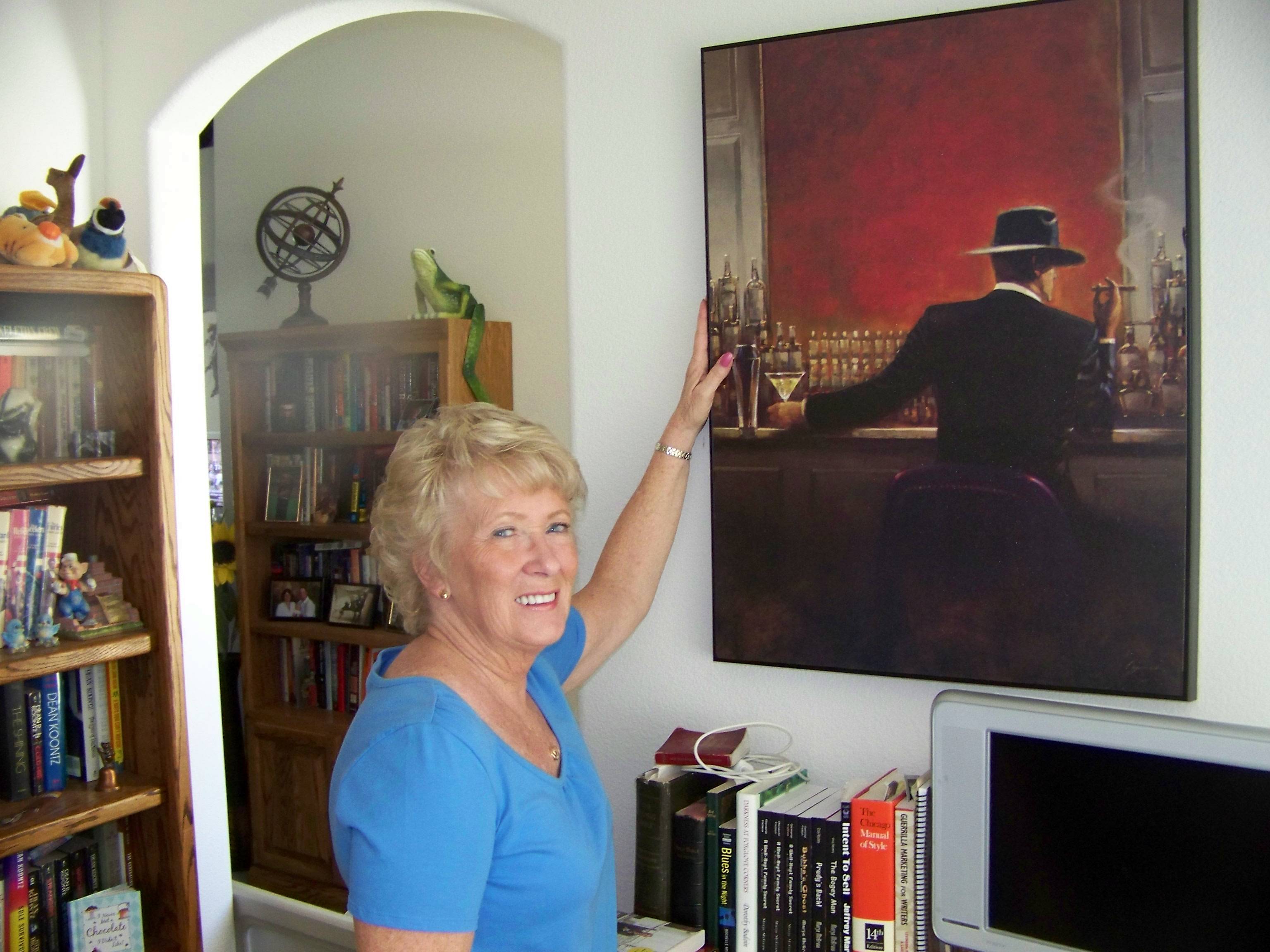
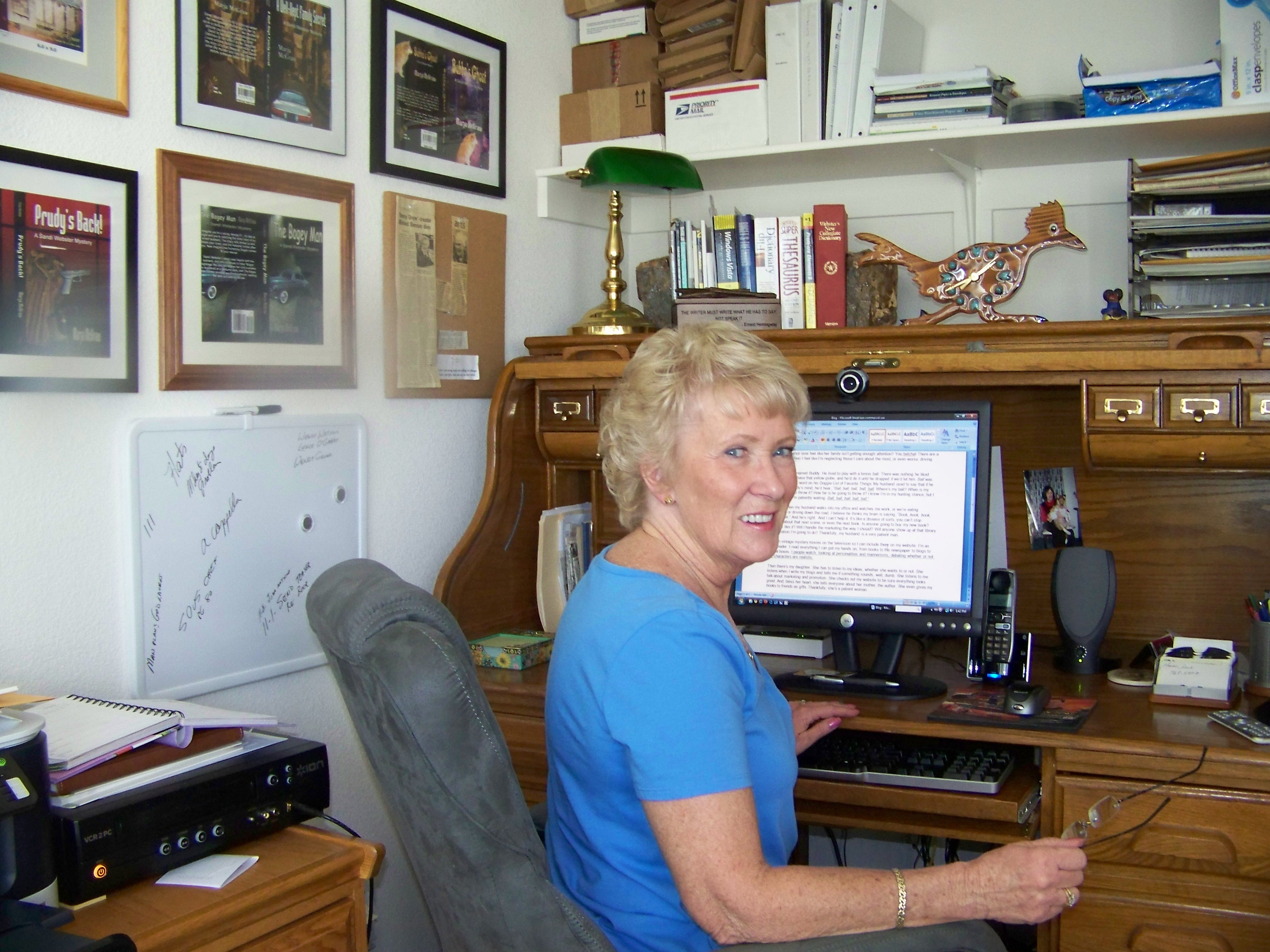
MM: When we had our house built, I had them turn the third bedroom into an office. I have an oak roll top desk that fits nicely into what would have been the opening for a closet, and the closet shelf holds my paper and other supplies. Copies of the book covers adorn the wall by my desk along with a photo of Humphrey Bogart, and I have bulletin boards that I can jot quick notes on, so I won’t forget ideas as they come to me. For my birthday, my husband bought me a painting of a man wearing a suit and fedora, sitting at the bar in a lounge. The view is from the rear and you can just barely see the man’s jaw line. He has a martini in one hand and a cigar in the other, and it could most definitely be a picture of the Bogey Man sitting at the bar in the lounge part of the restaurant he and his wife own.

Other than that, my workspace is pretty much a mess.

BH: Sounds like my workspace. Oh, I’ll admit it. It sounds like my whole house. What is your favorite book on the craft of writing?

MM: I can’t honestly say I have a favorite. I’ve read several, and I pick and choose what I need from each of them.

BH: What is the best writing advice you’ve received?

MM: Never give up and keep striving to make your writing cleaner with each read through. And grow a thick skin, because not everyone will like what you write. (Nah, really?) Always, always, remember your manners and treat people the same way you’d like to be treated. Lastly, and most importantly, don’t let family and friends fall by the wayside because you think you’re too busy for them.

BH: Any words on advice to aspiring writers for keeping the hope alive?

MM: If you honestly believe you’ve written a good book that people will enjoy reading, never give up. Read some of the stories behind successful authors, and you’ll see that some of them went through a lot of hoops to get where they are now.

The Sandi Webster series is published through Wings ePress, and I’ll always be thankful to them for giving me a chance.

Now let me tell you my success story. I’d submitted Bogey Nights to Oak Tree Press, and they liked it, but they wanted to meet me. They were attending a conference in Las Vegas and asked if I could be there. Ha! Like I would have missed that opportunity. They offered me a contract right there, on the spot, something they’d never done before. Sometimes good things happen when you least expect it.

BH: That’s the kind of story that keeps us unpublished authors type-type-typing away. Thank you, Marja, for stopping by and answering some questions for us!

I don’t know about all of my writer and reader friends, but for me, it’s inspiring and informative to hear responses like this from other authors. The success stories are great because they get me movin’ and hopin’, and the advice is always sound, coming from other professionals in the trenches…er, I mean field.

To learn more about Marja and her books, you can visit her website by clicking here.