NiFtY Author: Jeri Westerson

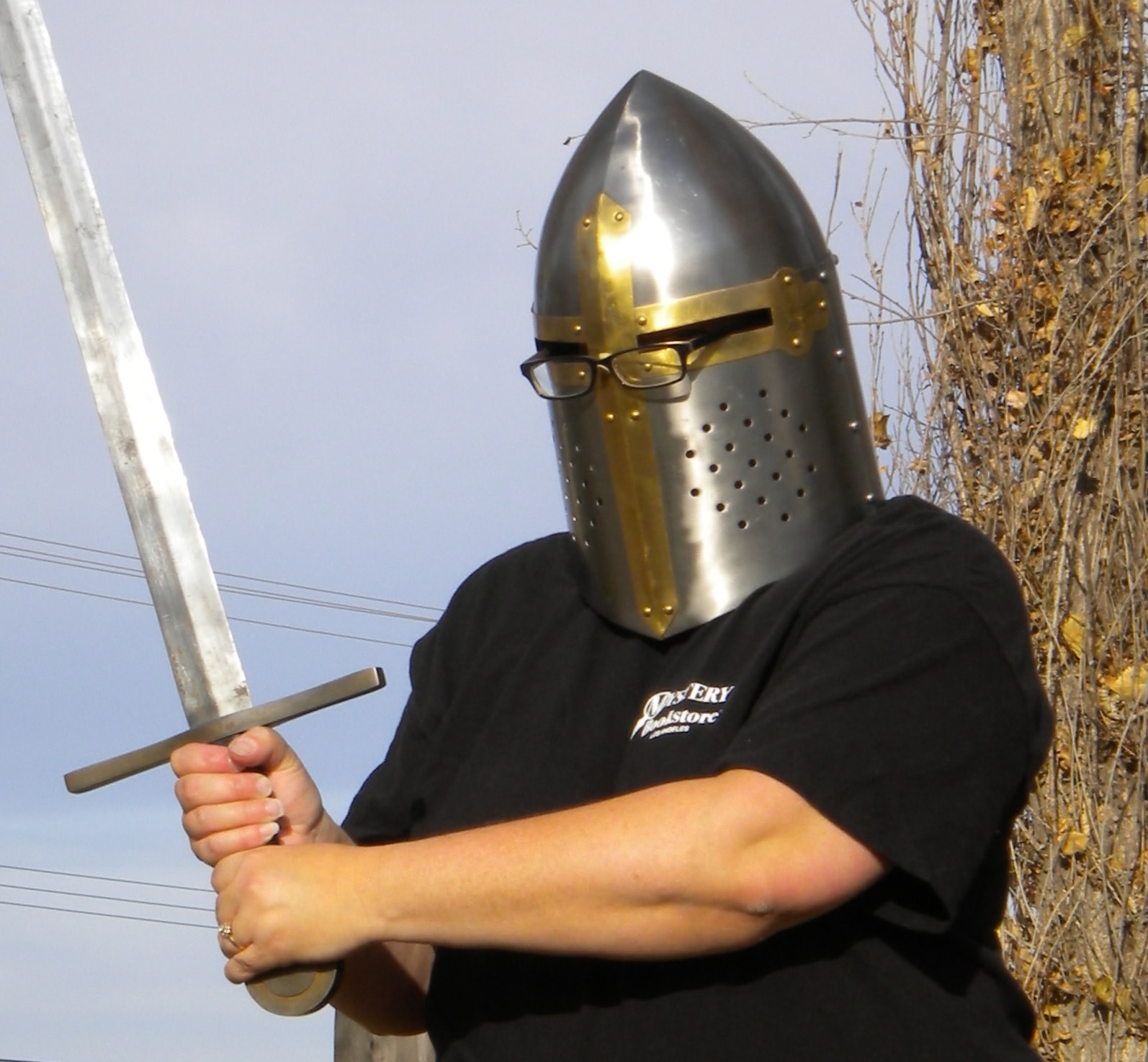
We’re taking a break from contemporary mysteries and moving back in time…far back in time. Try…the Middle Ages. Meet Jeri Westerson, author of the Crispin Guest medieval mystery series. In addition to writing great books, she’s not afraid to don a helmet and wield a sword (see photo below!).

BH: What’s your one-paragraph pitch for the latest novel in your Crispin Guest series?

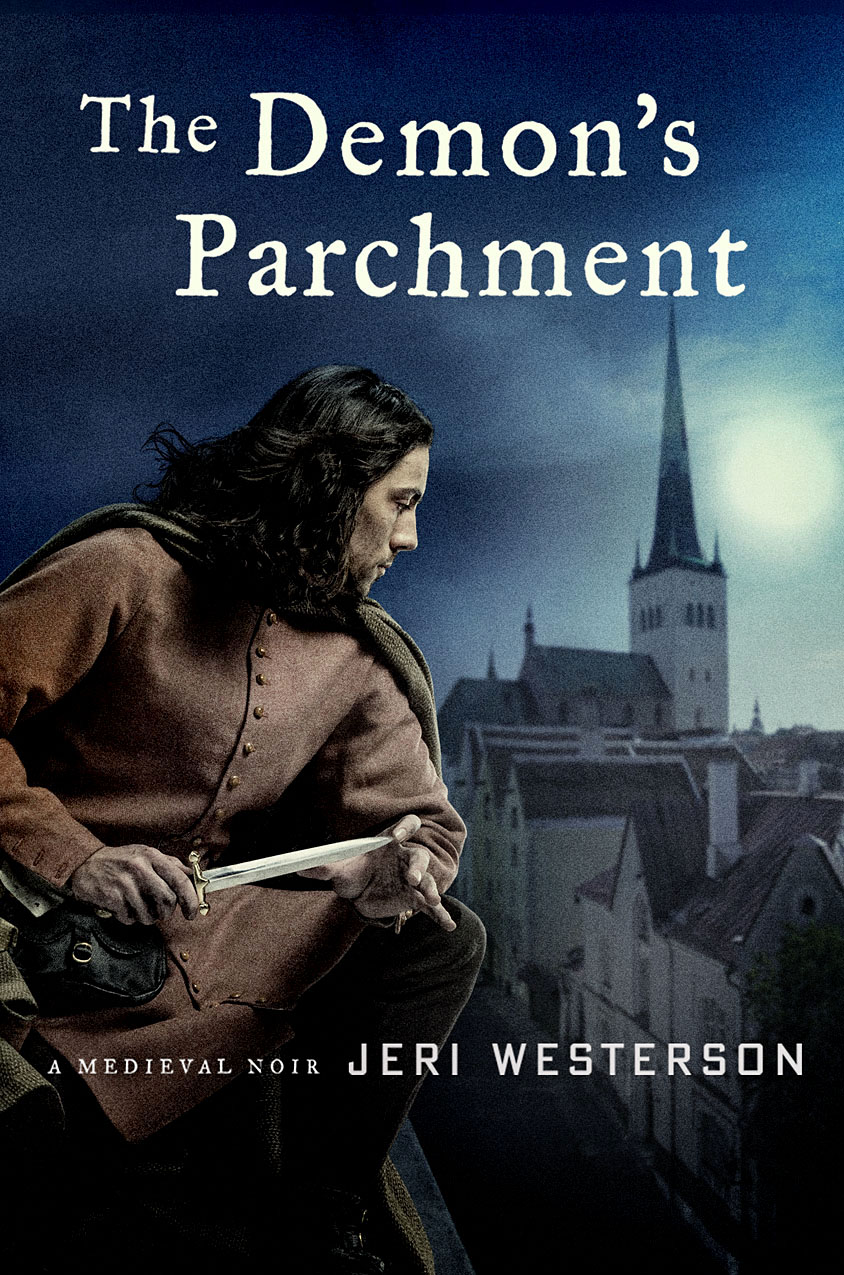
JW:  In THE DEMON’S PARCHMENT, Jacob of Provencal is a Jewish physician at the king’s court, even though all Jews were expelled from England nearly a century before. Jacob wants Crispin to find stolen parchments that might be behind the recent gruesome murders of young boys, parchments that someone might have used to summon a demon which now stalks the streets and alleys of London.
BH: The Demon’s Parchment, due out October 12, is the third book in this series. When you wrote the first novel, did you plan to create a series mystery?

JW: Yes, it was always designed that way. I had never written a series before so when I completed the first one I just jumped right into the next book, first to see if I could write a series and second because I really liked my character.

BH: What are some of the joys of writing a series character?

JW: Writing series fiction is wonderful because you can really have a chance to explore your character fully, and in my case, to see him age. His story arc can go on a long time. At least for as long as the publisher wants to publish the books. I hope that will be a long time because I have quite an extensive timeline for Crispin. I think that it’s a good idea to have some idea how the series will conclude and then all the background story arcs can lead inevitably to that conclusion. I really don’t know of any series that should go on forever. The stories can get too trite, too clichéd. Best to conclude them in a timely fashion. That being said, I’ve got some thirteen more novels in mind before I’m done with Crispin.

BH: Crispin Guest sounds intriguing: flawed, enigmatic, sexy…Where did you get the idea for this character?

JW: I wanted to write a medieval detective story, not like a Brother Cadfael with an amateur sleuth, but something more along the line of a medieval Sam Spade, a tough guy who’s hired specifically to do the dirty work. I thought that this Dashiell Hammett/Raymond Chandler kind of hard-boiled detective would translate well into the Middle Ages. No one else was doing it. As far as I could tell, authors were churning out the same old medieval mysteries they always had, and that was fine, but I wanted to write something a little different, with a little more action, a little more violence, and sex! They say you should write what you can’t find out there to read. The trope of the hard-boiled detective as a loner, someone who has a chip on their shoulder, who has run-ins with the cops is a familiar one. Raymond Chandler’s Philip Marlowe was designed as a white knight with his own code of honor, and so I thought that a real knight—disgraced or otherwise—would work as well. Everything is kept true to the time period, including Crispin’s feelings about honor, faith, and other cultural necessities. (And actually, all the sex is off screen so no worries for all the fan boys and girls out there, and there are quite a few young male readers.)

BH: And who’s the hottie posing as Crispin on your website header? I have some single friends who may want to get in touch with him.

JW: Mmm. Yes, he’s got quite the following now. He’s the fellow on all the book covers. All I know is that he is a model named Wes and probably lives in Oregon. Before we changed the covers from the rather static VEIL OF LIES hardcover, my editor showed me Wes’ model sheet and I said oh yes. He’ll do. The paperback division didn’t like the hardcover VEIL cover image and so St. Martin’s went back to the drawing board to come up with something else, something different. Something like I wanted in the first place! Since my novels are very character driven, I thought it would be better and more interesting to have a figure on the cover in a moody London background and they certainly delivered. It makes it look very different from your average medieval mystery. I love my book covers now. I think they are very cinematic. Hollywood, take note!

BH: Do you plan to stick with Crispin for awhile, or do you have other project ideas (or both)?

JW: I certainly have a lot of Crispin’s story to tell, but currently I am working on a second medieval mystery series, one that’s a little more light-hearted than Crispin’s tales. If that one doesn’t work out I’ll have to think of another one. It’s a good idea to have a few series out there, something else for fans to sink their teeth into. But I fully intend to continue with the Crispin novels. Number four, called TROUBLED BONES, comes out Fall 2011.

BH: Is it hard to write from a male perspective? Do you have any tips for authors who wish to write from the perspective of the opposite sex?

JW: I don’t find it hard at all. In fact, in all the novels I have written (some twenty-two) I’ve only written from the female perspective three times. I don’t enjoy that. I enjoy getting into the male mindset, all that uniquely male thinking. I find that whole “band of brothers” thing fascinating. There is no female equivalent. I was a tomboy growing up and I think I’m still a bit of a tomboy. I always gravitate toward the groups of men at parties…unless they’re talking about sports. Can’t get into that at all.

The only advice I have to offer on writing the opposite sex is observation. I hate reading a female character who does guy things or a male character who does girl things. You shouldn’t be able to tell whether the author is male or female either. It shouldn’t matter if the characters are well written.

BH: Do you write full-time?

JW: I have had the luxury of writing full time only since June but that won’t last. When the money runs out you might see me at your local McDonald’s behind the counter. If you think you are getting into writing novels for the money you are sadly mistaken. Even writing for a big publisher does not guarantee a living wage, at least not at first. They say that it takes till the fifth book for the author to make a profit. I have to pay my own way to mystery fan conventions, book touring, and something as innocuous as getting bookmarks printed. All my advances go back into promotion. So I do a lot of traveling and a lot of public speaking. It’s all about sales. So buy, buy, buy! Fortunately for readers of all stripes, my books are available in a few formats: hardcover, paperback, and e-books. (The SERPENT IN THE THORNS paperback was released September 28.) And readers should check out my series book trailer on my website. It gives you a good idea of what the series is all about. Very moody. Talk about cinematic. And you get to hear Crispin speak!

BH: What is your writing schedule like?

JW:  I do my writing business in the morning, answering emails, going on Facebook, Twitter, blogging (I have two blogs; mine called www.Getting-Medieval.com. It’s like a magazine of articles on history and mystery, and Crispin’s blog at www.CrispinGuest.com. It’s his Facebook page, by the way, so look for his name, not mine.) I do a little writing and/or research in the late morning, some reading during the middle of the day, then do more writing late afternoon and into the evening. I’m also trying to write some short stories and a barrel of blog posts for my fall blog tour.

BH: What does your workspace look like?
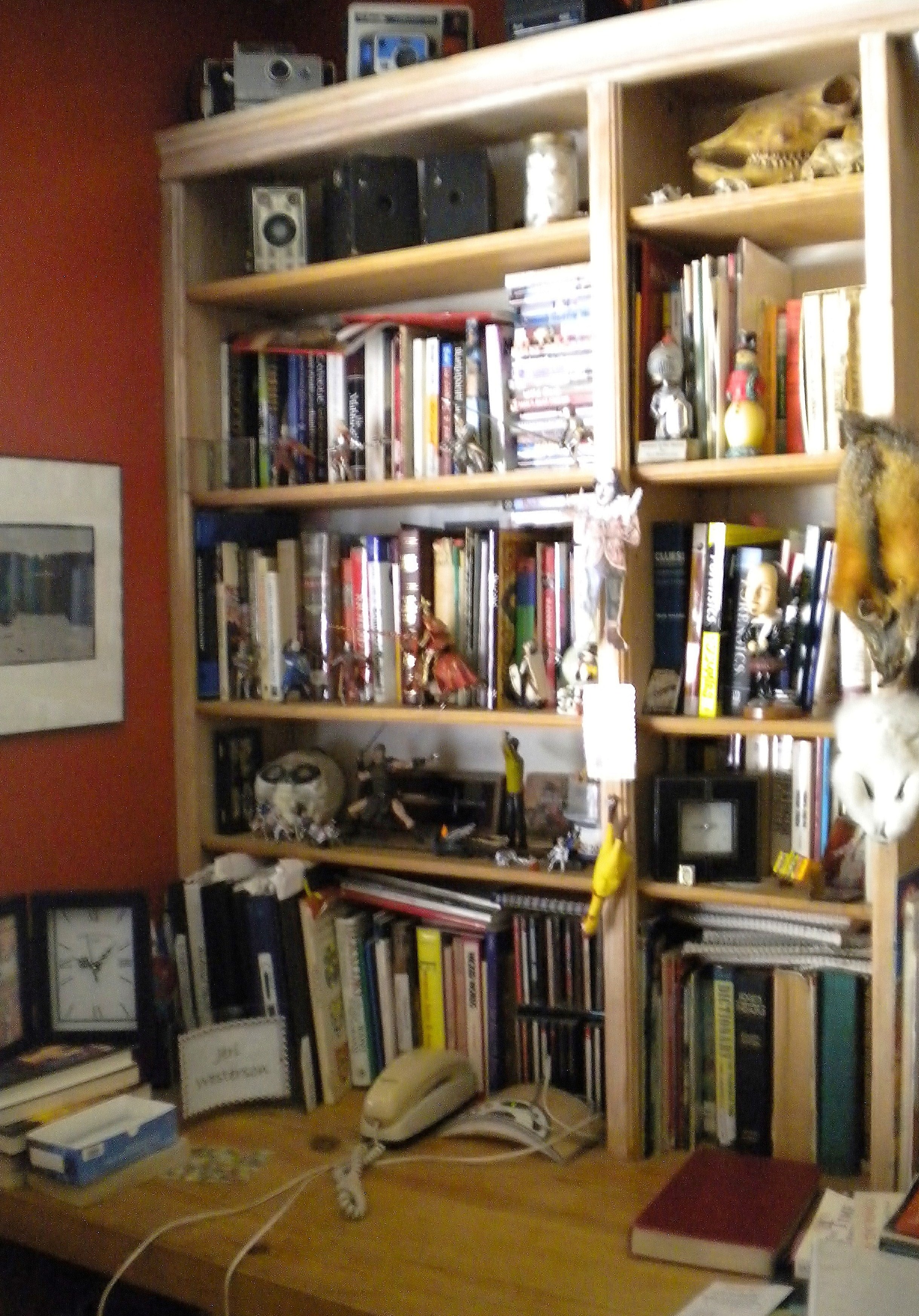
JW: I have a home office chock full of books, books, and more books. My desk is, in fact, specially built just for me (by me and my husband. We are truly Renaissance people with many hands-on skills) with a ten foot long flat surface (covered in papers and notes) with shelves above and behind me with another ten foot long surface mirroring my desk. I have a lot of research books about knighthood, everyday life in the Middle Ages, medieval words, cookbooks, commerce, religion, forensics, people, roads, maps, clothing, woodlands…you name it, I’ve got it. I also have a lot of toys, a lot of knights in battle all over the shelves; some Harry Potter stuff like a Time Turner; a couple of fox pelts hanging on the shelf; some assorted snowmen (because I collect them); a bunch of old cameras (because my photographer husband collects them); some skulls (a sheep, a goat, a cat, a rabbit, a mouse—all collected from our yard or surrounding area when it used to be more rural); a dagger I like to play with while I write; a small figurine of Death; a rubber chicken; a Shakespeare bobble head; two framed posters (one of a Klee the other a Kandinsky); a rather dashing picture of my hubby; a candy dish, empty; a figurine of a Golem; my “Box of Death” which I cart around to my speaking engagements which includes a helm and a bunch of medieval weapons; a coffee cup warmer; computers and printers (of course); and a comfy swivel chair that has seen better days. And two cats who are really not supposed to be in there, but they worm their way in with big soppy eyes and soft furry faces and type in my novels and leave hair absolutely everywhere.

BH: What is your favorite book on the craft of writing?

JW: The last really great novel I read.

BH: What is the best writing advice anyone has given you?

JW: Don’t give up. That would be from my long-suffering husband.

BH: Any words of advice to aspiring writers for keeping the hope alive?
JW: Learn the business. Don’t be an amateur, be a professional and learn your craft, research the industry before you start to ask questions. Then network with other authors. Keep on writing and reading. As you finish one novel, start writing the next. Don’t wait around for the first one to sell before you start another. The first one may never sell. Mine didn’t. Write the best darn books you can. Take the advice of professionals. Don’t dismiss it just because you don’t want to hear it. And don’t self publish just because you can’t place that one darling manuscript. Maybe there’s a reason for its being rejected over and over. Write the next book, and the next. Hone your craft.

Thank you, Jeri, for telling us about your books, sharing your insights about the writing life, and bringing us one step closer to Wes, your Crispin cover model.

For first chapters of Jeri’s novels, book discussion guides, and her fabulous series book trailer, go to her website at www.JeriWesterson.com.

Click the titles to view each book on Amazon.com:

The Demon’s Parchment (third in the series)

Serpent in the Thorns (second in the series)

Veil of Lies (first in the series)
We gon’ light it up like it’s dynamite

In which the Ever-Suffering Mother listens to pop music.

Some months ago a friend posted on Facebook that some days, country music is a necessity. I know I will offend more than a few people when I say that country music is only a necessity if your aim is to drive people away. And up until a month or two ago, I would probably have said the same thing about pop.

Let’s travel back in time to see Beth as an Enlightened College Student, rather than an Ever-Suffering Mother. She (ten or fifteen pounds lighter) walks around her flower-bedecked college campus with her diary book, some pens, and a well-read copy of T. S. Eliot’s collected poems. American Beauty, although dead depressing, is the most meaningful movie she’s ever seen. The Enlightened College Student has just discovered Pink Floyd. She never heard such beautiful caterwauling. Such dips and valleys of emotion in a single Shine-on-you-crazy-diamond kind of song.

Pop music blares from the open window of a shiny white Jetta blazing down the street. She wrinkles her nose, distracted from translating her own dreamy/angsty poetry into French, naturellement. Pop music? Quelle horreur. It’s such a cliché. Please. That Jetta-driver is killing brain cells with every beat of the synthetic bass drum.

[Fast-forward sound effects, please.]

The Ever-Suffering Mother needs some pep. She’s sleepy. Unhappy in the mornings. Grouchy. She filled a prescription for antidepressants but was too afraid to take them. She’s tried re-reading all her favorite books, and they are great escapes. But she cannot read them while she’s driving. The Spanish radio stations are fun in their way, but she keeps searching, searching…there. Rihanna’s rich voice sounds from the speaker. The Ever-Suffering Mother turns up the volume. What is this? This is…shallow. Light. Easy to digest.

She is transported into another world. What are these sounds? This is nothing like the alternative rock she listened to as a teenager. Where is the anger, the creepy “give it up to me” the Toadies intoned over and over? It is not here! This is one-second teenage-dream infatuation! Pop stars slinging out slang she will never ever understand: like a G-six? What? The announcer comes on, name-dropping faster than a stuffy literature professor. The Ever-Suffering Mother cannot even interpret where the names end and the song titles begin.

What a great escape! For a few minutes, she pretends she’s in a club, where they go hardcore and there’s glitter on the floor and she’s just dancing dancing dancing (and not looking like an idiot because after all this is a fantasy).

Then a voice sounds from the back seat of her sport-utility Mom-Mobile: “Snack please?”

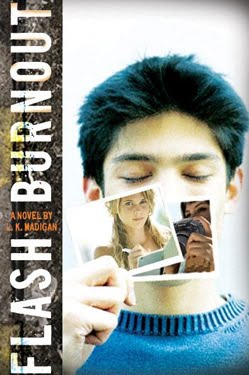
Flash Burnout by L. K. Madigan

Now, I’m not a teenaged boy, and I never will be. So my assessment of what a “valid” or “true-to-life” male teenager’s voice sounds like might not be one hundred percent accurate. But Blake’s voice in Flash Burnout is convincing enough for me.

The whole sarcastic/funny teenager can be overdone in YA literature. And writing from an adolescent male’s voice is undoubtedly tricky (click here to read the simultaneously scathing and encouraging gauntlet author Hannah Moskowitz throws down on writing books geared toward YA males). Blake’s voice is humorous and poignant, and not in the way that sounds like the author is breathing “look how funny I am” from the white space between the words.

I enjoyed this book. The humor worked, the male point-of-view worked, and without Blake appealing to me-as-a-woman because he was so unbelievably romantic and tragic and sparkly, but instead because he sounds like a real guy experiencing real problems. There wasn’t anything sparkly about the romance here…I don’t even think I want to call it romance, at least not in the traditional way everyone might think of it in literature.

Another interesting point in Flash Burnout: the parents are both present, and they are awesome. A few months ago Julie Just wrote an essay for the New York Times Sunday Book Review, discussing what’s going on with all the absentee/horrible parents in young adult literature. Madigan gives us something refreshing in Flash Burnout: I fell in love with both of Blake’s quirky, fun, and ultimately there and loving mom and dad. In fact, Blake’s family serves as a foil for the families of the two love interests, making the family excellence a double-whammy.

But really, the humor is what did it for me. I love funny books. This was effective, and still had a meaningful story. I’m very sorry to say it, but Louise Rennison’s Georgia Nicolson books are a bit lacking in the poignant, life-changing drama department (click here to read my review of those lovely tomes). Georgia is hilariously funny, but a well-curved character arc is not something she can boast about.

Blake, in Flash Burnout, isn’t a heart-throb. He’s a normal guy, and a funny one at that. His story is worth your time.

To read more about L. K. Madigan and her fiction, you can visit her website by clicking here.

NiFtY Author: Sunny Frazier

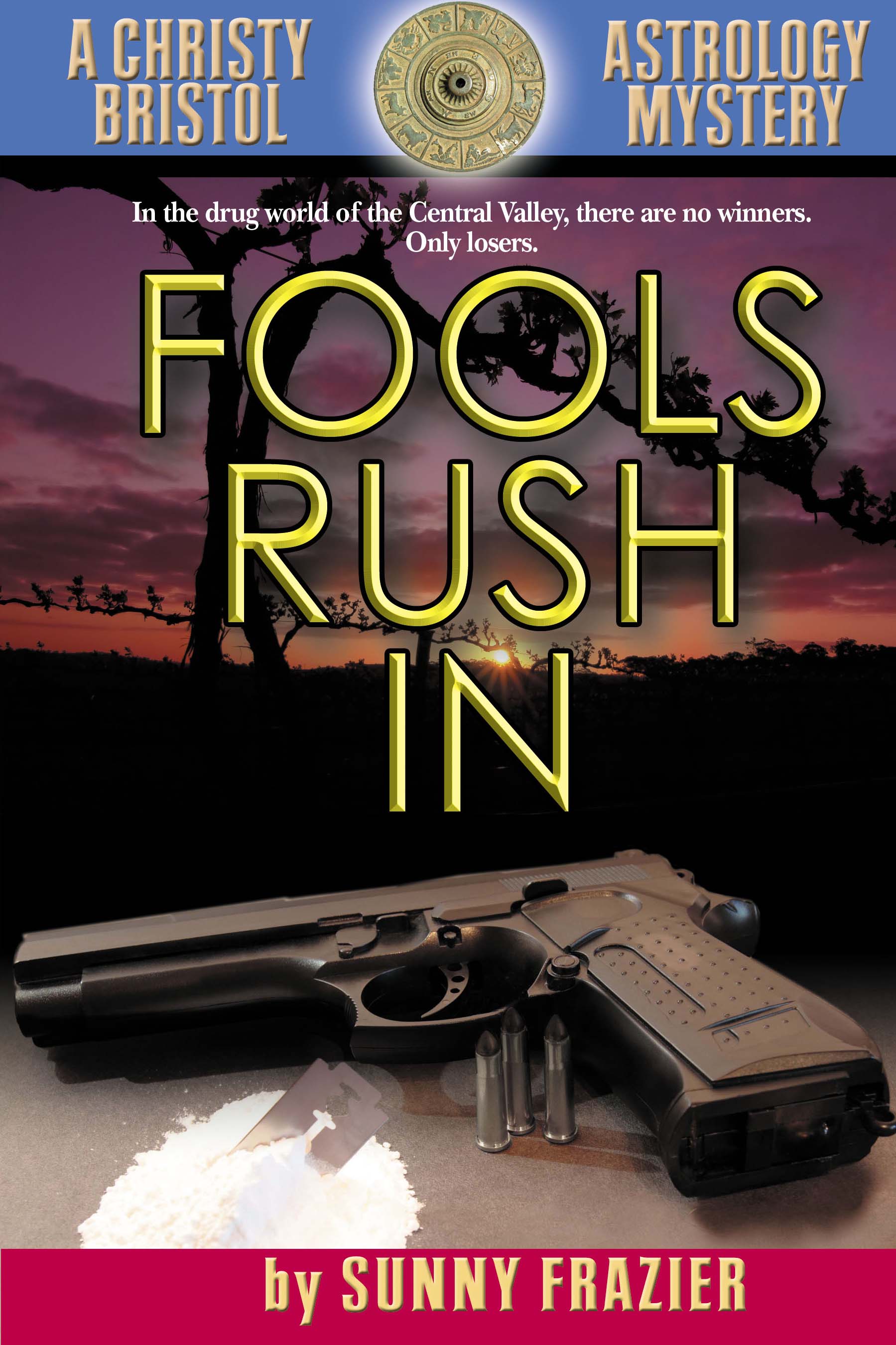
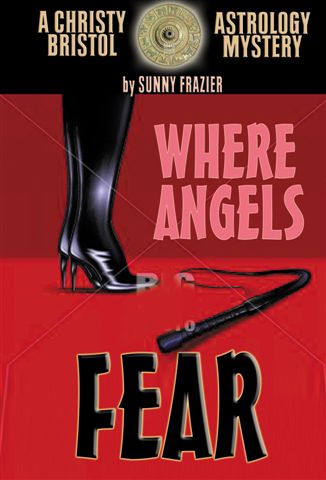
For today’s NiFtY Author I give you…drum roll…Sunny Frazier! Sunny has published two mysteries, Fools Rush In, and Where Angels Fear, as well as contributed to numerous anthologies. She’s also active in her publishing house, and works to help other authors promote their work. Keep on reading to learn more about this nifty author!

BH: What’s your one-paragraph pitch for the first Christy Bristol book, Fools Rush In?

SF: Astrologer Christy Bristol is egged on by a former boyfriend to do a horoscope for a drug dealer and finds herself the one with a precarious future.

BH: Can you tell us a little about your path to publication? Did you go the traditional “agent” route, or did you use some other scheme?

SF: I won a spot as one of the seven authors chosen for the Seven By Seven anthology. The publisher liked my flash fiction so much that he offered me a contract for my book.

BH: Ah, that’s the kind of success story we unpublished authors salivate over. What are some of the challenges you faced by not working with an agent? Were there benefits as well?

SF: I only experienced the benefits. I got not only a lot of say with how my own books were published, but both my past publisher and my current publisher have looked to me for input on picking manuscripts for the publishing house. They also picked my brain for marketing ideas.

BH: Your publisher, Oak Tree Press, is an independent publisher. What are some of the benefits of working with an independent publisher?

SF: Trust and immediate access. We communicate constantly, by e-mail and phone. I am now acquisitions editor for the Dark Oak mystery line. I also introduced two new lines: Wild Oaks Westerns and Mystic Oak for paranormal novels.

BH: Are there any disadvantages to working with an independent publisher?

SF: It’s never easy to get books into brick and mortar book stores. However, many are closing and the reading public is ordering on Amazon. Also, e-readers are finally finding acceptance with Kindle and the I-Pad. Aggressive Internet marketing is leveling the playing field for authors with smaller houses.

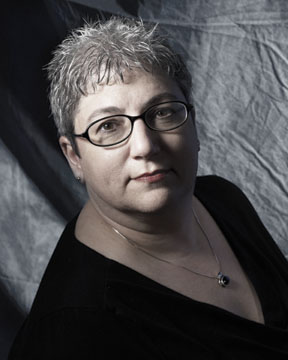
Sunny standing with publisher Billie Johnson at a pitch session in Las Vegas

BH: I tried to write a mystery—once. It quickly turned into a (not very good) thriller/suspense novel because I couldn’t figure out how to give just enough information without making the killer’s identity obvious. Do you have any tips on this for aspiring mystery writers?

SF: I think the definition of “mystery” has blurred considerably. The “puzzle” type mysteries such as Agatha Christie wrote are not common these days. Instead of being plot driven, we are seeing more character-driven story arcs. I don’t write whodunits, I write whydunits. In fact, I tell you who the victim is and who the killer is on the first page—the “Colombo” formula. The reader keeps reading to see how my character Christy uses astrology to her advantage.

You should have stuck with your suspense novel.

BH: Oh, I did. Unfortunately the premise wasn’t a wowzer, so I’ve moved on, and I read other peoples’ mysteries now.

Every unpublished author thinks all her problems will be solved as soon as she gets her name in print…even though published writers tell us this isn’t true. Did you have any unfortunate wake-up calls?

SF: What I try to instill in writers is to start promoting as soon as you decide you want to write a book. Name recognition is very important. Getting people accustomed to your “voice” through blogging, learning about the industry by monitoring group sites, getting comfortable with promotion. People want to make it a chore and it’s more of a mindset. I work on promotion on Sundays. I have 35 sites I belong to, all are professional sites for writers, readers and publishers. They each give you your own page, so it’s like having 35 websites. I developed what I call “the posse” to teach people how to effectively promote. All I need is an e-mail and attentiveness to my nudges. It takes years off people’s careers, unless they want to start from scratch and reinvent the wheel.

BH: When you first wrote Fools Rush In, were you already planning a sequel?

SF:  I had six books in mind: titles, plots, characters.

BH: What was the most enjoyable part of writing the sequel, Where Angels Fear?

SF:  I didn’t realize that Fools Rush In was one of the hardest types of mysteries to write. My protagonist was stuck in a room for most of the book. In the sequel, Christy and her sidekick Lennie get to traipse all over the Central County uncovering clues to a sex club. There’s more humor as well. I had a hard time keeping a straight face while writing.

BH: Is a third book in the works?

SF:  Slowly but surely, A Snitch In Time is making its way on paper. I’m so busy speaking at conferences and conventions as well as reading query letters for Oak Tree Press that my own work suffers.

BH: Can you compare your series character, Christy Bristol, to anyone you know in real life?

SF: Uh—me. I worked as an office assistant with an undercover narc team for 17 years in the sheriff’s department and I’ve done astrology for nearly 40 years. Christy is much like I was in my earlier years.

BH: What is your writing schedule like?

SF:  My computer is on for 12 hours a day. I write in small clumps, fitting in the novel when I get tired of reading manuscripts and conducting business via e-mail. My eyes get so tired staring at the screen, sometimes I just hit the couch and close them. My brain keeps going over the story until I’m ready to tackle the keyboard.

Oh, and I don’t have kids, a husband or a job to interrupt me. Just a bunch of cats who give me space when I’m at the desk. If not, they have to go out in the yard and play.

BH: What does your writing workspace look like?

SF: It’s usually a mess with notes scattered all over. I have a rolodex, a Victorian calendar, and a pen carousel with a fake raven stuck in the center. For some reason I work well in chaos.

BH: What is your favorite book on the craft of writing?

SF: Self-Editing For Fiction Writers—How To Edit Yourself Into Print by Renni Browne and Dave King. I checked it out at the library and loved it so much I ordered a copy from Amazon.

BH: What is the best writing advice anyone has given you?

SF:  Early on I heard authors say “Enjoy the journey, not the destination.” That’s the truth. If writers fret too much about publication they will miss the whole point of writing. It’s all about the people you meet, the sharing of minds, the art of creating, giving your ideas to the world. Money is usually lousy, hours are bad, solitude wears on you and there are no health benefits. But still, it’s a wild ride.

BH: Any words on advice to unpublished writers for keeping the hope alive?

SF:  Small presses are worth taking a chance on. I always tell writers “You can’t promote what doesn’t exist.” Get that first book out there and get the machine rolling. Don’t think the first book you’ve written is the only one you have in you. Start another right away.

Sunny, thank you so much for the interview, and for sharing your books and insights. To our studio audience: don’t forget to check out the links below to learn more about Sunny, her books, and her publisher! Simply click on a description to reach the site.

Sunny’s website. This is where you can find The Murder Circle.

Oak Tree Authors are assigned blog dates. Meet us!

Order Oak Tree Titles, learn about our contests, get the latest info on what we’re doing in the publishing world.

How Teaching High School Prepared Me for Parenthood…

…and how it didn’t.

Now that Z has hit the magical age of TWO, my life has moved from the Fast Lane to the Super Fast Lane…with nightly visits to the Family Bed (Of Pain) [more on the Family Bed (Of Pain) in a future post]. Yet occasionally in the Super Fast Lane, we take a naptime break from mach speeds and I am able to reflect.

Recent reflection: Parenting a toddler is a lot like managing a classroom. No, I am not saying ninth graders are just like toddlers. Okay, maybe a little. But since all of my ninth graders have graduated or are now seniors, this list shouldn’t compromise any egos.

1. Routines! Kids of all ages thrive on routines. My ninth graders had a Daily Starter, something other teachers call “bell work”…it’s a short activity to keep students occupied while you take role, take a breath, and buckle up your seatbelt for the hour ahead. Z’s daily starter is a snack prepared by Daddy while Mommy lies in bed and growls at the cruel cruel world. (No, I am not a morning person.)

People like to know what’s coming next. Leave surprises for birthday parties, and keep your kids clued in by doing daily things in the same order every time. I cannot stress how important this has been for bedtime. Cannot. Stress. How important. For bedtime. The simpler the better, and we’re working on that.

2. Transitions. This is something I never quite “got” as a teacher. I guess some people like more warning than, “Hey! Put those papers away, it’s time to move on! Move it move it move it!” As a mom, though, it makes more sense. “Z, you have two more minutes of swimming time, and then we’re going inside to do something really fun, like wash the dishes!” And my daughter, bless her, cheers wildly because she LOVES doing the dishes. By the time I pause to wonder where she got this particular freaky genetic aberration, I’m sure it will have faded away.

3. Short Breaks. Those five-minute passing period breaks we got? Old students of mine, count yourselves lucky. Maybe it’s fine when you’re young to have an entourage every time you step into the bathroom. Me, I like the door firmly closed between myself and any other persons, yet most days Z and her “friends” walk right in. Sometimes she makes comments, which I will not share here.

4. Rewards and Praise. Every single person appreciates rewards and praise. Praise is inexpensive, but don’t give it away for free, or it will seem cheap. Stickers got me a long way on the Great Potty Training Experiment of 2010, but after awhile they lost their luster. And their stick.

5. Workload. I could write pages about how underpaid public school teachers are. They work so hard, earn so little…We all know this. Why isn’t it changing?

6. Kids can tell when you don’t know what the H-E-Double-Hockey-Sticks you’re doing. Now, the younger they are, the easier it is for you to pretend. But if they’re older, and they sense doubt, weakness? They go for the kill. I think substitute teachers have one of the worst jobs on the planet. I’m shuddering as I type this.

7. Inexplicable Temporary Deafness.

Teacher: Okay, class, your paper is due on Friday. When’s the paper due?
Class: Friday!
Teacher: Say it again.
Class: Friday!
Friday comes. Sixteen kids “forgot” the paper was due Friday.

Compare to:

Ever-Suffering Mother: Z. Z? Z! Stop playing with that. Bring it to mama. Do it now. What did I just say?
Z: Stop playing with that.
ESM: Yet what are you doing?
Z: Playing.
ESM: Yes, with that. Now stop.
Z: [does not stop playing with that.]

8. You are an example. Ah, how I hate this one. Wouldn’t it be grand if I could just let loose with a string of swear words every time some…poo-poo brain cuts me off on the road? But the truth is, as soon as I signed that teaching contract, and as soon as that baby was born – boom. I am now a person that another little person watches. All the time. And in the classroom it might be worse. Watched by many. If I had the good fortune of their attention.

There are differences between teaching and parenting as well. As a high school teacher, I got to go home at the end of the day. Maybe not always as early as I would have liked. Maybe I never felt like I was leaving my work behind me (often I was indeed carrying it along in the form of essays to grade).

Looking back from where I’m standing now (which is next to the potty while my child sits and sits and sits and sits), the most important difference was that my high schoolers did not ask me to wipe their bottoms. They went through Very Important Do-Not-Ever-Lose-These Handouts as if they were toilet paper, though.